
Providence · United States

The collector’s field guide
Gorham silver at RISD Museum
A furniture showpiece, an angular coffee service and sea-inspired silver in Providence.
Start with the collection, then check the cases
Providence is a good place to put Gorham silver in context. Jabez Gorham opened his workshop nearby in 1831, and RISD Museum began collecting his company’s work with a spoon in 1909. The museum’s major Gorham Silver exhibition ran in 2019; its surviving page is useful background, not a current event listing.
A Changing Reflection, the silver and metalwork display in Case Gallery PH 609, is temporarily off view. That warning applies to a particular gallery, not every silver object in the museum.
Use the three objects below to compare what silver can do: furnish a room, sharpen a coffee service into angles, or turn a serving utensil into a miniature landscape. These are our looking suggestions, not a promised gallery route.
Martelé: silver on a furniture scale
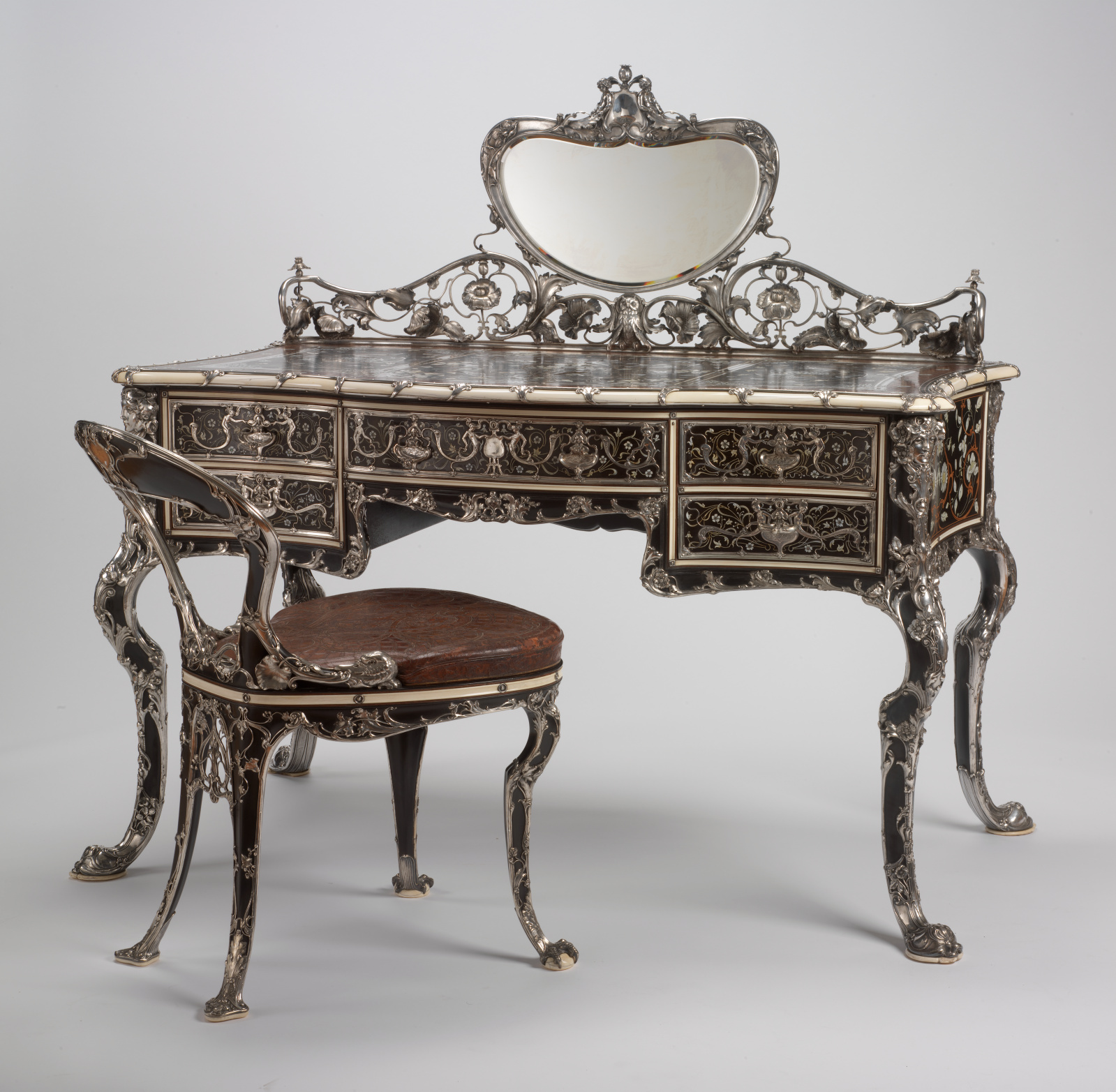
Gorham’s Martelé Writing Table and Chair, designed by William Christmas Codman in 1903, combines silver with woods, ivory, mother-of-pearl, mirrored glass and gilded tooled leather (58.095ab). Ask staff for its location.
Notice how the metal meets the other materials. The record also credits a silversmith, modeler and cabinetmaker: a useful reminder to look beyond one designer’s name when thinking about the skill behind an object.
Cubic: follow the changing surfaces
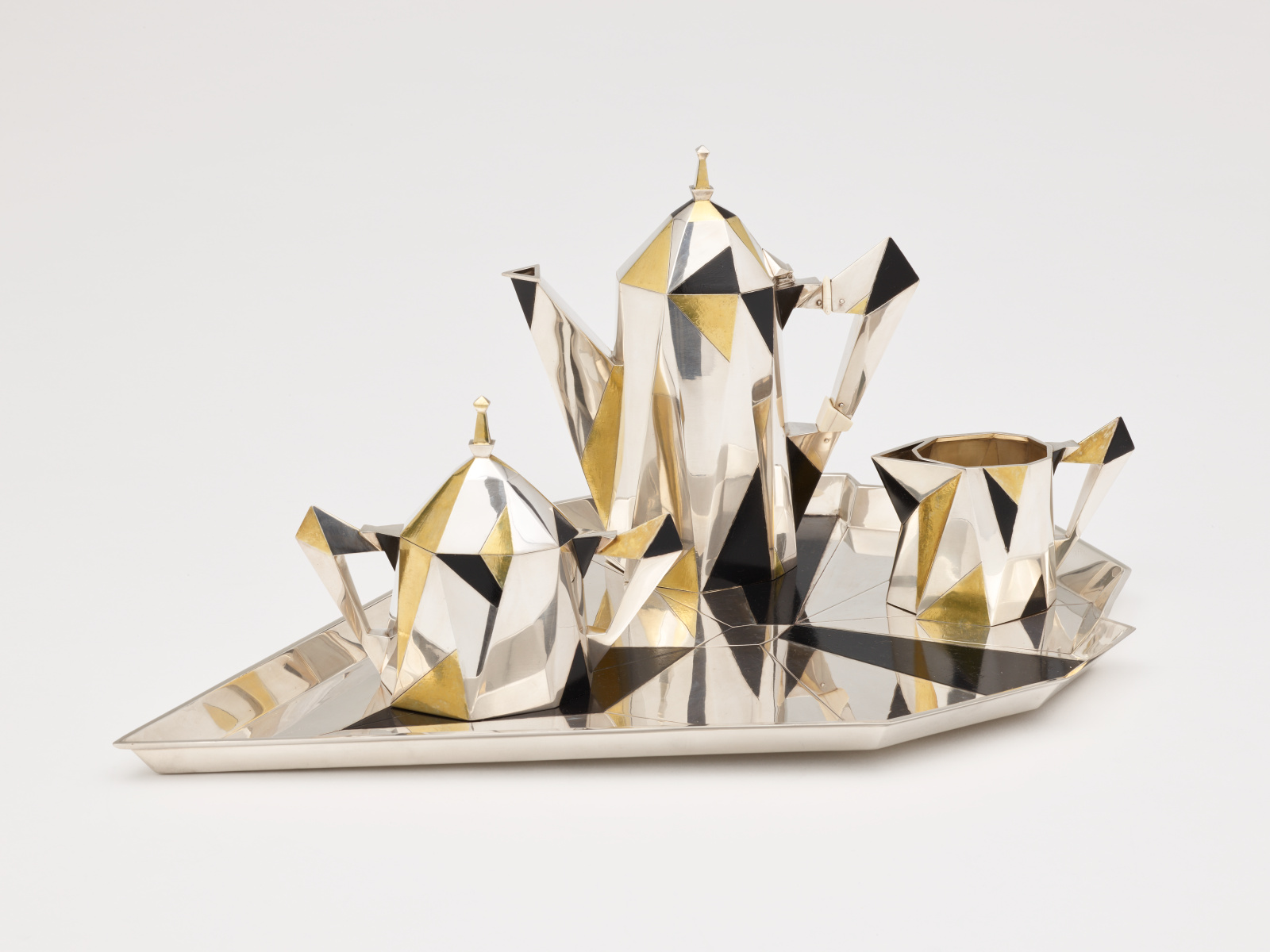
Erik Magnussen designed the Cubic Coffee Service for Gorham in 1927 (1991.126.488). Made in Providence, it brings together a coffeepot, creamer, sugar bowl and tray. Sterling silver, gilding, dark patination and ivory create its striking contrasts. The official record did not confirm current display when checked.
Study the collection photograph even if the service is unavailable during your visit. Trace a single edge around the pot, then notice where a change in surface makes that edge seem to break. How easily can you read the familiar parts of a coffee service through all those facets?
Narragansett: bring the shoreline to the table
Gorham’s Narragansett Salad Set dates to about 1885 and is catalogued as silver with gilding (84.060). Its current display was not confirmed in the collection record.
The fork and spoon carry shells, fish, crabs and twisting seaweed. Follow the decoration from the working end into the handle. Where does a recognisable creature become a useful part of the utensil’s shape? The museum’s article on the set offers a closer look at those details.
Keep the approximate date and the full material description in your notes. A warm-colored area and a silver-colored area can belong to the same object; a photograph alone is a poor substitute for its catalogue record.
Plan the visit around what you can see
The museum opens 10 a.m.–5 p.m. Tuesday, Wednesday, Friday, Saturday and Sunday, and noon–8 p.m. Thursday. Adult admission is $22. Sundays and Thursday evenings from 5 p.m. are free; check the official page for holiday closures.
Both entrances are wheelchair accessible, with a limited number of wheelchairs available to borrow. The winter notice directs Thursday evening visitors to 20 North Main Street because the Benefit Street entrance closes at 5 p.m. Recheck before travelling.
Save the accession numbers before you go. If silver is the main reason for your trip, ask Visitor Services which pieces are available and whether any relevant gallery is closed. An old exhibition page, a collection image and a current display label answer different questions.
Providence, Rhode Island
Find the museum.
RISD Museum20 North Main Street / 224 Benefit Street, Providence, RI, United States
The map locates the museum, not an object or an accessible route.
Map not displaying?
Share a good find.
Sources & further reading
Museum records supply makers, materials, dates and display statements. Looking prompts are Collect Silver editorial suggestions; photographs do not establish present display.
Collection and objects
- Gorham Silver: historical 2019 exhibition (opens a new tab)
- Martelé Writing Table and Chair, 1903 (58.095ab) (opens a new tab)
- Cubic Coffee Service, 1927 (1991.126.488) (opens a new tab)
- Narragansett Salad Set, about 1885 (84.060) (opens a new tab)
- Tracing the Silver Seaweed, 2013 (opens a new tab)