
At a glance
A fitted case turns a collection of small things into a portable arrangement. A cup holds tools; a velvet-lined box keeps cutlery in place; glass jars carry silver lids. The pieces tell a story of eating, drinking or dressing away from home, but their cases are evidence too.
Start by identifying the purpose and materials of each component. Then ask whether the surviving pieces belong together and how safely the case can be opened. A beautiful group is not necessarily a complete or original set.
A pocket canteen with a place for each part
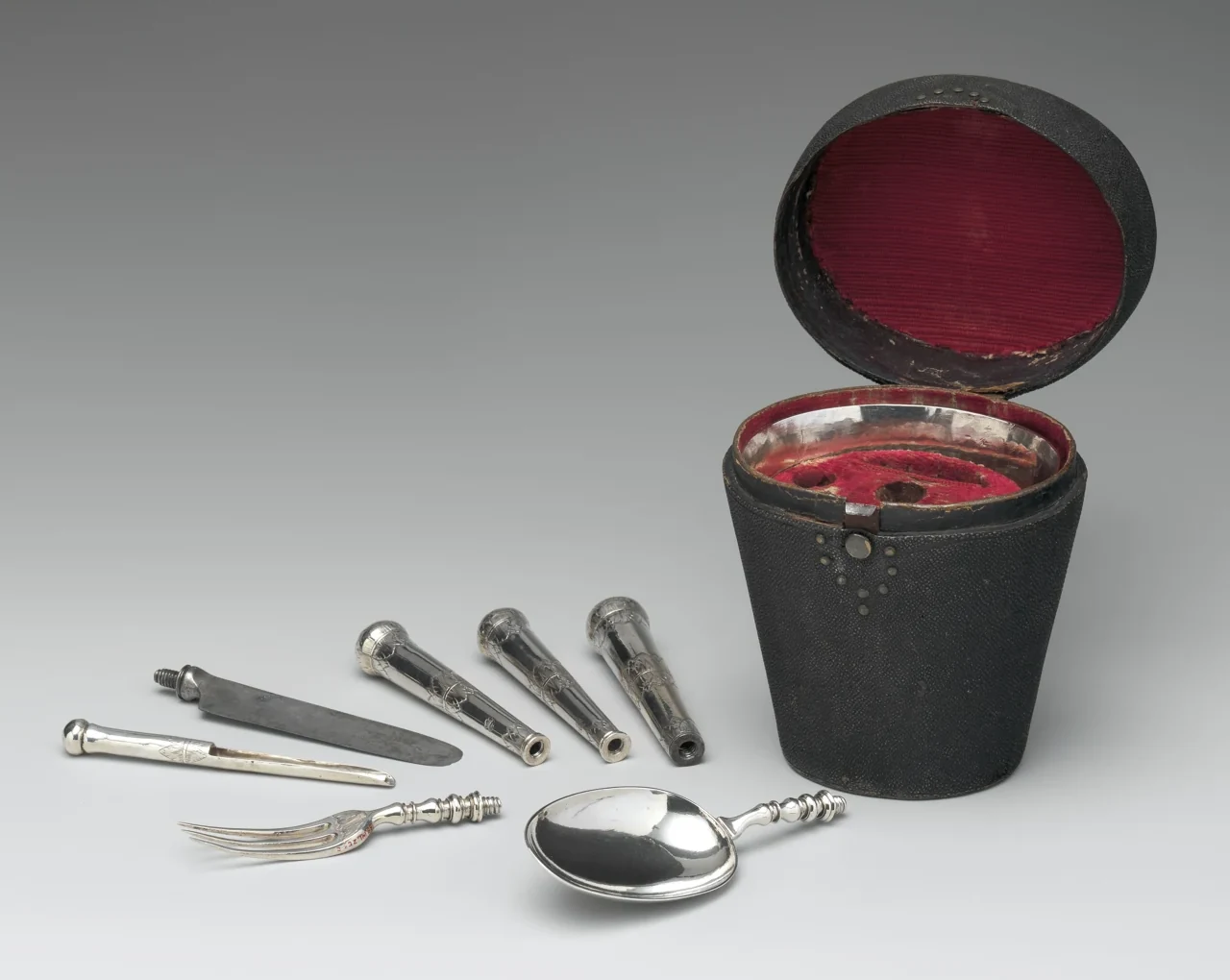
The Met’s London pocket canteen of 1709/10 packs a beaker, knife, fork, spoon and marrow spoon into a small conical case. The cutlery has removable handles: the photograph makes the threaded ends and separate handles visible. The case is wood covered with shagreen, with a removable wooden fitting lined in velvet and silver braid.
The museum identifies Charles Overing as the maker of the cup, while the cutlery bears the identities T. T. and E. H. The makers of the separate parts deserve separate entries in a collector’s record. The engraved hunting scenes on the beaker suggest to the museum that it was intended for a hunt; they do not establish where a particular owner actually used it.
Dining equipment in a fitted case
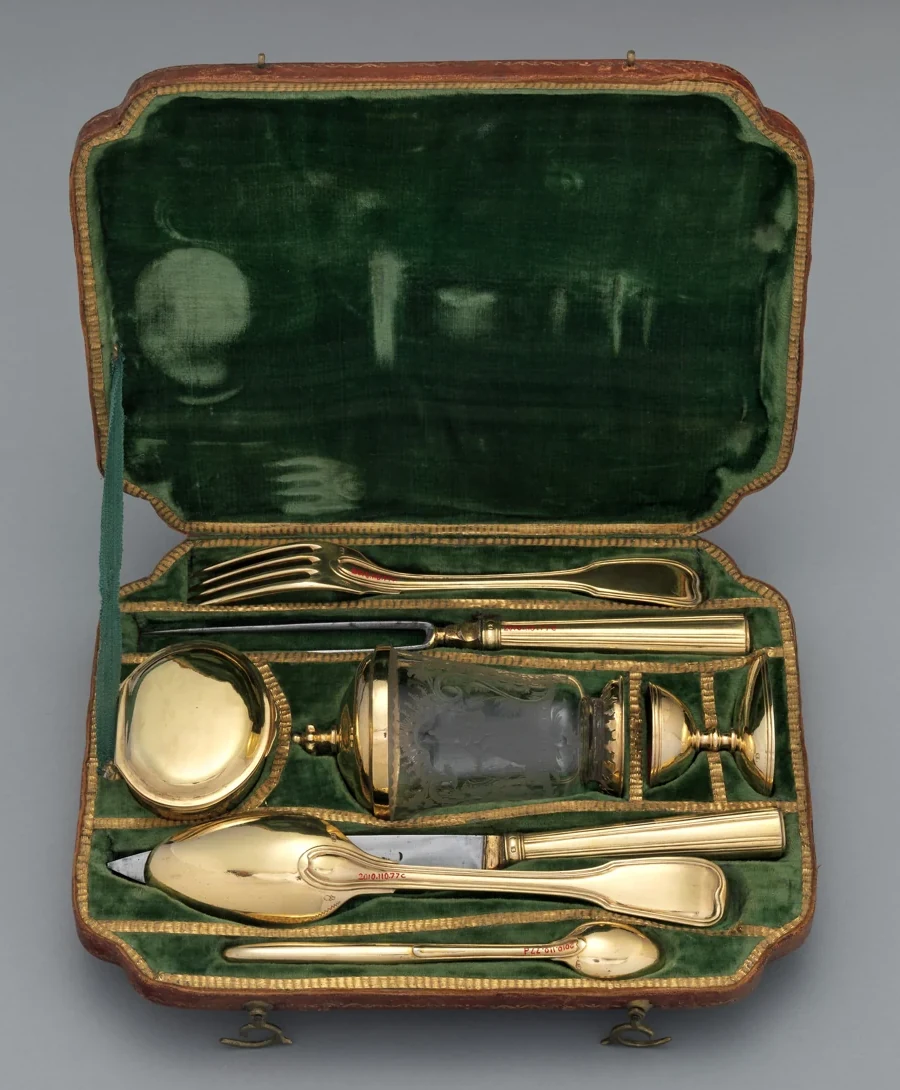
Samuel Bardet’s Augsburg traveling set of 1777–79 offers a different solution. Its velvet-lined leather case holds a glass beaker with lid, cutlery, an egg cup and a spice box. The gilded silver, glass, steel, leather and velvet are all part of the object’s construction. The photograph shows how the compartments give separate pieces a shared home.
Fitted shapes are useful clues, but a good fit alone does not prove that a piece is original. Linings can be altered and objects replaced. Look for evidence across the group: marks, decoration, wear, dimensions, documentation and how the pieces meet their recesses. A vacant space suggests a question, not a certain answer about its former contents.
Not every traveling set was a dining set. A fitted case could hold dressing accessories instead, and the distinction depends on its documented contents rather than the external shape alone. Compare these objects with the flatware guide and its other traveling cutlery example.
Dressing on the road
The Met connects a luxury dressing case to the growth of nineteenth-century rail travel and identifies Frederick Jenner and Fabian James Knewstub as retailers of such cases. The case incorporated pivoting compartments and many fittings, a reminder that portability could come with considerable bulk and expense. It represents a luxurious provision for travel, not the luggage of every passenger.
Two cosmetic jars from that case were made by Barnard Brothers in 1874–75. Their cut-glass bodies and decorated silver tops illustrate why “silver dressing set” is a description of an assembly, not proof that every part is silver. The jars are catalogued separately as 61.78.13 and 61.78.14; the photograph shows both together.
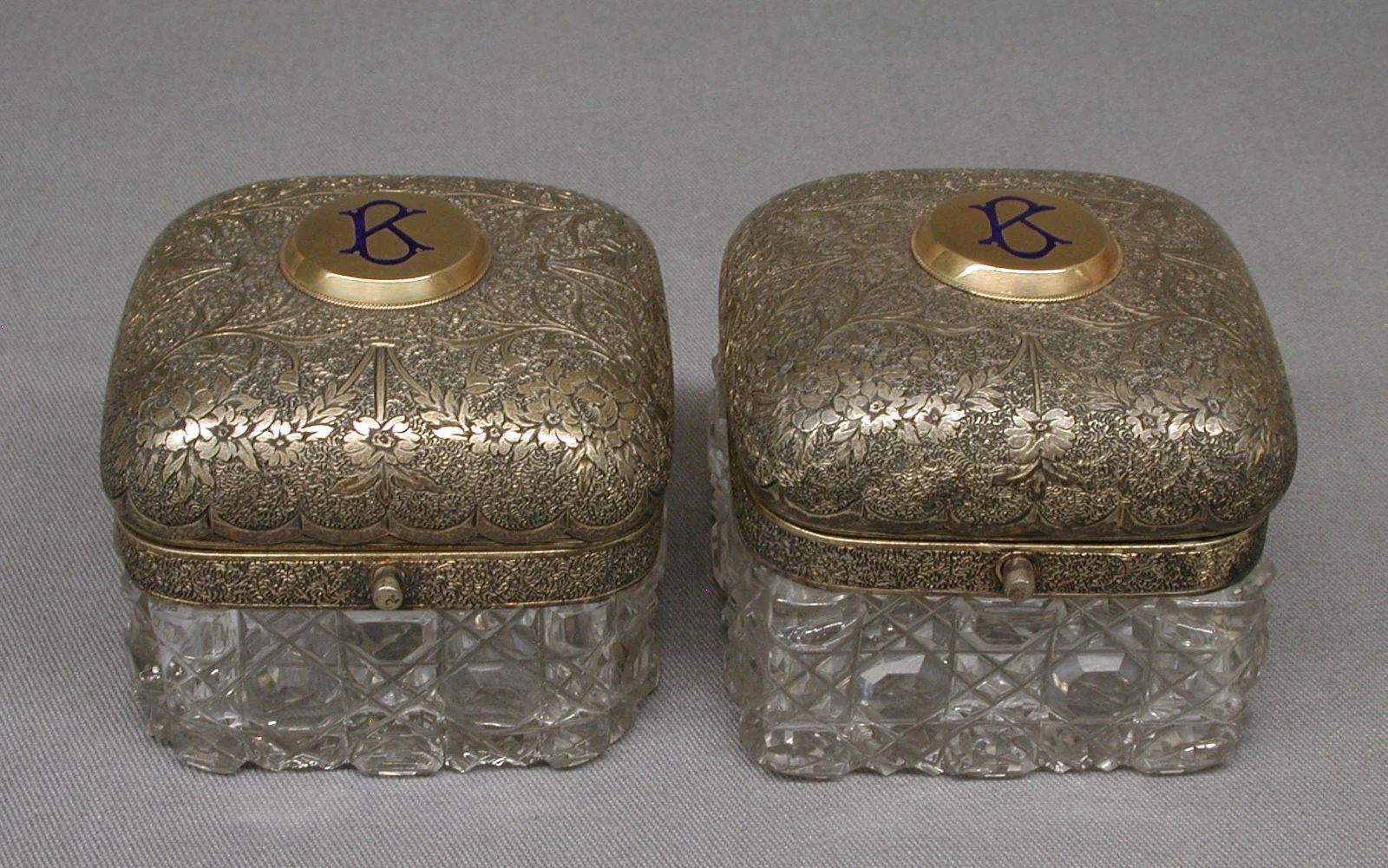
Maker and retailer are different roles. A retailer’s name on a case can be valuable evidence of sale, while a mark on a jar may identify its maker or sponsor. Do not transfer a mark from one component to every object in the box. The makers and dealers directory and UK hallmark guide help put those marks in context.
Questions to ask before buying
- What survives? Request an inventory and photographs of each piece, its recess, lids and the case’s exterior and underside. A set can be appealing even when incomplete, provided its description says so.
- What belongs together? Compare marks, wear, fit and any records of ownership. Differences can invite further research; neither a mismatch nor a matching pattern alone settles the question.
- What are the materials? Record silver, glass, steel, leather, textile, shagreen and any other identified material separately. A silver handle, cap or mount does not make a whole object solid silver.
- What condition is visible? Look for cracked glass, loose mounts, worn gilding, damaged lining, distorted hinges, corrosion and repairs. Ask for clear images rather than forcing a stuck lid or threaded joint.
- Are the marks legible? Photograph each mark in place and use a suitable reference. The authenticity guide offers a starting point; an experienced silver specialist can help with uncertain marks or assemblies.
Preserve the assembly
Support the case and lid when handling it, and keep loose components from moving against glass or delicate linings. Do not force fittings into their compartments. Leave residue, old labels and inscriptions in place until they can be assessed: they may be evidence of the set’s history.
Composite objects need particular care. Immersion, dips and aggressive polishing can harm leather, textiles, glass joins, gilding and steel. Consult a conservator when a lining is fragile, a joint is seized, corrosion is active, or a material is uncertain. The composite-silver care guide explains why treatment begins with construction.
Follow the pocket silver guide for other objects carried close at hand, and the silver bottles guide for glass and silver scent containers. The sewing and chatelaines guide explores another family of small fitted implements.
Sources
Reviewed November 14, 2026. The Met identifies these historic objects and photographs as public domain; its Open Access policy permits unrestricted reuse. The canteen and Bardet photographs are cropped around the objects; the jar photograph retains its full frame.