
Look before the movement
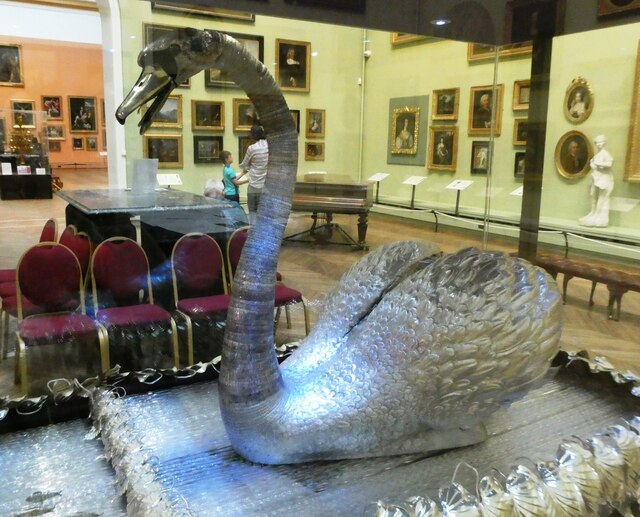
Before it moves, the Silver Swan already rewards a slow look. The neck rises in a long curve from folded wings. Overlapping feathers break the light into small, shifting patches; the silver leaves around the bird frame a surface that looks like water. The illusion begins with the metalwork, not with the clockwork.
Then the scene changes. In performance, the bird turns and preens, lowers its head toward a fish and appears to swallow it. Music accompanies the action while the glass water moves beneath it. At The Bowes Museum in Barnard Castle, this eighteenth-century automaton joins sculpture to a carefully arranged sequence of mechanical effects.
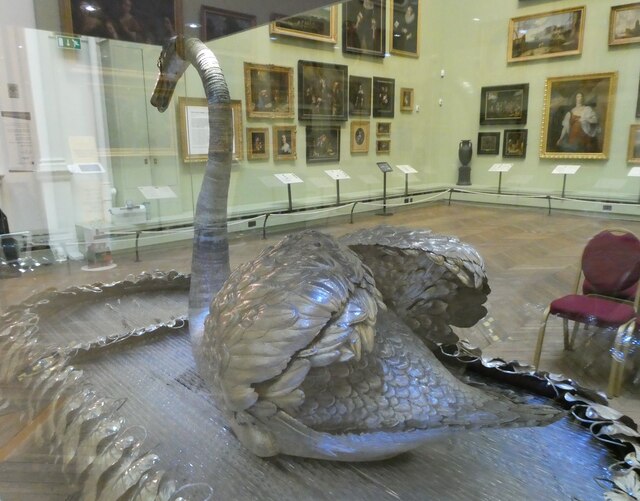
From the front, the long neck and breast dominate the view. From behind, the layered wing feathers come into their own. Reflections in the case and glimpses of the surrounding gallery place the Swan within the experience of a museum visit.
Silver, but not silver all the way through
The body, head and neck are formed in chased and repoussé silver. Those terms describe work on the metal’s surface and form: chasing develops detail from the face, while repoussé shapes relief from behind. The result is a feathered skin around a mechanism, not a solid bird-sized lump of silver.
The glass rods, internal clockwork and supporting structure belong to the object too. Describing the Swan simply as “solid silver” can obscure that construction. Its interest lies in the cooperation of materials: reflective metal gives the bird presence, glass supplies an imagined stream, and concealed machinery makes the whole scene perform.
A modern bullion specification would answer a different question. The cited sources describe construction rather than provide a tested fineness or total silver weight for the complete assembly.
A workshop, not a single pair of hands
The Swan is usually dated to about 1773 and associated with James Cox’s London enterprise. Cox’s name matters, but it should not erase the people who made the work possible. The Metropolitan Museum of Art describes him primarily as an entrepreneur who relied on a network of independent suppliers and craftspeople. An attribution to a commercial enterprise does not necessarily identify the person who made each movement.
The design and management of the Swan’s mechanism are often attributed to John Joseph Merlin, Cox’s chief workman until 1773. A 2023 study by conservator Matthew Read and Rachel Wicaksono is more cautious than many short accounts: the exact makers, production date and intended market remain uncertain. “Associated with Cox’s workshop; mechanism attributed to Merlin” preserves the distinction.
There is firmer ground for its early public life. Cox’s 1773–74 museum catalogue describes “A Swan as large as life.” The surviving automaton is a remarkable witness to that world, but a catalogue appearance is not a dated record of every stage of manufacture.
Three systems, one performance
In Read and Wicaksono’s detailed account, three clockwork systems divide the work. One provides the music, another turns the glass rods, and the main movement coordinates the Swan and the fish. The apparent stream and the moving animal are separate effects brought into time with one another.
Read and Wicaksono explain how a multi-function cam, working through followers and linkages, organizes actions of the neck, head and bill. A cam is a shaped part whose changing profile directs another part’s movement. Here, mechanical instructions become a sequence that a viewer reads as animal behavior.
Knowing that does not make the Swan less compelling. It changes what there is to notice: the pause before the head lowers, the relationship between the moving water and the bird, and the difference between a repeated mechanical sequence and the living creature it suggests.
London and a wider market
Cox’s business reached well beyond Britain. The Met’s account places his luxury objects in trade first with India and then with China, where elaborate clocks and mechanical curiosities found customers. His Spring Gardens museum in London opened in 1772, turning such objects into a public spectacle.
That international setting is important, but it is not the same thing as a documented journey for this Swan. The Bowes Museum presents an intended destination at the court of the Qianlong emperor as a possibility. It should remain a possibility, not become a confirmed commission or a line on a map carrying the Swan to Beijing.
The same care keeps it separate from Cox’s Peacock Clock in Saint Petersburg. A maker’s wider career can explain a workshop’s ambitions without merging the histories of different objects.
Paris and a restless observer
By 1867, the Swan was at the Paris International Exhibition. The Bowes Museum’s history identifies the jeweller Harry Emanuel as its exhibitor and records John and Joséphine Bowes seeing it there. This is the clearest continental stop in its documented story.
Mark Twain noticed it too. In chapter XIII of The Innocents Abroad, he remembered “a living grace about his movements,” then described the apparent catching and swallowing of a silver fish. Read the passage in context and the encounter is brief: the immense exhibition and its crowds repeatedly pull his attention elsewhere.
That makes the account more interesting, not less. It catches the Swan doing what a display object must do in a crowded room: hold a person’s attention long enough for an illusion to become convincing. Twain is an eyewitness to its effect, not a technical inventory of its mechanism.
Bought for a museum
The Swan later came to John and Joséphine Bowes through the Parisian jeweller Monsieur Briquet. The museum’s accounts agree on a price of £200 but do not agree on the acquisition year. Its current collection page gives 1873; its history article gives 1872. The conservation study also uses 1872.
The precise acquisition year remains unsettled in these accounts. The broad sequence is clear: Paris exhibition, subsequent purchase, and a new public home in County Durham. According to the museum’s history, the Swan was displayed as a static object when The Bowes Museum opened in 1892.
Barnard Castle is therefore more than the last dot on a travel map. A spectacular mechanical attraction became a museum object, with new responsibilities for display, study and care. The photographs also show how much a display setting contributes to an encounter: glass, lighting, neighboring pictures and the height from which a visitor looks all shape what is seen.
Keeping a moving object alive
A moving museum object presents a difficult choice. Keeping it still protects it from some kinds of wear, but removes an essential part of what it was made to do. Running it preserves that experience while asking old parts, and later repairs, to work together. Neither choice is simply neutral.
The museum records a major conservation project in 2008 and a further study period in 2021. Its account of the recent work describes specialists examining the Swan before returning it to performance. That history is a reason to avoid presenting every component or every movement visible today as unchanged since the eighteenth century.
In a release dated 14 March 2024, The Bowes Museum announced that performances would resume on 19 March after more than 1,500 hours of work. The team included the Cumbria Clock Company, the museum’s conservators and clock-conservation interns from West Dean College and Birmingham School of Jewellery.
This continuing work belongs in the Swan’s history alongside its first exhibition and purchase. Conservation is not merely polishing the outside until it looks new. With a mechanism, the pace and character of a movement are part of the experience being cared for.
See the Swan, then follow the evidence
The Silver Swan is in The Bowes Museum at Barnard Castle, County Durham. Consult the museum’s current visitor information for admission, access and performance times before travelling. An object’s presence in a collection is not a promise that it will perform at the moment of a visit.
For a closer reading, begin with the museum’s collection page, then compare its historical account with the conservator-authored study. The most rewarding story is not the one with every uncertainty removed. It is the one that lets the remarkable object remain visible while showing how its history has been assembled.
Three documented places in the Swan’s history
Locations of making, exhibition and museum life. Connections are schematic, not a verified transport route. Arrows show the next documented place. Not to scale.
- LondonCirca 1773 / documented 1773–74
Associated with James Cox’s London enterprise. Cox’s 1773–74 catalogue describes the Swan at his museum in Spring Gardens.
- Paris1867
Displayed at the Paris International Exhibition, where the Boweses and Mark Twain saw it.
- Barnard CastleMuseum display from 1892
The Bowes Museum displayed the Swan when it opened in 1892. It remains the Swan’s museum home.
Timeline
- Circa 1773 Usual dating of the Swan; exact production date and makers uncertain.
- 1773–74 Description in Cox’s museum catalogue.
- 1867 Paris International Exhibition.
- 1872 or 1873 Purchase for £200; museum sources disagree on the year.
- 1892 Displayed at The Bowes Museum’s opening.
- 2008 / 2021 Major conservation project and later study period.
- 19 March 2024 Announced date for renewed performances after extensive conservation.
Sources
- The Bowes Museum: The Silver Swan
- The Bowes Museum: The Silver Swan Story
- Journal of the Institute of Conservation 46(2), 97–113: Modelling a cam track for the Silver Swan automaton at Bowes Museum: a cross-disciplinary reflection on ‘what things are’
- The Metropolitan Museum of Art: James Cox (ca. 1723–1800): Goldsmith and Entrepreneur
- Project Gutenberg: The Innocents Abroad, chapter XIII
- The Bowes Museum: 1500 hours of painstaking work with several thousand parts make a working Silver Swan
- The Bowes Museum: Visit
- The Bowes Museum: Terms & Conditions