

Exhibition silver
Silver designed to be seen.
George Paulding Farnham (1859–1927) designed jewelry and silver for Tiffany & Co. The Metropolitan Museum of Art describes an apprenticeship around 1878, work as assistant to artistic director Edward C. Moore about 1885 and appointment as head jewelry designer in 1891; he left Tiffany in 1904.
His work demonstrates the distinction between a designer and a manufacturing house. The Met credits Farnham with designing the Viking Punch Bowl and identifies Tiffany & Co. as its maker. Its iron, silver, gold and ebony combine to create a monumental exhibition vessel rather than a simple silver bowl.
For Tiffany’s 1900 Paris exposition display, Farnham created silver vessels inspired by Native American art. The Met describes one vase inspired by Navajo pottery, with a hand-raised silver body and corn-cob handles set with freshwater pearls. Its materials also include silver-gilt, amazonite and opals.
His orchid jewelry designs offer a useful comparison across media: The Met describes an enameled and jeweled orchid brooch from 1889–96 designed by Farnham and manufactured by Tiffany. That particular brooch is gold, diamonds and enamel, not silver.
From the museum collection
Read the object and its credits
Two exhibition vessels show how an individual design and a firm’s production can share a record.
A hand-raised vase for Paris
The Met’s 1900 vase, accession 2017.162, was made by Tiffany & Co. and described by the museum as one of Farnham’s designs. Its hand-raised body, stone and pearl details reward close examination of both construction and surface. The museum notes its exhibition at Paris in 1900 and Buffalo in 1901.
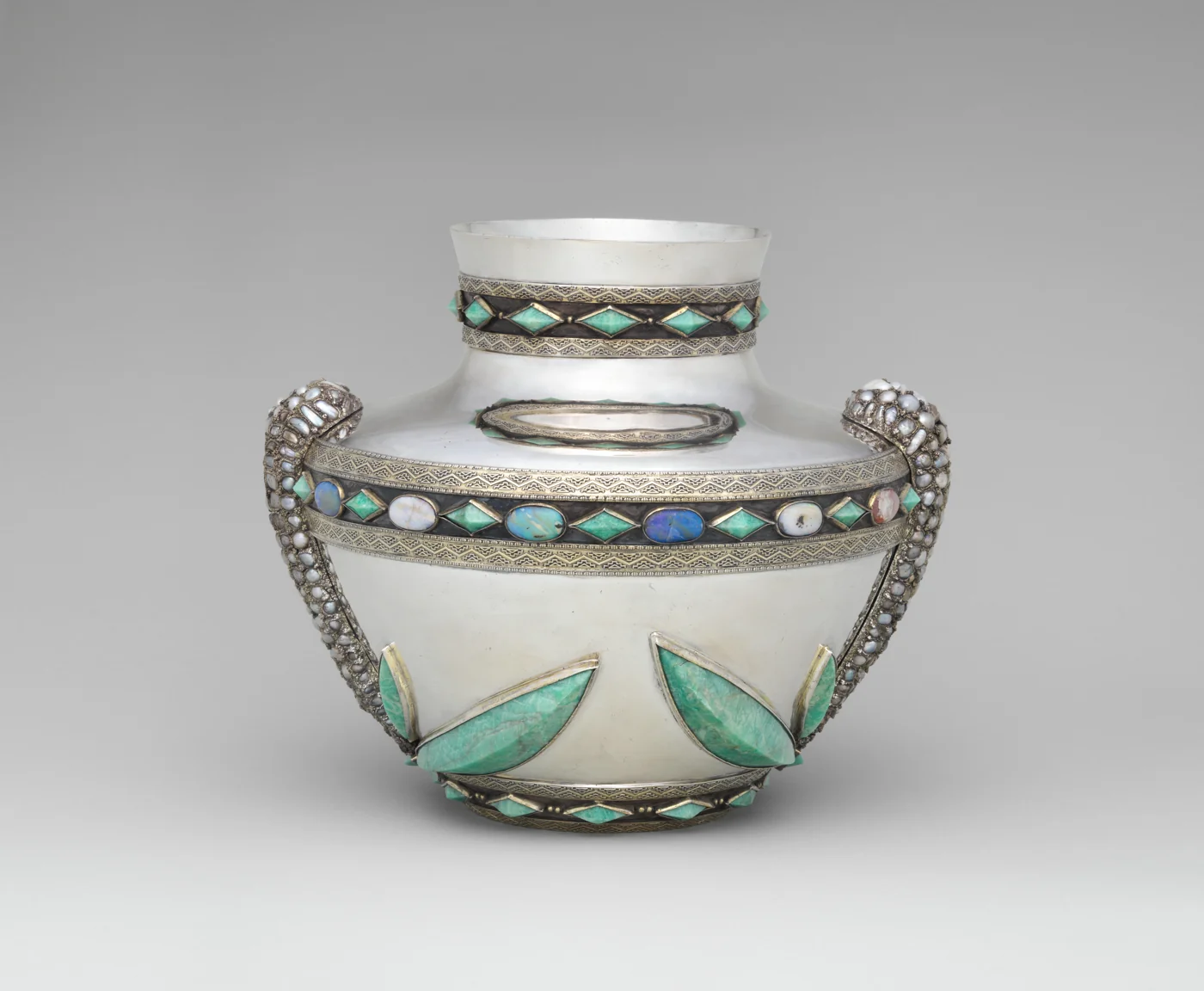
Vase designed by Paulding Farnham, made by Tiffany & Co., 1900.
The Metropolitan Museum of Art, Purchase, Jacqueline Loewe Fowler, and Richard and Gloria Manney Gifts, 2017. Museum record · Public domain / CC0
View the larger museum photographThe Viking Punch Bowl
The Met dates the Viking Punch Bowl, accession 69.4a, b, to about 1893 and credits Farnham as designer and Tiffany & Co. as maker. Displayed at the World’s Columbian Exposition, its Norse-inspired form incorporates iron and ebony as well as silver and gold.
Attribution in context
A Tiffany attribution alone does not establish Farnham as designer. Compare the specific form, materials, dimensions, documentation and condition with an institutional record; distinguish a known design from the people who executed an individual object.
Names & chapters
How the story developed.
- c. 1878
Tiffany apprenticeship
Farnham begins his apprenticeship, according to The Met.
- 1891
Head jewelry designer
He becomes Tiffany’s head jewelry designer.
- 1893
Chicago exposition
Tiffany exhibits the Viking Punch Bowl at the World’s Columbian Exposition.
- 1900
Paris exposition
Tiffany displays Farnham-designed silver vessels at the Exposition Universelle.
- 1904
Departure
Farnham leaves Tiffany.
Follow an interest
What to explore.
Historical research based on museum records; no object was examined or authenticated.
Check the details
Before you buy.
Begin with the individual object and the evidence for its design and manufacture.
Open the references
Research this name.
- Museum collection
Explore Farnham’s 1900 vase
Review materials, construction, exhibition history and photograph.
- Museum collection
Study the Viking Punch Bowl
Compare an exhibition vessel’s designer and maker credits.
- Museum collection
Examine an orchid brooch
Compare Farnham’s jewelry with his silver vessels.
- Collect Silver resource
Document a collectible
Keep measurements, condition and attribution together.
- Collect Silver profile
Explore Tiffany & Co.
Compare the designer with the manufacturing house.
Sources & further reading
- Vase, 1900, accession 2017.162 The Metropolitan Museum of Art · Museum object record: designer, manufacturer, biography, material and public-domain image
- Viking Punch Bowl, ca. 1893, accession 69.4a, b The Metropolitan Museum of Art · Museum object record: designer, maker, materials and exhibition
- Orchid brooch, 1889–96, accession 2016.739 The Metropolitan Museum of Art · Museum object record: designer, manufacturer and materials
Museum records support the chronology and object descriptions. No object was physically examined. Sources checked November 14, 2026.