
American silver · Classical revival
An ancient-looking idea, made in New York
A silver necklace can look backward in time without containing an ancient coin. Shiebler’s necklace at the Met, made about 1880, sets portrait reliefs against irregular surfaces and links the miniature portraits into something wearable.
Christie’s traces the company to Shiebler’s purchase of a spoon manufacturer in 1876. By 1892, its account describes approximately 160 employees, a Manhattan store and Brooklyn manufacturing. This was a producing house, not simply a lone artist at a bench.
The Met lists the firm as active 1876–1907 and credits the company as maker. It does not name the individual hands behind these pieces. A company attribution is not a personal signature.
Shiebler’s work also reaches beyond jewelry. An 1880 silver case for a Megillat Esther, catalogued by Christie’s, carries floral relief and an engraved dedication. It is a useful counterpoint to the classical heads: the firm could adapt its silverwork to different objects, ornament and purposes.
From the museum collection
Two ways to make a portrait move
Look at the repeated units, then the spaces between them. These museum photographs show how a shared visual language changes from neck to wrist.
The necklace: a rhythm of links and medallions
The Met records fifteen graduated medallions imitating ancient coins, suspended from circular double links. Its medium is silver and silver gilt; the length is 16 inches (40.6 cm). A hook-and-eye closure completes the chain. The catalogue places it within the firm’s coin-inspired jewelry, associated with the name “Homeric Style.”
Follow the necklace from its smallest hanging element toward the center. The chain remains visually open, so each portrait has room around it. This is a different design problem from mounting one coin in a bezel: here the whole sequence supplies the effect.
If you are studying a similar necklace, photograph it laid out naturally before examining individual links. Look for missing pendants, mismatched connecting rings or repairs that interrupt the rhythm. Do not assume every variation is damage; record the difference and compare documented examples.
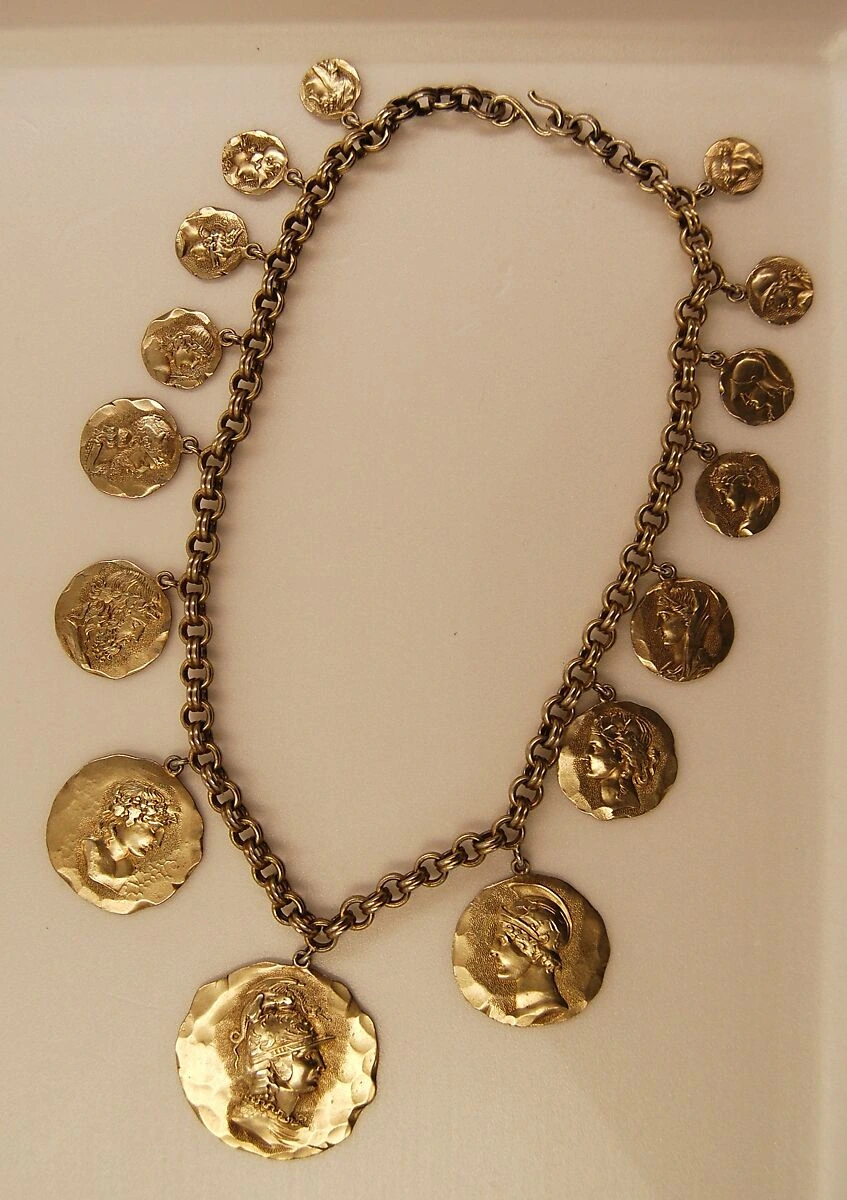
George W. Shiebler & Co., Necklace, about 1880. Silver and silver gilt.
The Metropolitan Museum of Art · 2009.110
View the larger museum photographThe bracelet: a small gallery around the wrist
The bracelet, accession 2009.111, is catalogued as silver, about 1880, measuring 1 × 7 inches (2.5 × 17.8 cm). Five square panels carry classical heads in low relief. Paired rows of oval links connect them; fan-shaped ends lead to a double tongue clasp. The Met describes stippled backgrounds and an irregular hammered finish.
Here the portraits sit inside a more continuous band. Compare the articulated joins with the broad faces of the panels: the design needs both a surface to look at and enough movement to curve around a wrist. Its seven-inch catalogue dimension is not a promise of fit for every wearer.
A close inspection should include the back and both ends of the clasp, not just the attractive portrait side. Ask for clear photographs before buying. Keep condition observations separate from any claim about maker, date or silver content.
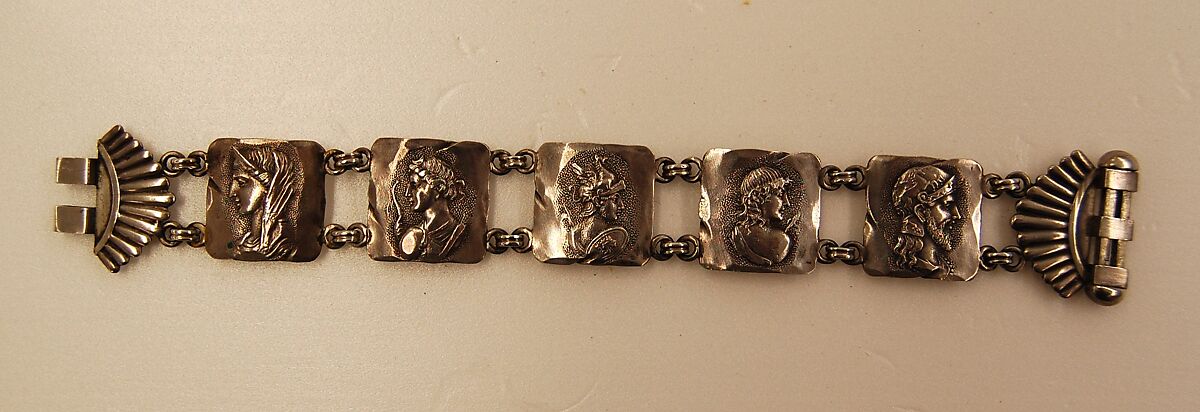
George W. Shiebler & Co., Bracelet, about 1880. Silver.
The Metropolitan Museum of Art · 2009.111
View the larger museum photographThe winged S: start with a documented object
Christie’s records a winged S and the word sterling on the lower part of its 1880 Megillat Esther case. That is evidence for the marks on that particular object, not a complete chronology of the firm’s stamps. The catalogue also describes a missing scroll: the surviving silver case and its original contents are separate questions.
For an unfamiliar piece, begin with the complete object and then its marks. A cropped stamp photograph is easier to misread when scale, construction and wear are missing. Keep a readable photograph rather than replacing the impression with a neat drawing, and retain the seller’s description as a claim to check, not as a conclusion.
Names & chapters
How the story developed.
- 1876
A manufacturing business begins
Shiebler acquires an existing spoon manufacturer, according to Christie’s firm history.
- About 1880
Classical heads become wearable silver
The Met dates its necklace and bracelet to this period.
- 1892
An established workshop
A substantial workforce serves the firm’s retail and manufacturing business.
- 1907
The museum’s firm endpoint
The Met lists the company as active 1876–1907; Christie’s describes bankruptcy in 1907.
Follow an interest
What to explore.
A historical company profile focused on documented silver objects and their construction.
Check the details
Before you buy.
Look at the whole object before following its smallest details.
Open the references
Research this name.
- Related Collect Silver guide
Silver chains
Compare the chain’s construction with other link patterns.
- Related Collect Silver guide
Silver necklaces
Follow the whole composition, from pendant to fastening.
- Related Collect Silver guide
Jewelry history and makers
Place a workshop within the wider history of silver jewelry.
- Related Collect Silver guide
The Silver Table
Explore the other side of a silverware manufacturer’s world.
Sources & further reading
- Necklace, 2009.110 The Metropolitan Museum of Art · Museum object record
- Bracelet, 2009.111 The Metropolitan Museum of Art · Museum object record
- Megillat Esther case, New York, 1880 Christie’s · Auction catalogue and firm history
Museum object records and an identified auction catalogue support this profile.