
Wearable silver / An eye for the whole
Silver necklaces,
seen as a whole.
Follow the curve. Notice where the eye settles, how the parts meet, and what happens at the back. A necklace brings all those decisions into one wearable design.
Begin with the shape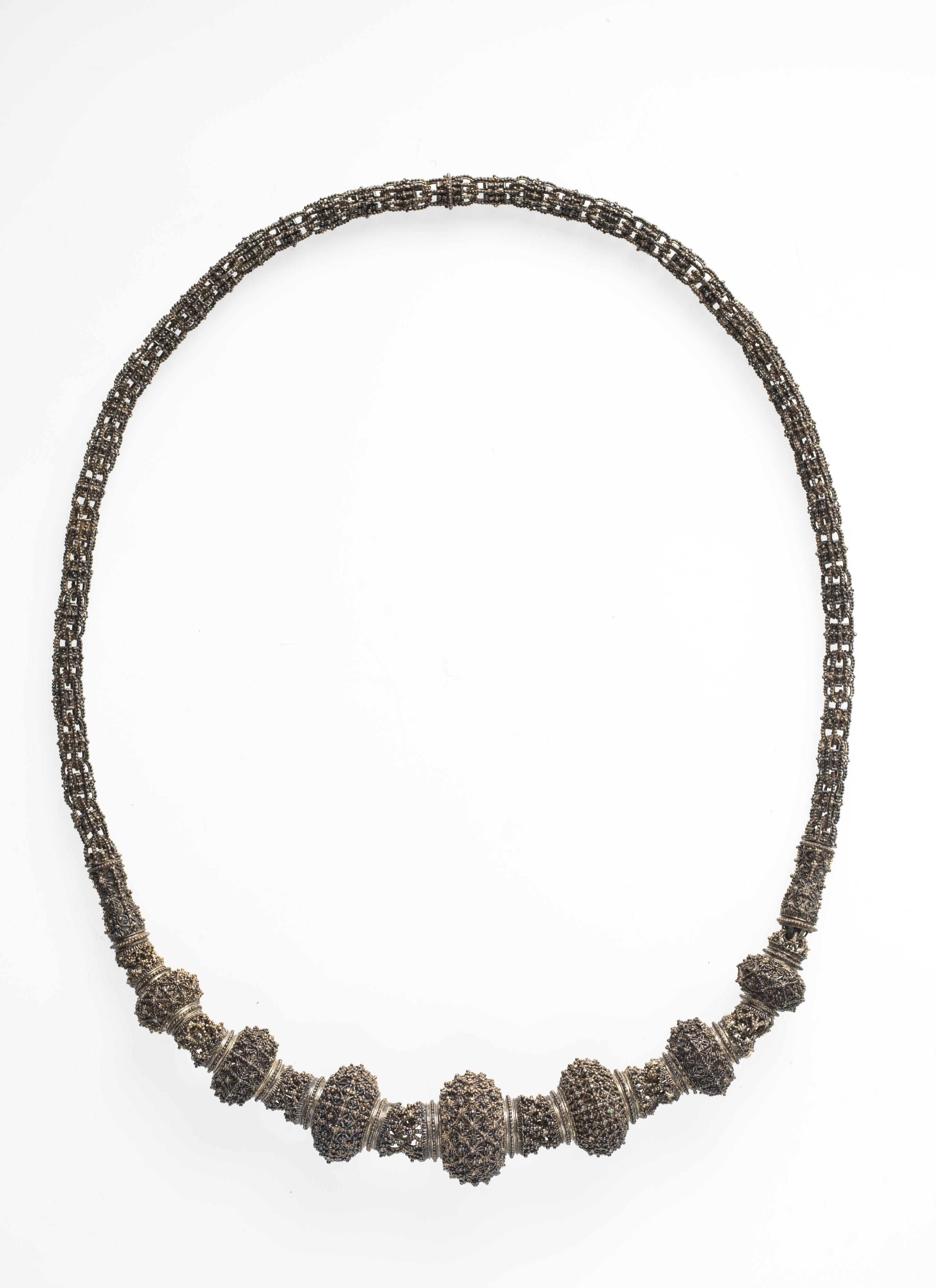 Open full photograph
The whole design
Start with the shape around the neck.
A necklace is the complete object worn around the neck. A chain describes linked construction and can be worn as a necklace itself; a pendant is the suspended ornament. Ask whether a listing includes the necklace, the pendant, or both, and whether the components are documented as belonging together.
Set link names aside for a moment. Look for an even rhythm, a widening front, a single focal point or several hanging elements. Notice the spaces between parts as carefully as the silver itself. The back can be quieter than the front while still doing essential work.
One continuous curve
A change in scale can make the centerpiece.
The Met records the necklace shown above as silver, dating to the 18th–19th century and attributed to Sri Lanka. Its photograph shows slender, repeating sections giving way to larger, textured forms along the lower curve. Look at the transition rather than searching for a separate pendant.
The catalog gives a length of 97 cm and a maximum diameter of 4.5 cm. Those are two different measurements of the object. They do not tell us its wearable inner circumference or how it would sit on a particular person. Preserve the museum’s labels when recording them.
Movement & balance
Separate the outline from the moving parts.
With an object safely supported, look for the places where sections join. Do broad elements overlap, pivot or hang independently? Does a central ornament attach at one point or several? A photograph may reveal connections, but it cannot establish their strength or show the full range of movement. Never pull or bend a necklace to find out.
Shiebler’s necklace, made around 1880, offers a different composition. The Met identifies its materials as silver and silver gilt, and its medallions as imitations of ancient coins. In the photograph, the medallions hang from the linked necklace at separate points; the largest draws attention to the bottom. Observe that arrangement without treating the ornaments as ancient currency.
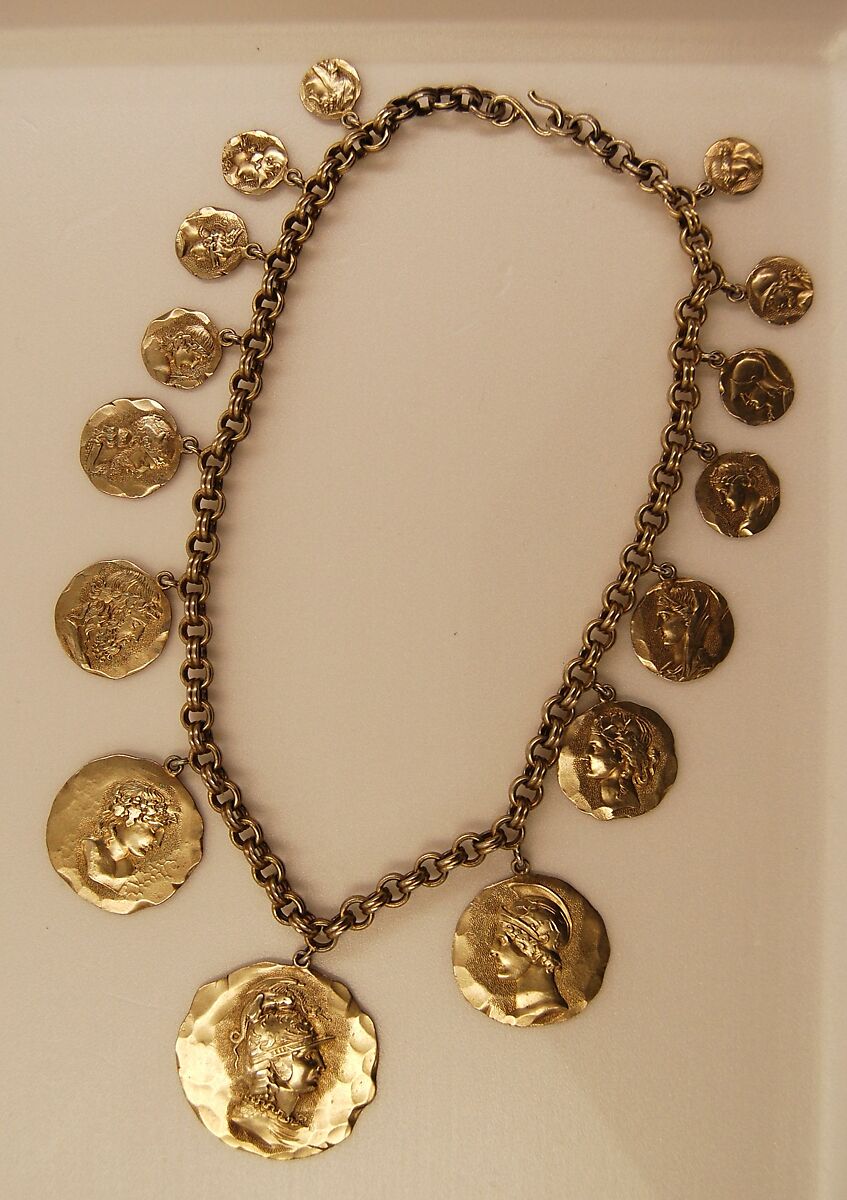 Open full photograph
The back & fastening
Give the closure its own close look.
Ask for clear photographs of the fastening, both end fittings and their joins, including the reverse. Note the mechanism as seen, any safety fitting, visible repairs and how the closure meets the rest of the design. A different-colored fitting is worth recording; color alone cannot establish a replacement.
A neat front view can hide a damaged catch or a stressed connection. If a fastening is loose, distorted or difficult to operate, have a qualified jeweler assess it before wearing. Do not assume that a museum photograph demonstrates a working closure or that all parts are original.
Dimensions & fit
Make the measurements useful.
For a flexible necklace that can safely be laid out, record the end-to-end length and say whether the clasp is included. For a rigid or shaped piece, record its inside width and depth without trying to straighten it. Measure a pendant or central drop separately, and describe the method so another person can reproduce it.
Fit also depends on thickness, shape and the space the design needs to move. Compare with a necklace you already wear comfortably, but do not reduce every form to the same length chart. A flat photograph has no reliable scale unless a measurement is supplied. Record total object weight as total weight, not automatically as silver weight.
Keep the evidence
Collect the details with the necklace.
Keep front, reverse, fastening and mark photographs together with the receipt, stated materials, dimensions, condition and known repairs. Distinguish what you observed from what a seller claimed and what a reliable record supports. A familiar motif or a stamped number does not by itself establish authorship, age or metal content.
Choose a direction that rewards your eye: graduated forms, sculptural centers, articulated panels or the relationship between a necklace and its pendant. Compare complete designs before comparing prices. Before cleaning an unfamiliar piece, identify its finishes and other materials and seek advice where uncertain.