
At first the surface looks almost too busy to read. Step back and the casket resolves into a stack of clear shapes: feet, a spreading base, a straight-sided body and a stepped lid. Move closer and those shapes become fields of curling wire. The design works at both distances. Broad borders organize the box; smaller lines make each enclosed space worth looking into.
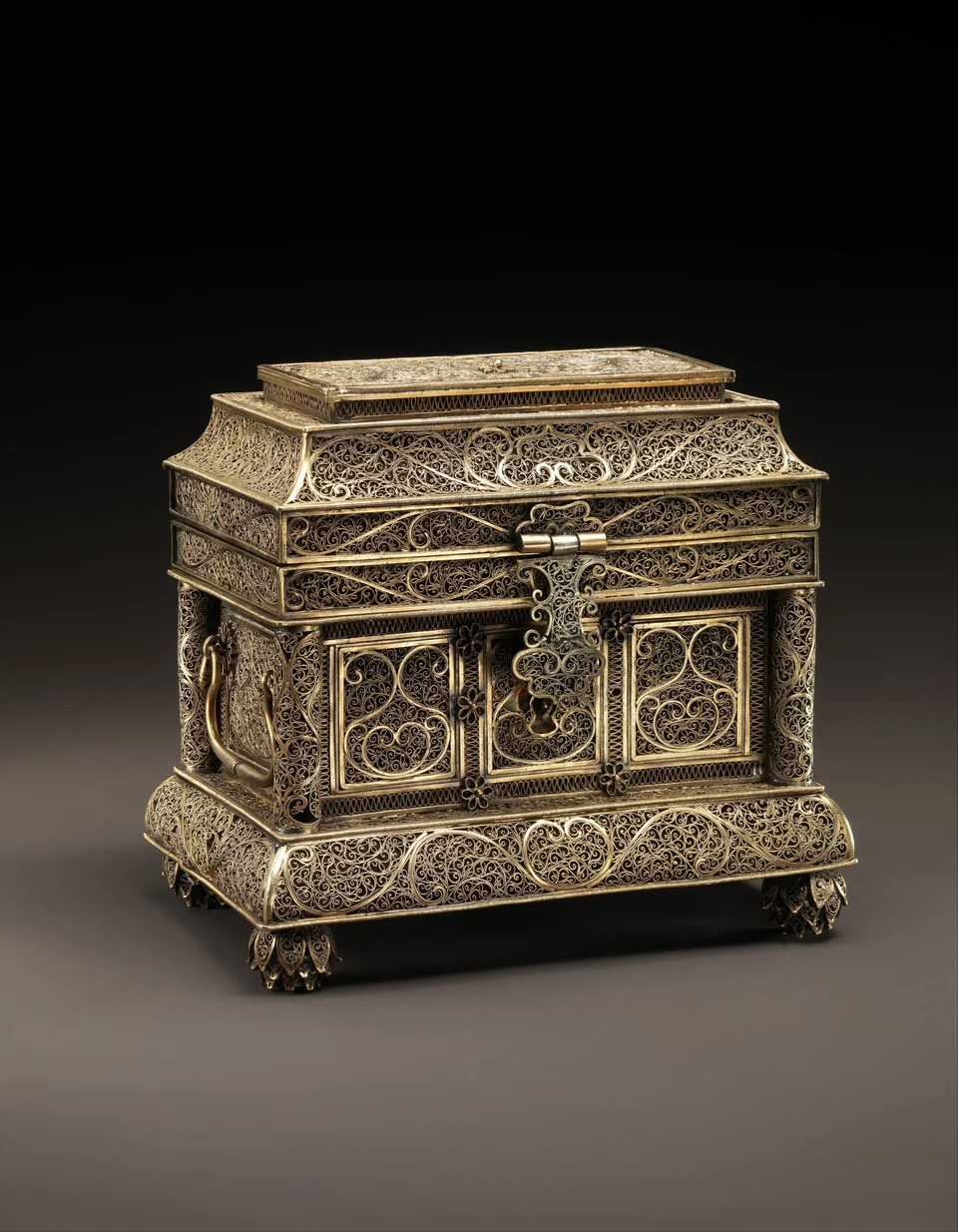
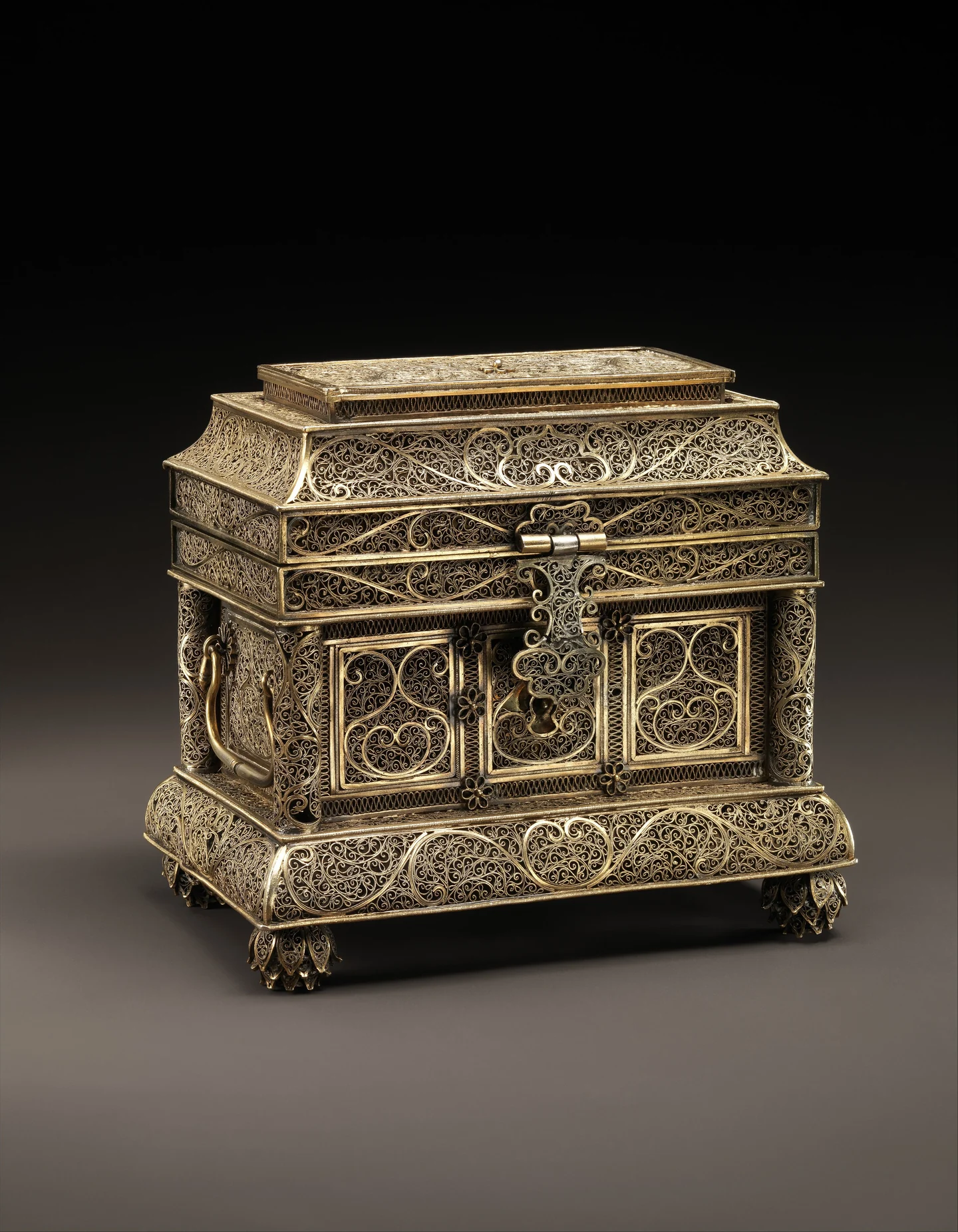
The Met catalogues this as Filigree Casket with Sliding Top, made in India, probably Goa, in the seventeenth century. Its medium is silver filigree, parcel-gilt; it measures 13 × 13 × 9 cm. The current record names no maker. Keep the word “probably” with the place: an attribution is part of the evidence, not a certainty to improve away. Read the object record, 2014.253.
Read the large lines before the small ones
Begin with the three framed panels across the front. Each has a firm rectangular boundary, an arrangement of larger curves and a much finer filling. The central closure interrupts the pattern instead of disappearing into it. Along the base, larger loops travel across a continuous band. The sloping lid repeats the contrast between broad curves and dense small curls.
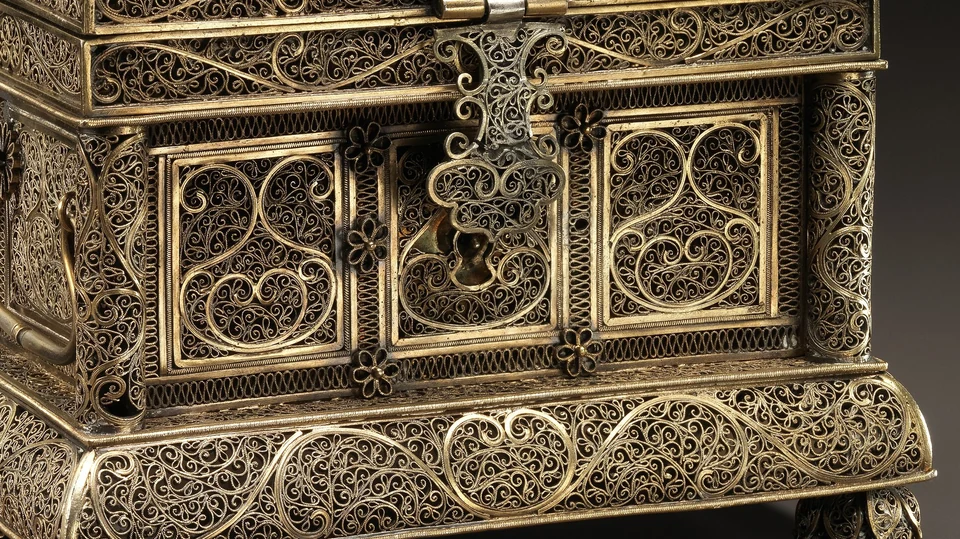
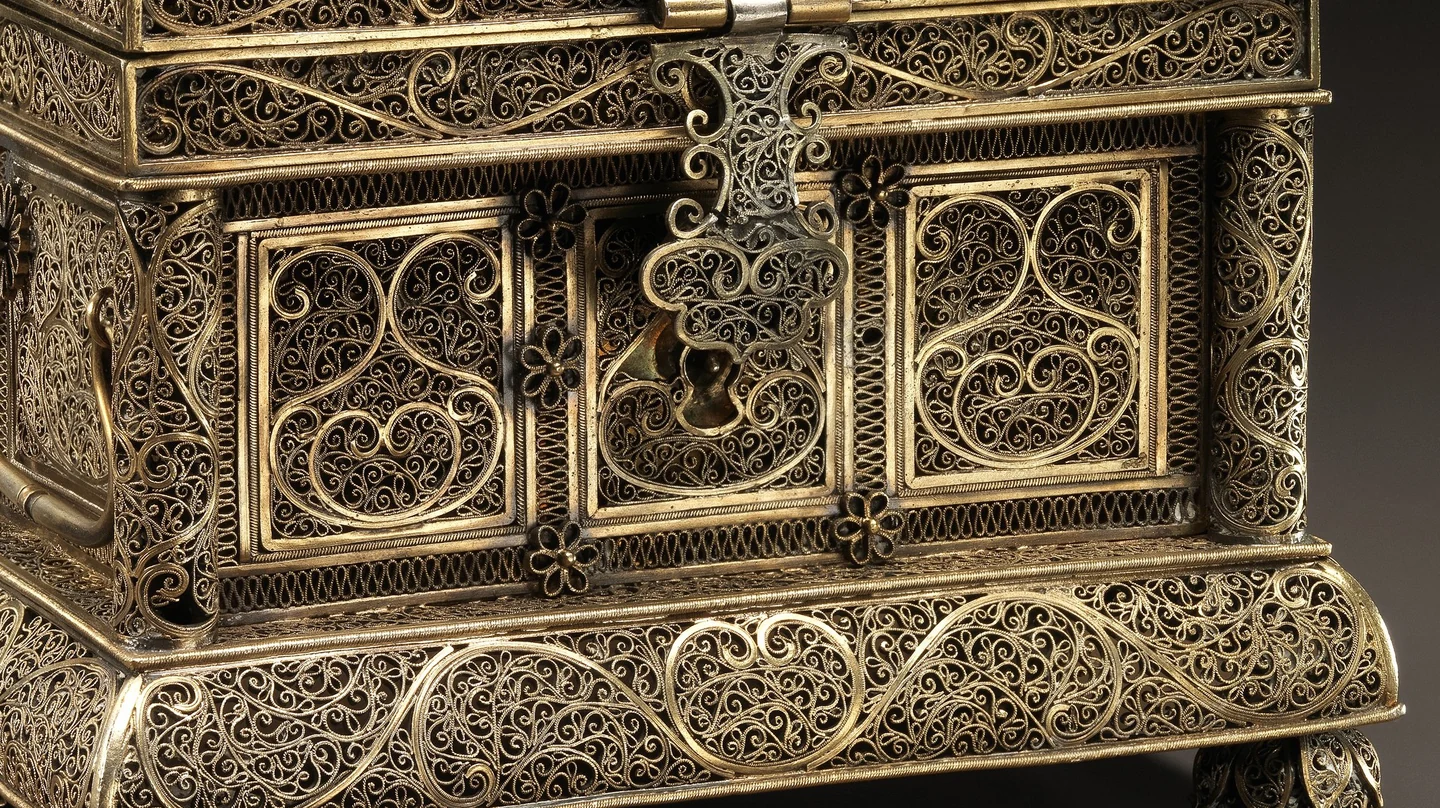
Try tracing a single line in the enlarged detail. Where does it turn back? Where does it meet the border? Where does one pattern stop and the next begin? This is a more useful first exercise than deciding whether the whole thing looks “handmade.” Describe the relationships you can follow before trying to reconstruct every operation at the bench.
The darker spaces need equal attention. In a photograph, an opening, a deep recess and a shadow can look similar. This closed view does not show the back of every wire field. It therefore cannot establish whether every apparent gap runs all the way through, or reveal the support concealed behind the decoration. An interior or reverse view would answer different questions from a larger version of this same photograph.
Compare this construction with the filigree examples in our decoration guide. The guide introduces wire ornament beside pierced, engraved and raised surfaces. Here the useful next step is to follow how a repeated pattern changes when it meets a corner, a lid or a working fitting.
From a length of silver to a joined pattern
Filigree depends on preparing wire as well as arranging it. The Met’s exhibition catalogue describes drawing metal through successively smaller holes in a steel plate. It also explains how different wire thicknesses, and plain and twisted lengths, give makers a varied vocabulary. Drawing changes the dimensions of the stock; twisting changes how a prepared length reads on the surface. See catalogue entries 184–185, pages 313–314.
1. Establish the frame
In the Cuttack practice documented by NID contributors Bibhudutta Baral and Hariharasudan T., makers begin with a drawn design, prepare wire from a silver rod and form the heavier outer framework. They check its shape against the drawing and solder it. Larger work can be assembled from smaller components. Their illustrated process record explains a workshop sequence; it is not a technical examination of this earlier casket.
Look back at the front panels with that distinction in mind. Their borders give you places to investigate how the ornament is divided and supported. You can record “rectangular borders around fine scrollwork” from the photograph. A claim about the exact order in which this casket’s panels were made would require further evidence.
2. Fit the fine wire
The same Cuttack account describes rolling, folding or twisting fine wires with tweezers and fitting them within the frame. The prepared design is levelled, then sprinkled with silver dust and borax before soldering and finishing. Those details make the work more intelligible: repeated curls are fitted components, and their contact points matter as much as their outlines. Read the documented sequence.
On an object you are considering, ask for a sharply focused view of a border junction and another of a tight curl. Is the line continuous? Does a missing section expose an attachment? Can you distinguish two strands where they meet? A visible irregularity is something to record, not an automatic guarantee of age or hand manufacture.
3. Join without losing the pattern
Soldering joins metal surfaces with an intervening metal that melts and sets; the V&A discusses it as an assembly technique used with many kinds of forming and decoration. Its metalworking guide helps separate the joining operation from the making of the parts. Neither a golden highlight nor a dark patch identifies the casket’s solder composition, and the museum record does not supply that analysis.
Inspect junctions in context. A smooth patch might merit a question about repair, but a photograph alone cannot establish when it formed. Ask whether a condition report identifies replaced wire, strengthened borders or repaired fittings. Keep such reports beside the images rather than converting every visible change of texture into a diagnosis.
4. Consider surface and finish separately
Parcel-gilt means that selected areas are gilded. The term describes the distribution of gold on a surface; it does not, by itself, identify the gilding method. The V&A distinguishes several ways of applying gold. Compare its coating techniques and our gilding guide. For this casket, record the museum’s material identification and the colors visible in the photograph separately. Lighting and reflections also affect those colors.
A sliding compartment, with a limit to what we can see
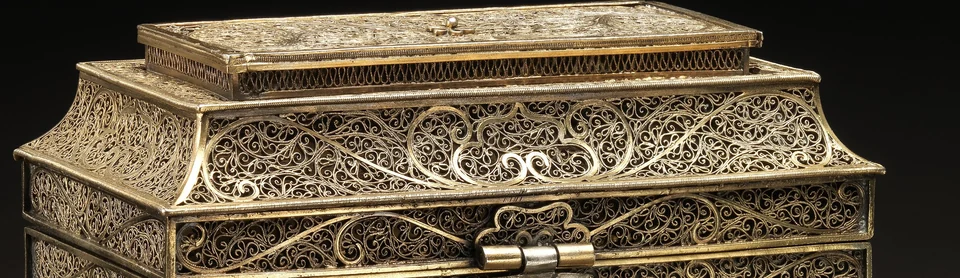
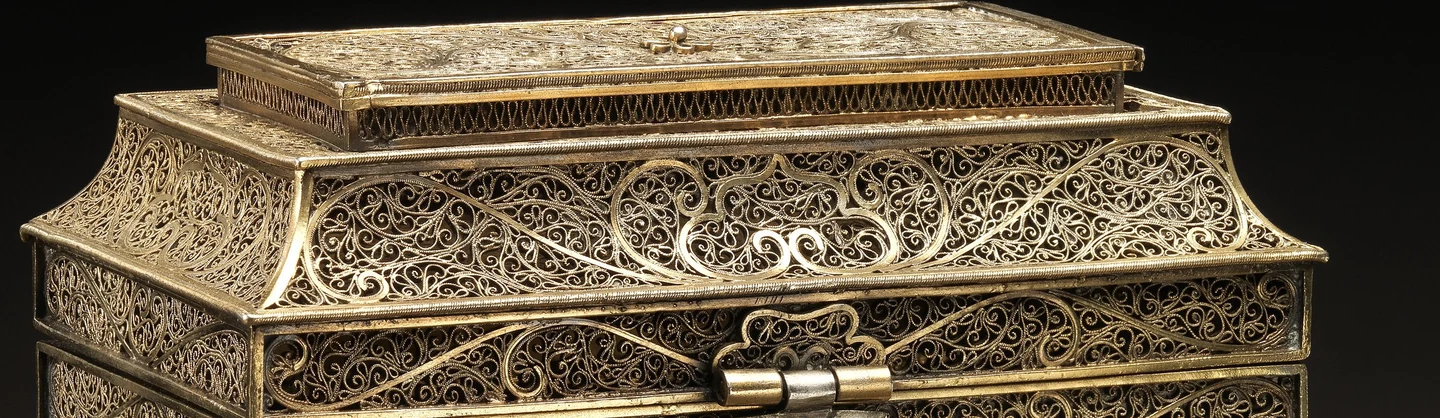
The Met describes a concealed space in the lid, opened by sliding, and suggests that it might have held the key. The compartment is documented; that proposed content remains a possibility. The museum also identifies a buta, or flame motif, in the ornamented interior. These statements come from its object description, not from the exterior detail above.
The two downloadable images linked by the museum when this feature was checked both show the closed casket from essentially the same angle. Neither shows the compartment open. Our details are crops of the primary photograph, not additional museum views. There is no basis here to describe an unseen interior arrangement, demonstrate the slide’s operation or say that a particular key survives.
That distinction matters for collectors of small containers. A familiar outer form can conceal very different fittings. Before describing a box’s function or completeness, request photographs of its accessible interior and closure, along with measurements and condition information. Ask the owner to demonstrate movement only if it is safe; do not force a stiff mechanism to reproduce an imagined arrangement.
The same habit is central to our pocket-silver guide: study the fittings that make an object usable. This casket offers a comparison in how to examine a container, not evidence that it was carried in a pocket. Its side handle is visible; its owner's actual routines are not.
Connections without making the makers disappear
The Met places filigree within an established medieval Deccani tradition and describes European imports as a new stimulus during the Portuguese presence in the sixteenth century. That account gives local craftspeople a practice of their own before the encounter. It does not say that this particular maker learned the technique from a Portuguese visitor.
The exhibition catalogue describes trade and exchanges among craftspeople in India and Portugal, and cites the Goan jeweler’s son Raul Xamtin staying in Lisbon. It also discusses Indian filigree objects influencing English production. The catalogue’s account of circulation is broader than a one-way story of imported skill. It does not identify Xamtin as this casket’s maker.
A useful comparison in that catalogue is the Hispanic Society of America’s Filigree Casket with Barrel Top, LR 2321/1, also attributed to probably Goa in the seventeenth century. Its rounded lid contrasts with this casket’s stepped profile. The two appear together as entries 184 and 185. Their relationship helps frame a question about form; it does not prove a common workshop. We have not reproduced the comparison photograph.
A living practice offers another kind of evidence
Dastkari Haat Samiti’s 2017 documentation of Cuttack tarakasi shows wire preparation and ornament-making as work that can involve different workshops and teams. It credits artisan Ruksar Ali and community filigree artists, with text by Jaya Jaitly and photographs by Chirodeep Chaudhuri. The story follows small pieces alongside large festival work, including silver backdrops for Durga images. Explore the documented workshop practice.
This changes what “fine work” can mean. Fine describes the scale of the wire, while the finished work can demand an extensive structure and coordinated labor. The documentation is valuable in its own right. It should not be used to fill gaps in the seventeenth-century casket’s biography or to imply that South Asia has a single, unchanging filigree tradition.
Make a record another person can check
Instead of a verdict such as “excellent old filigree,” build a description from locations and evidence. The following prompts are for an object you can examine or request images of; they are not a condition report on the Met casket.
- Wire and frame
- Photograph the whole object and one representative junction. Record whether the fine filling, border and neighboring panel can each be followed clearly.
- Breaks and changes
- Locate gaps, flattened areas and changes in texture. Distinguish a visible feature from a repair identified in a specialist report.
- Fittings and movement
- Record handles, feet, hinges, closures and any removable parts individually. Ask which parts have been replaced and what supports their identification.
- Interior and reverse
- List the views actually available. Write “not examined” where a lining, closed panel or inaccessible mechanism prevents inspection.
- Attribution and material
- Preserve the source’s degree of certainty. Keep a proposed origin, an assay result, a maker’s mark and an ownership history as separate kinds of evidence.
Use the collector’s object record to keep those observations with dated photographs and source links. Continue to how makers shape silver for the wider relationship between stock, construction and finished form.
The reward for looking closely is a more precise account of the object. Here, the wire can be followed through a hierarchy of frames and scrolls, while the photograph’s limits remain visible too. Both belong in the record.
Sources and photographs
Object facts follow the current Met catalogue record. Historical and wire-drawing context comes from Sultans of Deccan India, 1500–1700: Opulence and Fantasy (2015), entries 184–185, pp. 313–314. Cuttack processes follow the linked NID/D’source and Dastkari Haat Samiti documentation. General assembly and coating terms follow the V&A.
The Met marks the casket’s photographs Public Domain; its Open Access policy makes eligible images available under CC0. All three figures derive from its primary image DP340529: one uncropped view and two labelled crops, resized and encoded as WebP without retouching. The alternate DP335175 was checked but is omitted as a near-duplicate closed view. The maker and original patron are unidentified in the current record; no open-compartment photograph was verified. Sources and images checked 15 November 2026.