
Is Oneida Community Plate sterling silver?
No. Community Plate was an Oneida silverplate line, not a sterling fineness mark. Silverplate has a layer of silver over another metal. The company name is a separate clue: Oneida sold both plated and sterling flatware. The full mark tells you more than “Oneida” alone.
You can see the distinction in a 1951 Federal Register notice. It gives separate tables for Oneida’s Community Plate and Heirloom Sterling flatware. The prices are historical, not a valuation guide. What matters here is how clearly the two lines are separated in a document from the time.
Can the stamp tell me the pattern or date?
Not by itself. Community Plate is the line. The pattern is the design you see on the handle, including its outline and decoration. The wordmark is worth photographing in its entirety, but you’ll need the shape, decoration and type of piece to compare it with a dated advertisement or catalogue. Even a match to a dated catalogue tells you the design was advertised by then, not the date your individual spoon left the factory.
If your pieces came in one chest, record that. Then check several pieces from different groups, including knives and serving pieces. A family may have added replacements or pieces from a different line. The chest tells you how the pieces came down to you; it doesn’t guarantee that every one started there.
A date can also be part of a brand name. Why 1847 Rogers Bros. does not date your spoon to 1847 shows how a full stamp, a pattern and a box each tell a different part of the story.
Who put the shine on it?
In February 1942, a man sat at a broad buffing wheel in the Oneida Ltd. factory in Oneida, New York. Edward Gruber’s photograph shows instrument trays near his knees. The government caption explains what a collector otherwise wouldn’t know from looking: this machine normally polished silverware. Now it was being used to finish surgical instruments for Army and Navy physicians.
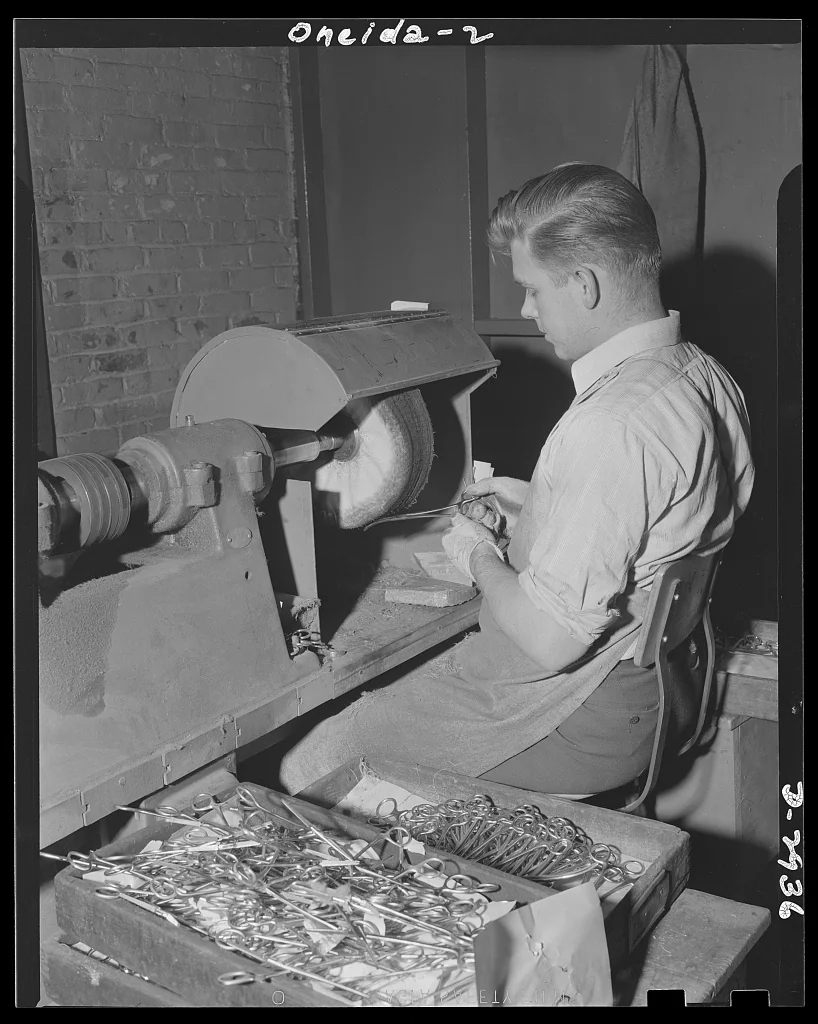
A second photograph from the same visit describes the plant as beginning a conversion from silverware to surgical instruments and bayonets. That doesn’t mean the instruments were silver, or that every line stopped making flatware the day Gruber came. It shows a machine and a skill being put to work on a very different object.
Decades later, the Oneida Community Mansion House’s oral histories recorded a different generation of employees. One remembered supervisors explaining the machines to visitors. Another recalled how much equipment Oneida designed in-house. Neither identifies the person in Gruber’s photograph. Together, the records show something the backstamp cannot: how much work there was between a factory’s name and a finished surface.
What should I save with the set?
Photograph the complete mark, a representative piece from front and back, and any original packaging or paperwork. Record the line and pattern separately. Note anything that doesn’t match: a replacement fork, a different mark, an area where the finish has worn through. If you don’t know a date, leave it open rather than relying on the seller’s description or assuming the age of the chest.
For the difference between a plated surface and a solid silver alloy, start with our guide to silver marks. For how the coating is made, see our electroplating guide. To identify the different pieces in the chest, go to Silver Flatware. The most useful record is one the next person can check: what the stamp actually says, what the piece looks like, and how it came to you.