
No. In “1847 Rogers Bros.,” 1847 is part of a brand for silverplated flatware, not the date an individual spoon was made. Start with the entire stamp and the pattern on the handle. If the pieces came in a box, treat the box as a separate clue.
A nineteenth-century name on a twentieth-century spoon
1847 is a real year in the story. In a 1934 opinion, a federal appeals court recounted that brothers William, Simeon and Asa Rogers went into business together in Connecticut in 1847, making electroplated tableware. About November 1862 the brothers joined the Meriden Britannia Company as employees. The court describes Meriden marketing goods under the name “1847 Rogers Bros. A 1.” The date was already doing two jobs: recalling the original business and helping shoppers recognize one line among many. Read the 1934 opinion.
A Meriden catalogue in The Met’s collection puts the name in the title. The museum dates the catalogue to after 1862. Fast forward again and the same number is selling new silverplate: Historic New England’s Anniversary pattern brochure was published by International Silver Company and is dated 1920–1925. A family could buy flatware from that brochure and see “1847” on a piece made generations after the brothers first went into business. See The Met’s catalogue record.
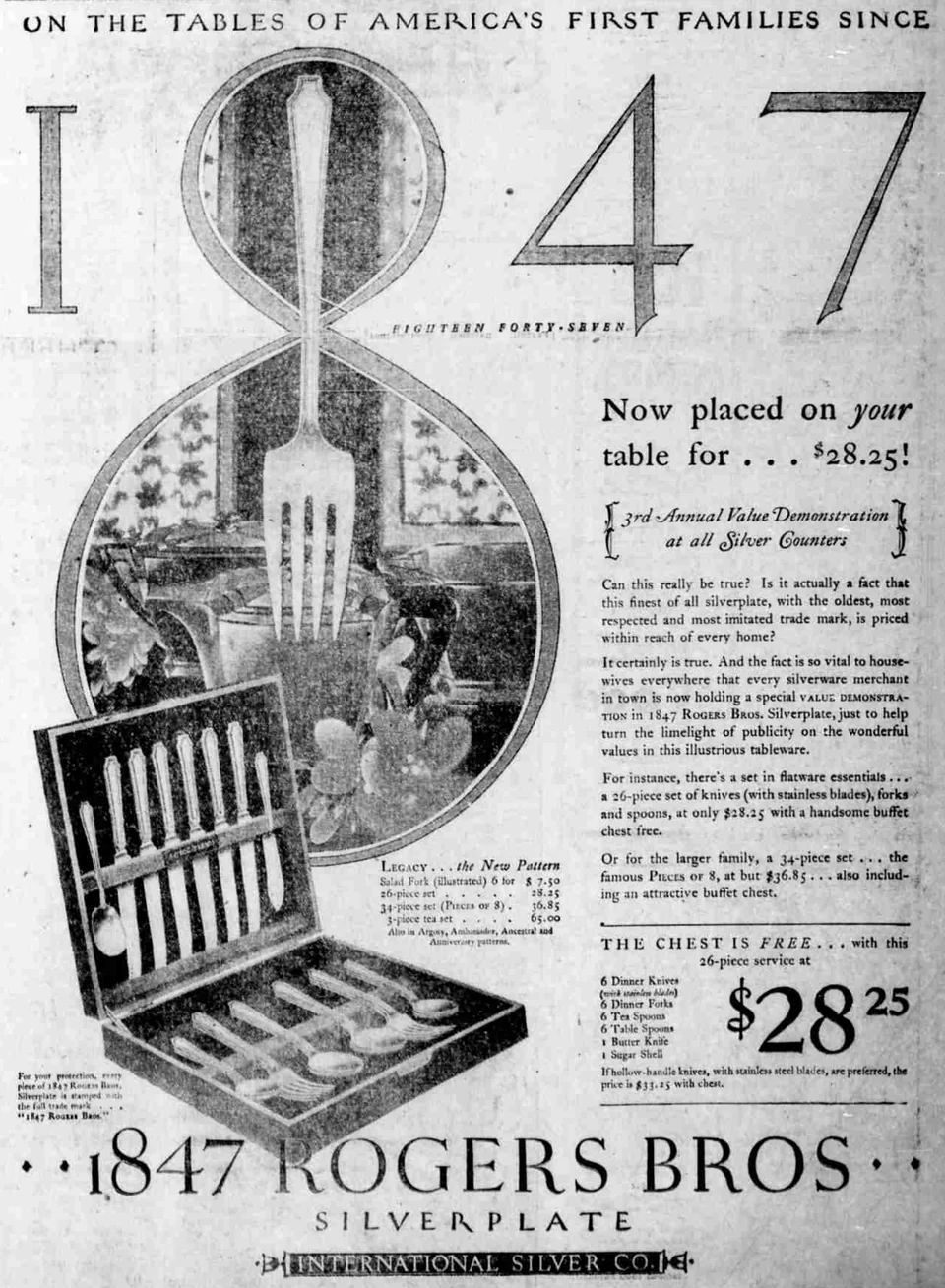
A 1928 newspaper advertisement made the distinction almost comically clear. It called Legacy the new pattern, while “1847” towered over the illustration of a chest of brand-new flatware. Underneath, the advertiser told shoppers to look for the full trademark on every piece. If Legacy matches your spoon, that ad gives you a documented sale period for the design. It still cannot tell you the day your spoon was made.
Silverplate or sterling? Look below the company name
Historic New England keeps another International Silver brochure from the same period, this time for its Fontaine service, advertised as solid silver. Two brochures, same publisher, different materials. “International Silver” alone is not enough to identify a piece’s composition. The full “1847 Rogers Bros.” mark points to the silverplate line, not to the publisher’s separate solid-silver wares. “A1,” if present, is not a sterling fineness stamp. Check the sterling vs. silverplate marks guide for what other inscriptions can and cannot tell you.
The box makes a good clue, not a verdict
The 1934 case involved International Silver and Oneida Community, which had acquired the separately named William A. Rogers business. The judges recorded four dealers putting Oneida’s plated wares in International Silver’s containers. That does not make every mismatch suspicious: families combine sets, replace a lost fork or use the best box they have. But the court record shows why a printed lid and a stamped spoon should get separate lines in a collector’s notebook. If the other side of the box says Community Plate, here is how to read that mark.
What to photograph before you look up the pattern
- Photograph the entire handle face-on and the reverse under angled light. Transcribe all the lettering; “Rogers” by itself loses the distinction between businesses and lines.
- Compare the tip, border and decoration with a dated brochure or pattern catalogue. A documented match shows the pattern was offered by then, not when your individual piece left the factory.
- Check a few forks and spoons separately. An inherited chest may hold more than one pattern or material. Record the box label and any dated receipt, but keep them separate from what you can read on the pieces.
A spoon doesn’t have to date to 1847 to be worth keeping. A named pattern and a good family record can tell you more about the table it served than the biggest number on the back.