A coin in a pendant belongs to more than one collecting conversation. Its mint identity matters, but so do the mount, any engraving and the history of its use. Begin by establishing what the central object is, then examine what happened when it became jewelry.
A classical profile is not proof of an ancient coin
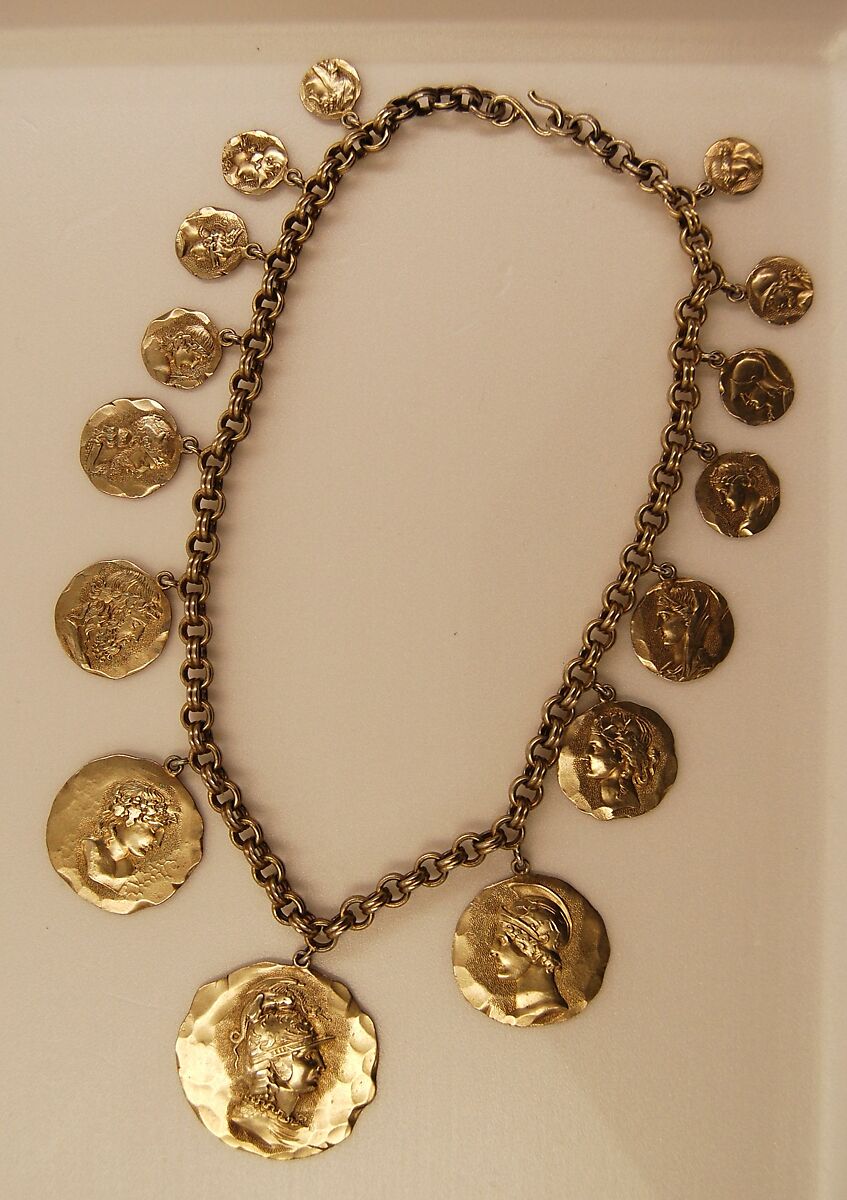
George W. Shiebler & Co.’s necklace at The Met, 2009.110, was made about 1880 in silver and silver gilt. The museum describes its suspended medallions as imitations of ancient coins. Their classical heads belong to the jewelry’s design, rather than proving that ancient currency was reused.
This is a useful distinction when browsing a dealer’s tray. Coin-inspired ornaments, medals, tokens, reproductions and genuine monetary coins can share a round shape and a portrait. Photograph both faces and the edge wherever accessible. Record inscriptions exactly, including parts hidden by a setting.
Do not authenticate an ancient coin from an irregular edge or a convincing portrait alone. A mount can conceal important evidence. If an attribution materially affects the purchase, seek a numismatic specialist’s assessment as well as a jewelry assessment. Keep the maker or date of the setting separate from the identity and date of the coin.
View full photograph George W. Shiebler & Co., Necklace, ca. 1880. Silver and silver gilt. Its medallions imitate ancient coins. The Metropolitan Museum of Art, Gift of Martha J. Fleischman, 2009 (2009.110). Public domain.
A frame may grip the coin with a screw closure, tabs or prongs. Another piece may have a bail soldered directly to the coin, or a hole through which a ring passes. These arrangements create different inspection questions. None should be described as harmless simply because the coin can theoretically be taken out.
Even a screw bezel can leave contact marks, conceal earlier damage or permit movement against the edge. A tight fit is not proof of preservation. Do not loosen, tighten or remove an unfamiliar mount to test the seller’s claim. An experienced specialist can judge whether inspection out of the mount is worthwhile and how it should be done.
Frame or bezel: look for concealed edges, fit, abrasion and movement without manipulating the closure.
Tabs or prongs: inspect visible contact points and ask about prior removal.
Soldered attachment: record its position and any visible alteration around it.
Pierced or cut-out coin: document the missing metal, edge of the alteration and surviving design.
Jewelry use can remain visible after the mount is gone
NGC’s Details Descriptions Glossary uses “Mount Removed” for evidence left by a former ring or bezel attachment. It also recognizes holes, repairs and other surface problems. Removing a mounting does not restore a coin’s original surfaces, and polishing to disguise the marks can create further problems.
A details designation describes a condition issue; it is not a declaration that a coin has no collectible value. Rarity, surviving detail, authenticity and market demand still need consideration. Equally, an attractive setting does not erase damage when comparing the coin with unaltered examples.
Ask for the actual grading description when one exists, rather than accepting a seller’s shorthand. If a formerly certified coin has been removed from its holder and mounted, do not assume its previous grade describes its present condition. Keep photographs and any certification history with a clear account of subsequent changes.
An engraved coin pendant may preserve initials, a date or a dedication that matters more to its owner than the original monetary design. Record the inscription without inventing the relationship behind it. A named recipient can be a research lead; it is not proof of a romantic gift, memorial or particular life event.
Photograph the complete mount before focusing on the coin. The frame, bail, connecting rings and chain can reveal separate phases in the object’s life. A much older coin in a later setting is not inherently suspicious, but the two dates should not be collapsed into one.
Avoid dismantling an established piece simply because the coin seems more interesting on its own. Removal may destroy evidence or damage the setting. If conservation or authentication requires it, document the assembly first and retain the removed parts. The appropriate decision depends on the particular object, not a general preference for loose coins.
Keep three valuations distinct
Metal value begins with the actual materials and quantities present. The coin and mount may have different finenesses, and a cut-out or worn coin may no longer match its original mint weight. Gross pendant weight is not automatically silver weight. A theoretical metal estimate is also not a guaranteed dealer offer.
Numismatic value concerns the identified coin, including rarity and present condition. Jewelry or historical value concerns the mount, design, maker, alteration and documented story. These three views overlap, but adding three independent estimates together can overstate the value of the assembled object. Compare with genuinely similar sales and disclose condition.
Do not choose a valuable collectible coin for wear on the promise of a nondestructive bezel. Consider a purpose-made coin-inspired ornament instead. For existing mounted pieces, enjoy the design while keeping expectations clear: an altered coin may remain collectible, and a handsome jewel need not be a financial investment.