
Begin with the object, not a name.
A maker search works best after you have recorded the whole object and considered its materials. An initial, a crest or a familiar name may be a useful lead, but the impression can belong to a sponsor, retailer or later fitting. A mark can also be copied or reused.
Photograph the front, reverse, underside and profile, then show where each group sits. Record dimensions, gross weight and separable parts; note any filling, blade, liner or repair before treating the weight as metal. Keep the seller’s account separate from what you can see.
Make the tiny impression legible.
Use diffuse light and steady support. Take a view showing the mark’s location, then close views from several angles; low, angled light can reveal shallow edges. Keep the original files and a scale in a separate view. Record what is uncertain rather than filling in a missing letter.
Photograph the entire group, its outlines, orientation and spacing, and any marks on lids, clasps or other parts. Avoid polishing, chalk, ink or abrasive rubbing to make a mark read more clearly. A worn impression may remain ambiguous even in a good photograph.
A phone can work: support it, tap to focus and move the light rather than the object when possible. Take several exposures without flash glare, and inspect the results at full size. A digital enlargement can help you read a detail, but keep the unedited original alongside it; sharpening, filters and shadows can change the apparent shape of a punch.
Label each view with the object and component, especially when a service has multiple lids or a piece of jewelry has several fittings. Photograph inscriptions and repairs separately. If a mark is hidden beneath a fragile lining or a stuck component, do not force it open merely to obtain a better picture.
Give each impression a job.
A hallmark is an official mark within a particular assay system; a maker’s or sponsor’s mark identifies a responsible party within its own context. Other stamps can identify a retailer, a pattern, a material claim or a decorative motif. A group of shields does not by itself establish that an assay office struck them.
First identify the probable system from the full group, object, period and source. Then compare the exact lettering, border, order and accompanying marks with a reference for that system and period. An assay location is not necessarily a manufacturing location; an import mark can be later than the object.
| Clue | Useful question | Limit |
|---|---|---|
| Initials | Whose registered punch has this lettering and outline? | The same initials can belong to several people or firms. |
| Number | Is it fineness, a pattern, a date code or a plating grade? | A number has no universal meaning outside its context. |
| Lion, crown or shield | Does the complete group match a documented system? | Decorative or trade stamps may resemble official marks. |
| Name | Is it a maker, retailer or later brand? | A name does not establish who made every component. |
Compare candidates, including the ones that do not fit.
Search a specialist register or museum collection for the full mark and object type. Save the record title, institution, stable link and date consulted. Compare the shape and lettering of the punch, companion marks, form, construction and plausible working period. A small image or transcription may omit a detail that would distinguish two candidates.
Build a short list when initials are shared. Note what supports each candidate and what conflicts: a date outside a documented working period, a different punch outline or an incompatible object form deserves investigation. Firms can change hands and marks can be used across periods, so a neat date match is still a lead rather than proof.
Choose a source for the question.
Use a source appropriate to the question. An assay-office register may help establish the registered sponsor of a punch; a museum catalogue can show a comparable object and its recorded attribution; a historical trade catalogue may help place a pattern in a period. Each has a different scope. A seller’s listing can suggest a search term, but repeating its description does not independently confirm it.
Record the edition or database, page or accession number, and what the source actually says. Distinguish a picture of a registered punch from a written list of initials. If a reference dates a pattern’s introduction, that date does not necessarily date every later object made in that pattern. If a catalogue says “attributed to,” keep that qualification with the note.
Reference notes: Victoria and Albert Museum; Sheffield Assay Office.
An example: a photographed group.
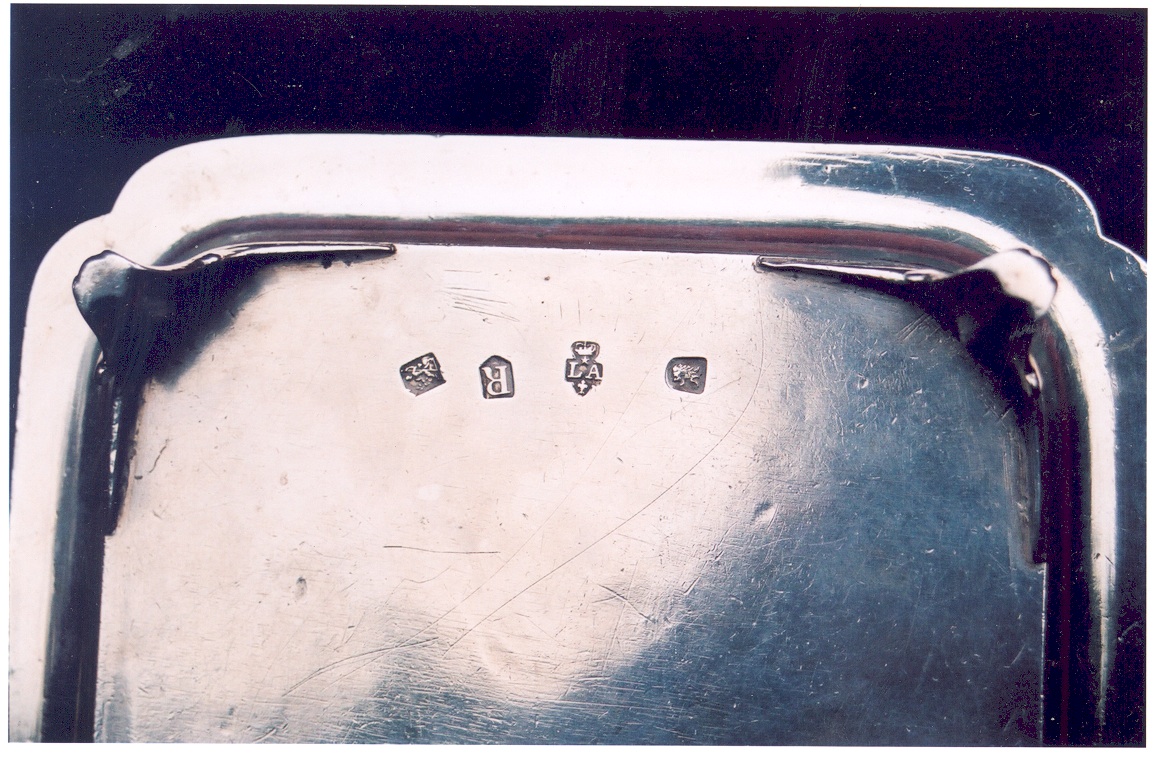
The photograph above shows four punches on a waiter. Its photographer identifies the object as a 1732 waiter by Paul de Lamerie. The photograph lets you examine the group and surrounding surface together; it is a documented example to compare, not a template that authenticates another object.
Imagine finding similar initials on a spoon: record the actual shapes and accompanying marks, check an appropriate register and compare the spoon’s construction and period. Until those strands agree with reliable documentation, “possibly associated with” is more accurate than naming the maker as a fact. A genuinely old punch on one part would not automatically establish the age or origin of every part.
Reference notes: Sheffield Assay Office; Victoria and Albert Museum.
Write a conclusion another person can check.
Observation: “Two worn letters appear inside a rectangular outline on the underside.” Possibility: “The impression may be consistent with a particular maker, pending comparison with a dated register.” Documented attribution: cite the source that connects the specific object or an appropriately documented mark to that maker, while recording any unresolved conflicts.
A close visual match alone does not prove originality, authenticity or the composition beneath a surface. A clasp may have been replaced; a lid may be associated; a reproduction may repeat an old mark. Retain alternatives and update the record when new evidence arrives rather than erasing earlier observations.
A practical record can carry three fields: what is visible on this object; the interpretation and alternatives; and the evidence that supports or challenges each interpretation. For example, a mark on a clasp is an observation about that clasp. Whether the chain has the same composition is a separate question, and an answer needs evidence from the chain itself.
When evidence conflicts, explain the conflict plainly. A different lid mark may indicate replacement or association, but it can also require more research into the relevant period and marking practice. Do not diagnose a repair, fraud or a country of origin solely from a photograph. Preserve uncertainty until a more suitable source or physical examination can resolve it.
Know when to ask for help.
For a consequential purchase or disputed attribution, bring the photographs, measurements, provenance and your competing hypotheses to an appropriate silver specialist or assay office. Ask what they examined, what their conclusion covers and whether further testing would alter the object. A surface test is not automatically a reading of a hidden core.
If the object is fragile, plated, filled or has a sensitive finish, consult a conservator before cleaning or testing. For value, choose an appraiser with experience in the object and explain the purpose of the appraisal.
Before arranging an examination, ask whether the expert specializes in the relevant region, period and object type, and whether the work is an identification, condition assessment, material test or valuation. Bring any previous reports and ask how the conclusion and its limits will be recorded. An appraisal for insurance or an estate may have a different purpose from a research attribution.
- Care for weighted and composite silver
- Find conservation and appraisal references
- Return to the identification pathway
Reference notes: Canadian Conservation Institute; Sheffield Assay Office.
Sources & further reading
Research and sources reviewed November 14, 2026. Official legal and assay guidance is separated from specialist historical references. These institutions do not endorse Collect Silver, and none has examined your item.
- Victoria and Albert Museum: A guide to metalworking techniques
Fused Sheffield plate, electroplating and museum examples of designed plated objects.
- Sheffield Assay Office: UK hallmarks and date letters
Traditional symbols and the optional date letter, including changes in 1975 and 1999.
- Canadian Conservation Institute: Silver: care and tarnish removal, Notes 9/7
Examination before cleaning, composite-object immersion risks and loss from polishing.
- Sheffield Assay Office: XRF and precious-metal analysis
Non-destructive analysis, small measurement spots and the role of calibration and trained analysts.