
Begin with observation
Describe the clue before telling its story.
Turn an object into a question, not a verdict. A join can be original construction or a later repair; different wear can reflect use, cleaning or a replacement. Photograph the whole piece and each area of interest before drawing conclusions. Do not bend, scrape, scratch, heat or chemically test it to find out.
- Joins and outlines. Look at handles, feet, hinges and seams for uneven edges, patches, gaps or solder-like material. Note where they occur; appearance alone does not identify the material, date or purpose.
- Surfaces and lettering. Record softened engraving, uneven polish, thin-looking areas, color changes and inscriptions. These may have several explanations. A dark recess may be an intended finish rather than dirt.
- Parts that belong together? Compare the fit, decoration, marks and wear of lids, clasps, bases or pieces in a service. Differences invite questions; matching details do not prove that components began together.
- Hidden complexity. Wood, glass, enamel, stones, plating, gilding, hollow spaces and old coatings can make an object sensitive to treatment. A mark on one component does not establish the material or date of every part.
Use the authenticity guide and hallmark reference to take the research further. Neither a photograph nor one visual clue can authenticate an object.
Three objects, several lives
Changes can carry evidence.
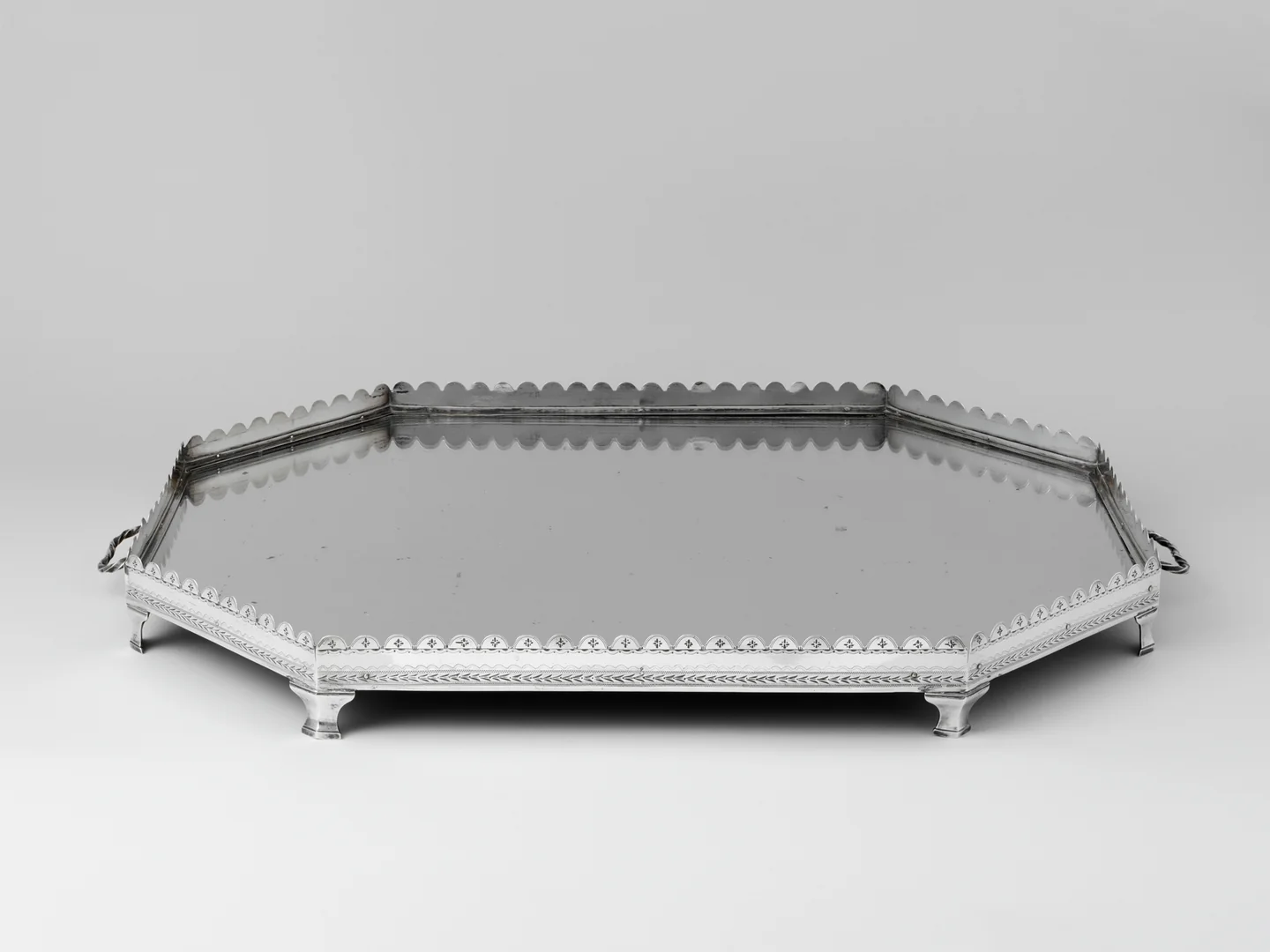
The Halsted plateau above has an octagonal mirror, silver borders and a copper base. The Met records that its twisted-wire handles were added later to make it easier to lift and carry. The museum dates the plateau itself to 1790–1805; it does not give a date for the handles. A practical addition can be documented without pretending to know when it was made.
A cup becomes a chalice
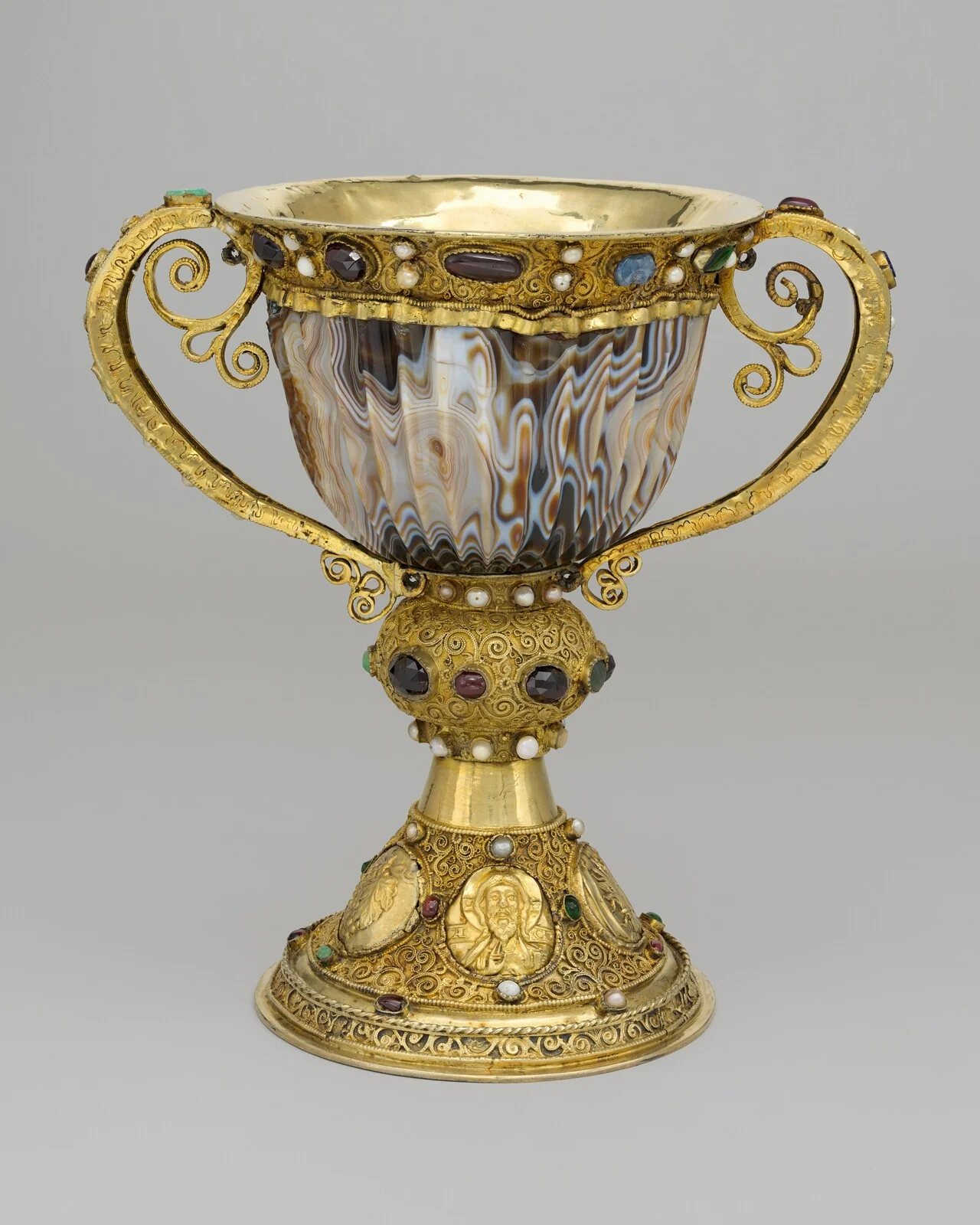
The National Gallery of Art dates the carved sardonyx cup to the 2nd or 1st century BCE and its jeweled, gilded-silver mounting to 1137–40. Abbot Suger commissioned the mounting for Saint-Denis, giving the ancient cup a new religious use. The museum records later changes and a long ownership history, while acknowledging that the cup’s provenance before Saint-Denis is unknown.
Question to carry home: Which parts and dates belong to the original object, and which belong to a later use?
A dedication arrives later
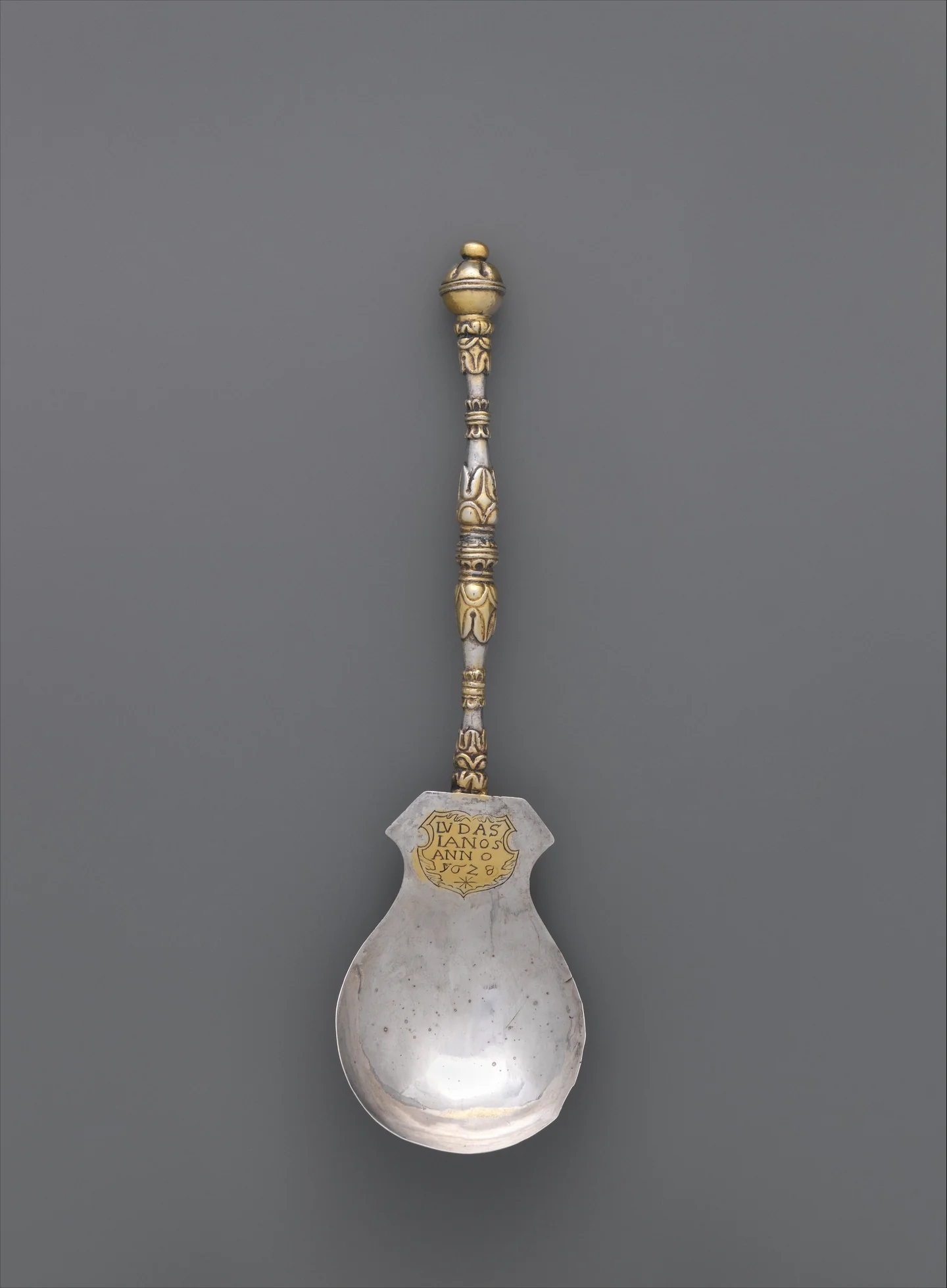
The Met dates this partly gilded spoon to the mid-16th century and identifies its origin as possibly Hungarian. Its Hungarian dedication, dated 1628, was engraved later. The inscription is evidence for a later moment in the spoon’s life, not its date of manufacture or proof of every owner.
Similarly, the Met describes its matching Gorham medallion teapot, creamer and sugar bowl as an assembled set: the teapot is engraved “Linda,” while the other two bear “T. S. B.” Describe the group as assembled when the evidence warrants it; a shared pattern alone does not establish an original commission.
Another documented change is Milwaukee Art Museum’s Revere tankard made into a pitcher. A surviving 1816 receipt records Davis Brown’s addition of a spout to a vessel made around 1760. The Chipstone Foundation suggests temperance as a possible motive, not a proven one. Its reproduction comparison is a different object, not a photograph of the tankard before alteration.
The evidence file
Make a record someone else can follow.
Give the piece an ID and use it for its photographs and documents. Work on a stable, padded surface; support fragile or loose parts without forcing them. If handling risks damage, leave the piece in place and seek help.
- Photograph the whole object. Capture front, back, sides, base and interior when safely accessible. Add close views of marks, inscriptions, joins and damage, with a wider view showing where each detail belongs. Include a scale in the frame where safe; date the images and keep the originals.
- Write what you can verify. Record dimensions with units, materials as identified or claimed, markings and their locations, condition, and any loose or separate components. Transcribe lettering as seen; mark uncertain characters rather than silently correcting them.
- Keep evidence and interpretation distinct. Separate “a gray line at the handle join” from “possibly a repair,” and identify who offered an opinion and when. Record unknowns and competing attributions. A named person in an inscription is not automatically a proven owner.
- Preserve the trail. Save receipts, listings, old photographs, correspondence, family accounts and reports with dates, sources and relevant permissions. Note who recalled a story and when. Keep digital backups and retain earlier versions when a description changes.
- Record what happens next. Keep dated before-and-after photographs and the specialist’s report, including materials, actions, reasoning and any limits. Ask for removed or replaced parts to be retained and identified when feasible.
The collection-record worksheet offers a place to start. The inherited silver guide has more on keeping family memories and documentation together.
Before buying, repairing or repurposing
Ask questions that leave room for uncertainty.
For a seller or specialist
- What is known about repairs, replaced parts, engraving, plating or past cleaning? May I see a condition report and images of the relevant areas?
- Which components are marked, and what evidence connects them? Is the set original to one commission, assembled later, or unknown?
- What documents support the maker, date and ownership history? Which statements remain family tradition or an attribution?
- Is a join stable enough for intended handling or use? What examination would help, and what are its limits?
For a conservator
- What are the options, including leaving the surface alone or stabilizing it? What evidence or material could each option affect?
- How would mixed materials, gilding, plating, a coating or a hollow part change the decision? What risks and uncertainties remain?
- What will be documented, what will it cost, and how should the object be handled or stored afterward?
A sound historical repair may interest one collector and matter differently to another. Its effect on function, desirability or price depends on the object, its condition, disclosure and the intended market; no universal percentage applies. Before resizing, engraving, combining or recycling an heirloom, document its current state and consider the evidence that could be lost. See also how silver is recycled.
Care is a decision, not a formula
Why conservators choose different approaches.
The Canadian Conservation Institute emphasizes examination and prevention: both polishing and chemical tarnish removal can take silver away. It warns about immersion of composite objects and liquid entering hollow parts, and does not recommend routine lacquer or wax.
Winterthur’s 2019 treatment paper describes different materials for different surfaces and a monitored coating program for its own collection. It also documents coating failures and the work involved in removing old coatings. That museum program is not a general instruction to coat an heirloom.
For the Walters’ gilded-silver and porcelain water pipe, the conservation team found that even its gentlest tested mechanical method removed gold. The team chose a chemical treatment for that particular object while acknowledging possible surface and aging risks. That choice does not make a silver dip safe for another piece.
Until the object and its surfaces are understood, avoid polishing, immersion, dips, coatings and attempts to repair it. Seek a qualified conservator for fragile, mixed-material, gilded, plated or historically significant pieces. The existing silver-care reference covers preventive care in more detail.
Sources & further reading
- The Metropolitan Museum of Art: Halsted plateau, 2007.471.1
- National Gallery of Art: Chalice of the Abbot Suger, 1942.9.277
- The Metropolitan Museum of Art: Spoon, 2010.110.69
- The Metropolitan Museum of Art: Gorham teapot and assembled service
- Chipstone Foundation: Revere tankard and 1816 receipt
- Canadian Conservation Institute: Silver—Care and Tarnish Removal
- Winterthur: Current Silver Treatment Practices, 2019
- O’Connor and colleagues: treatment of a Walters water pipe, 2015
- International Council of Museums: Object ID
Sources reviewed November 15, 2026. Museum inclusion does not imply endorsement.