
Silver in motion
A stag, a vessel and a mechanical wonder.
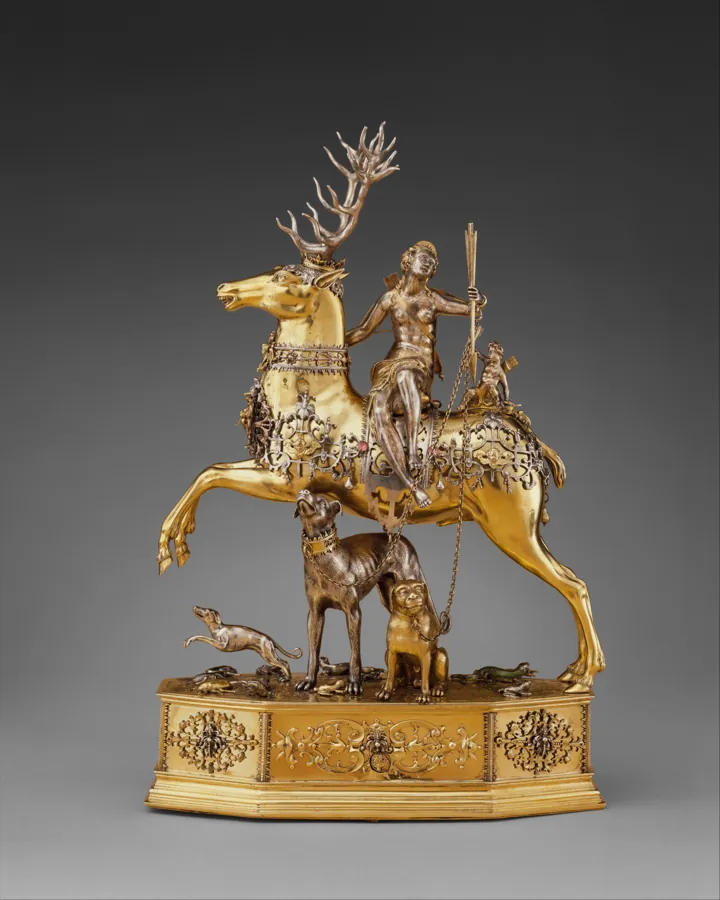
Joachim Friess, approximately 1579–1620, became a master in Augsburg in 1610. The Metropolitan Museum of Art credits him as maker of Diana and the Stag, a silver automaton dated about 1620. Augsburg was a center of silverworking and clockmaking, where elaborate table ornaments enlivened aristocratic banquets.
Diana rides a stag whose body serves as a vessel: it is hollow and its head can be removed. The piece combines a sculptural figure with a mechanical base. Such objects could move across the table as part of drinking games, joining skilled metalwork with mechanisms and performance.
The Met describes the case as partially gilded silver, enamel and jewels, and the movement as iron and wood. Several paste stones and other details are later additions. An attractive silver surface does not make the entire mechanism silver, nor does the current appearance establish that every detail is original.
From the museum collection
A closer look at Diana and the Stag
The Met’s collection record describes one surviving object; it does not establish the construction or condition of another automaton.
Sculpture that holds a drink
The Met dates this Augsburg object to about 1620 and lists its accession as 17.190.746. Diana sits on the stag, whose removable head opens a hollow body. The museum explains that the guest before whom the automaton stopped would drink from the stag.
The case combines silver, enamel and jewels, while iron and wood are listed for the movement. Record the materials of each part separately; a whole-object weight cannot be treated as its fine-silver weight.
Names & chapters
How the story developed.
- 1610
Master in Augsburg
The Met identifies 1610 as the year Friess became a master.
- About 1620
Diana and the Stag
The Met dates its mixed-material silver automaton to approximately this year.
Follow an interest
What to explore.
A historical profile based on a museum record. No object was physically examined or authenticated.
Check the details
Before you buy.
Study each component and its condition before drawing conclusions about a complex object.
Open the references
Research this name.
- Museum collection
Read the Met object record
See the material, date, collection history and museum discussion.
- Collect Silver guide
Explore silver sculpture
See Diana and the Stag among other museum examples.
- Collect Silver guide
Investigate silver authenticity
Learn to document materials and marks.
Sources & further reading
- Diana and the Stag, 17.190.746 The Metropolitan Museum of Art · Museum object record and curatorial account
The Met documents the object and its later additions. Source checked November 14, 2026.