
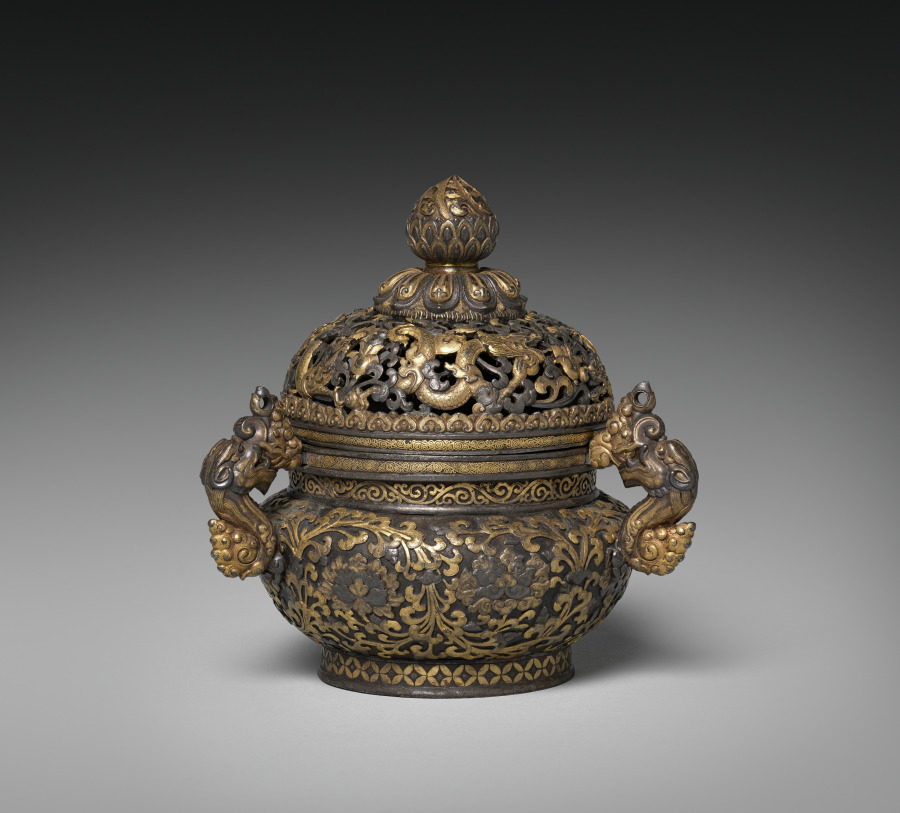
Bright curling ornament spreads across a dark, rounded body. Above it, an openwork cover rises toward a pointed finial. The contrast is immediate, but the material description is the useful surprise: the Cleveland Museum of Art identifies this burner as iron inlaid with gold and silver.
Inlay is not the body
This is not a solid-silver vessel. The record places gold and silver in an iron object, so a description that begins and ends with “silver burner” would lose the material relationship. Nor does a photograph let us assign each bright line to gold or silver with certainty. The catalogue identifies the combination; the view shows how contrasting surfaces organize it.
Pattern and openings
The museum describes three dragon-head handles, flowers in rounded fields formed by a winding creeper, a dragon on the perforated cover and a lotus-bud handle at the top. Those identifications follow the record. This frontal photograph makes the openings in the cover especially clear, while the body presents a denser field of ornament.
Trace the narrow horizontal bands around the neck, then compare them with the larger curling forms below. On the cover, dark spaces interrupt the bright pattern. On the body, the pattern runs over a continuous dark ground. Looking at those two arrangements separately is more revealing than treating every decorated surface as the same kind of work.
The object therefore belongs in a study of silver decoration without being a vessel made principally of silver. Compare the guide to silver decoration, while keeping this burner’s iron body and inlaid metals explicit. Place, period and decorative identifications above follow the Cleveland Museum of Art record.