
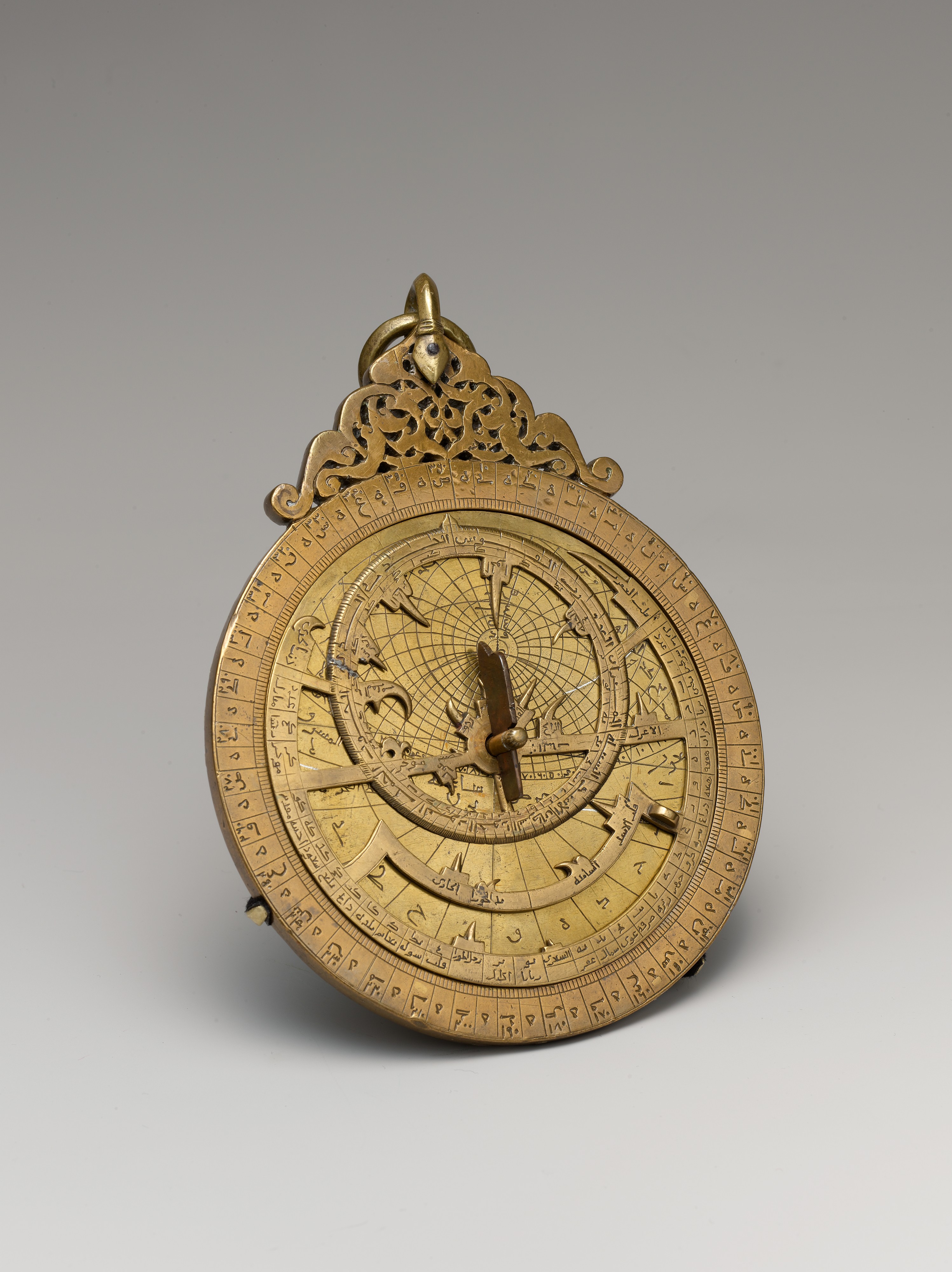
At first glance, this intricate disk could be a piece of jewelry enlarged to the scale of a scientific instrument. Look closer: pointed forms overlap a web of engraved curves, while tightly packed markings follow the rim. Beauty and measurement occupy the same small surface.
A maker with an unusually clear record
The Met attributes this astrolabe to the Rasulid prince ‘Umar ibn Yusuf ibn ‘Umar ibn ‘Ali ibn Rasul al-Muzaffari. Its inscription and a surviving scientific manuscript connect the instrument to him before his reign in 1295–96. The manuscript, held in Cairo, describes this very object and records his teachers’ approval of his ability to make astrolabes. The date is 690 AH/1291 CE, not the date he became ruler. These identifications follow the museum’s object record.
Brass first, silver inlay second
This is not a solid-silver astrolabe. The museum identifies brass worked by casting, hammering, piercing and chasing, with silver inlay. Its case measures 15.6 cm in diameter; the net and plates are 12.7 cm across. The photograph is not an assay: it cannot tell us the silver’s purity or weight.
Notice how the fine incised lines differ from the edges of the openwork shapes. The first draw across a surface; the second let you see through one layer to another. Reading those layers is more rewarding than treating the whole face as a single decorative pattern. Nor should every pale mark in the photograph automatically be called silver.
Why study the sky?
Astrolabes relate observations of the Sun or stars to calculations such as time. In the medieval Islamic world, practical needs included establishing prayer times and the direction of Mecca, alongside calendrical questions. Astronomers refined earlier knowledge from Greek, Iranian and Indian sources rather than merely preserving it. Marika Sardar’s Met essay on astronomy and astrology places these instruments within that wider scientific culture.
Here, the interest for a silver collector is not a large quantity of precious metal. It is the meeting of material, skilled workmanship and a remarkably specific human story. Compare the guide to silver decoration to keep inlay distinct from engraving and from the metal of the body itself.