
No stamp does not mean it is silverplate, and it does not make it sterling. Even when you can't read a name or number, the shape, workmanship, and family records may tell you what the piece is and who owned it. The silver content is a separate question.
Four pieces, and not one maker's stamp
The eagle on Nelly Custis Lewis's coffeepot is easy to spot. The four letters under the family crest take a closer look: L, E, P, and L, intertwined. They stand for Lawrence and Eleanor Parke Lewis. Eleanor, known as Nelly, was Martha Washington's granddaughter. She and Lawrence married at Mount Vernon in 1799. The same crest and initials appear on all four pieces of their tea and coffee service, which stayed in the family until it was given to The Met in 1980.
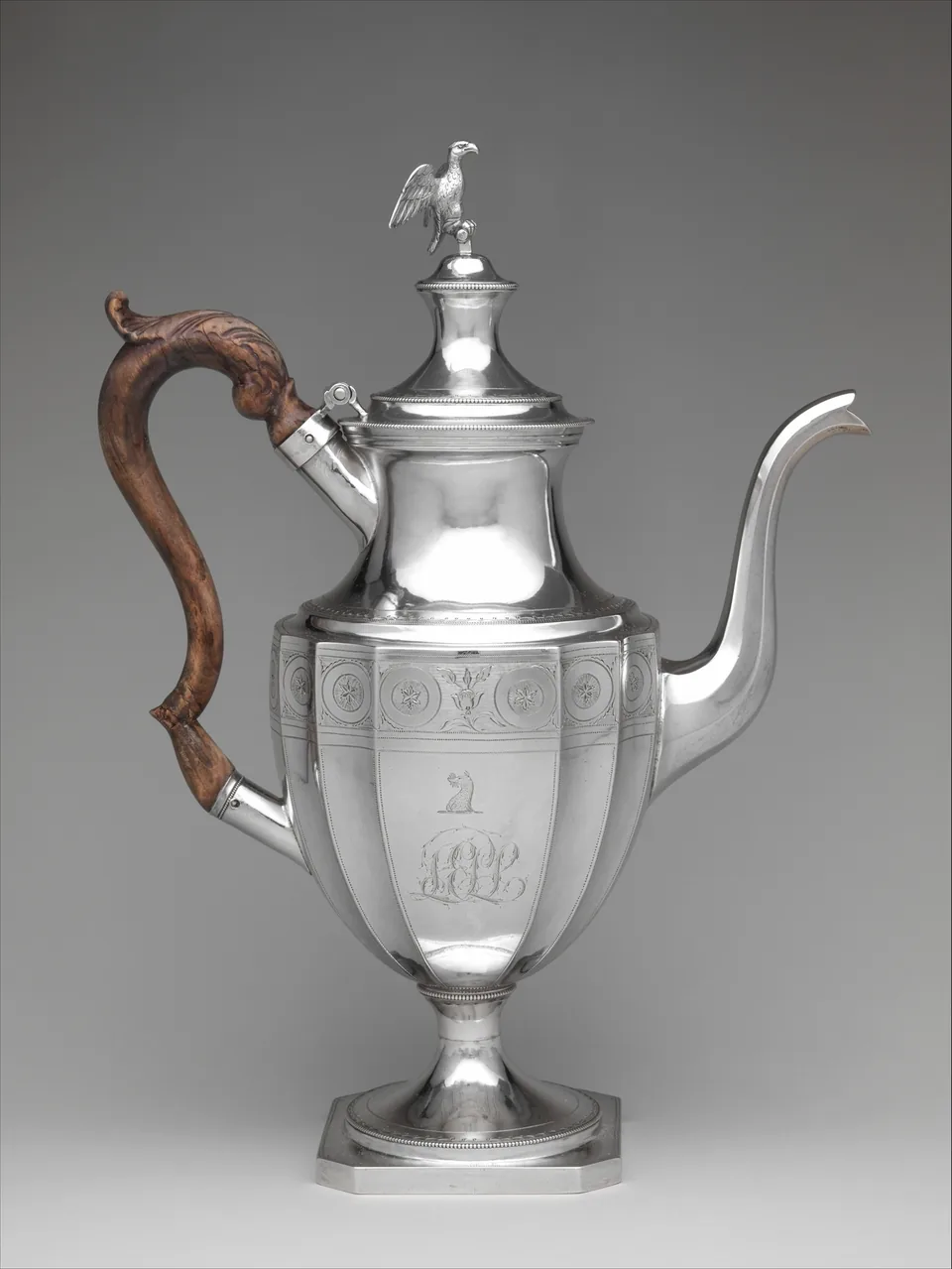
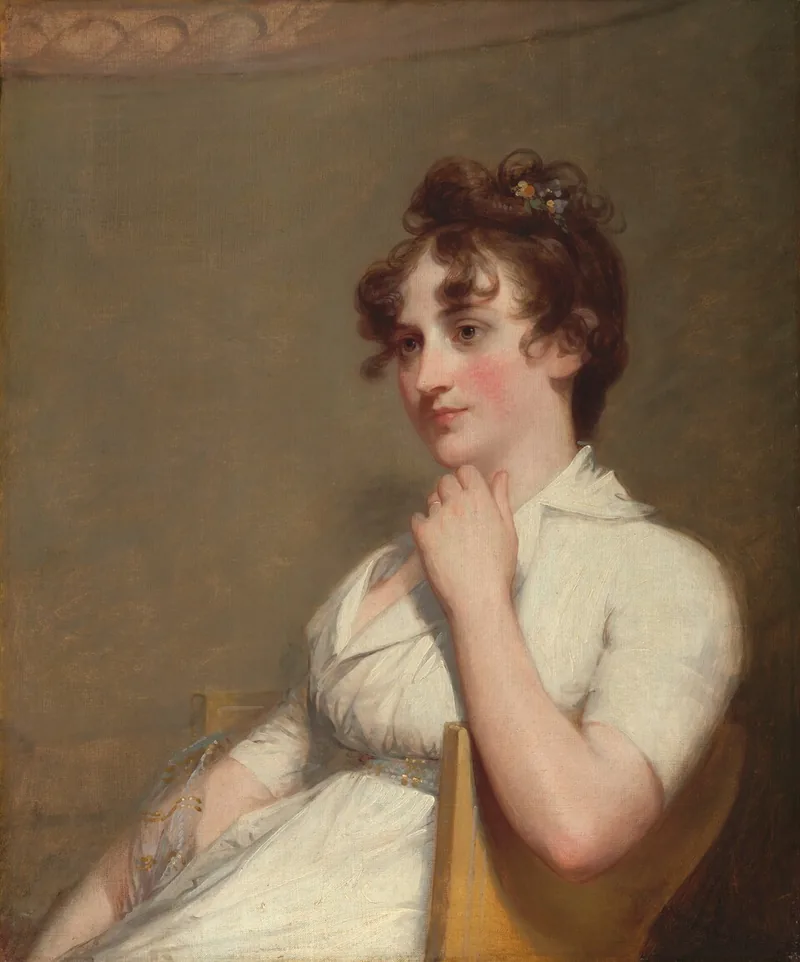
The family also passed down a story that Lafayette gave the service to the couple for their wedding. That story is worth keeping, but it's not the same kind of evidence as a receipt. The Met calls it family tradition. The descendant who gave the silver to The Met also donated Gilbert Stuart's 1804 portrait of Nelly to the National Gallery of Art six years earlier. Those museum records let us follow two family possessions separately, without needing the wedding story to check out. Behind the coffee, the wedding, and the impressive crest is a collector's familiar problem: there is no maker's stamp on any of the four pieces.
How The Met narrowed down the maker
In its catalogue, entries 86 and 87, The Met describes comparing the deep fluting and engraved bands with another service in Boston. The carved wooden handles on the Lewis coffeepot and teapot also resemble handles on pieces that do carry the Philadelphia silversmith Christian Wiltberger's mark. The eagles, on the other hand, aren't his usual finials. The curators considered other makers, and the label still says attributed to Christian Wiltberger. That's a reasoned identification, not a signature in disguise. Our guide to reading silver catalogue labels explains how to spot that distinction in other museum records. The museum lists the material as silver without giving a fineness.
What changes when a mark survives?
Hannah Rowe's 1791 tea urn offers the opposite case. The Met catalogue records REVERE stamped on the front and back of the base, and HR engraved on the body. The maker's stamp and the owner's initials do different jobs. Revere's ledger supplies a third piece of evidence: on April 20, 1791 he charged Mrs. Hannah Rowe for a silver tea urn. The three clues reinforce one another. None of them is a laboratory result for the metal. And Rowe is not the Hannah Carter from our story about Revere's overstruck marks.
What to look at before you polish anything
- Look again under angled light. Photograph the whole object and the underside, then check the foot, rim, back of a handle, and any loose lid or insert that lifts out easily. Record where each clue is. Don't force parts apart or polish to make a mark emerge.
- Write down the family story as a family story. Keep the old photo, receipt, box, or handwritten note, even if it doesn't settle the identification. A monogram can give you names to research, but it isn't an assay or a maker's stamp.
- Keep the metal question open. Exposed base metal at a worn edge can be a clue to plating; a bright surface is not proof of solid silver. If the metal matters to a purchase or sale, ask a qualified examiner whether they can distinguish coating from underlying metal on the relevant parts without damaging the piece. Until then, “no stamp found; metal unverified” is more useful than a guess.
Start with the silver marks guide if you do find lettering, or Silver Authenticity if composition is still the main question. And photograph first: as the Canadian Conservation Institute explains, polishing removes some silver and can be particularly damaging to plate.