
A long spout rises from a rounded brass body. Across the surface, pale fragments catch the light: figures, curling stems and letters, worked in silver. This is a silver-related collectible whose principal metal is brass. Its interest begins with the relationship between the two.
The Cleveland Museum of Art’s ewer, dated 1223, offers an unusually rich place to start. Its inscriptions preserve a craftsman’s name and good wishes for an owner; its present shape includes later additions. Read it closely and a seemingly simple label—“silver-inlaid brass”—opens into questions about making, patronage, geography and survival.
Silver can be the drawing, while brass supplies the body
A collecting category can follow a material’s use as well as its quantity. Here silver creates selected parts of the decoration. Calling the vessel brass inlaid with silver tells us both what supports its shape and how the precious metal participates. Calling it simply a “silver ewer” would obscure that construction.
Brass is a copper–zinc alloy. Inlay introduces a different material into prepared areas of its surface. The result asks us to notice the spaces between metals: the warm ground, the bright lines and patches, and the changing visibility of each as the object turns. The silver does not have to dominate the weight to be central to the design.
For a collection record, keep three questions separate: What is the body made of? What has been added to its surface? What is known about each component’s date? The total weight of a mixed-metal vessel is not its silver weight, and a photograph cannot establish the inlay’s purity or quantity. Collecting its craftsmanship is a different exercise from calculating a bullion holding.
A ewer with more than one voice
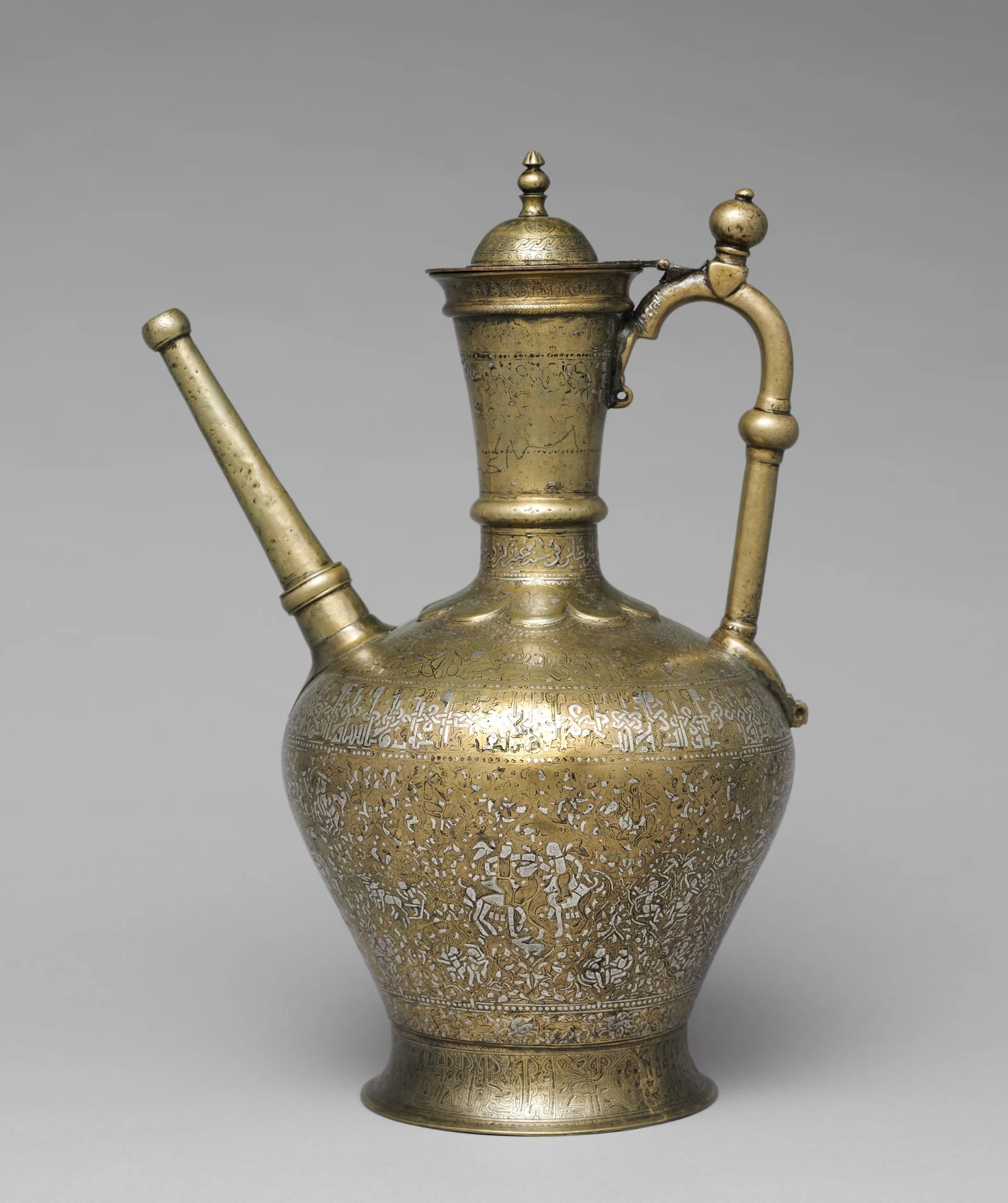
Cleveland catalogues accession 1956.11 as Luxury Ewer Extending Good Fortune to the Owner: Iraq, possibly Mosul, in the Zangid or Artugid period. The medium is brass inlaid with silver, with the lid and base added later. Its current overall height is 37.9 cm; the museum records a diameter of 26.6 cm and a base diameter of 14.5 cm. Those measurements describe the surviving assembled object, not an independently reconstructed original.
The museum identifies hunting, falconry, dancing and musicians in the lobed medallions around its body, against scrolling vegetal ornament. These are curated scenes of life and pleasure, rather than a photograph-like record of a particular event. The shoulder’s elaborate lettering adds wishes for its owner’s flourishing. Cleveland’s object record supplies the identification and interpretation.
Read the inscriptions by location
- Neck: name and date
- The museum’s transcription identifies Ahmad al-Thaki, the engraver, al-Mawsili, and the year 620. Cleveland catalogues the ewer as 1223 CE. Its modern artist heading uses the spelling Ahmad al-Dhaki al-Mawsili and the role “inscription by”; the descriptive text calls the work signed by him. These are different fields in the same record, not evidence for two craftsmen.
- Base of the handle: another signature
- A second inscription names Ahmad al-Thaki al-Mawsili. Do not confuse this location with the separately added foot.
- Shoulder: wishes, not a named commission
- The museum identifies plaited, animated kufic lettering and translates a sequence of blessings, including learning, generosity, justice and peace. This does not establish the identity of the first owner.
- Neck: later ownership graffiti
- The roughly scratched names include Husayn ibn Qasim and a second reading, Usta al-Muhtasib, marked uncertain by the museum. These later marks are distinct from the formal dated inscription.
- Foot: a later inscription
- The foot is a later addition. The museum records its naskh inscription as not yet deciphered. It should not be used to date the original body.
These readings follow Cleveland’s full catalog data; they are not a new reading of the Arabic from the photograph. The record does not date the later lid or foot, identify who added them, or supply a comprehensive conservation-treatment history. “Added later” is the supported description. It does not establish a particular restoration campaign, or mean that every other surface is untouched.
The published ownership history is also partial: the dealer Raphaël Stora sold the ewer to Cleveland in 1956; the earlier starting date in that provenance entry is unknown. That is an acquisition trail, not a complete account of its journey from a medieval workshop.
How a metal surface receives silver
The British Museum’s Blacas ewer, made in Mosul in 1232, provides a particularly clear technical comparison. Its catalog describes a body formed from hammered sheet brass, with fine silver wire worked into grooves and small silver and copper pieces set into cut recesses. Lines and broader shapes therefore need not be made in the same way. This describes the Blacas object; it is not a technical examination of every part of the Cleveland ewer.
Think of the process in three stages: form the supporting object; prepare a design in its surface; fit the contrasting metal into the prepared spaces. Engraved details can contribute to the finished image as well. On a photograph, however, a cut line, a surviving inlay and a recess that has lost its filling may be difficult to distinguish.
Inlay differs from plating, which puts a coating over a supporting metal. It also differs from niello, a dark inlay material: a museum’s description of “black compound” should not automatically be rewritten as niello. The V&A’s technique guide explains these overlapping methods and the varied use of the term damascening. That term alone does not prove manufacture in Damascus. For related comparisons, see How silver is decorated and How makers shape silver.
Why “possibly Mosul” matters
An artist’s name can connect a work to a place without settling where it was made. The name al-Mawsili associates a craftsman with Mosul; it is not, by itself, the same evidence as an inscription explicitly locating production there. That distinction matters when skills, objects and people travel.
In his study of the “Mosul school,” Julian Raby re-examined inscriptions, workshop relationships and shared motifs. He challenged an earlier proposal that placed Ahmad al-Dhaki’s workshop in Amid, and argued for close connections with other Mosul craftsmen. He also cautioned against assuming a wholesale migration of metalworkers to Syria and Egypt. These are scholarly arguments; they do not erase the qualification in Cleveland’s current catalog. See Raby, 2012, especially pp. 16–17 and 30–37.
“Islamic art” is used here as a historical and cultural field, not as a claim that every object served worship or that every maker and owner shared a faith. The Met’s overview of Ayyubid art notes that some inlaid metalwork includes Christian scenes. A vessel, a writing box and a light-bearing object can share techniques while serving different settings. Their specific records deserve more weight than a general label.
From the writing desk to the candlestick
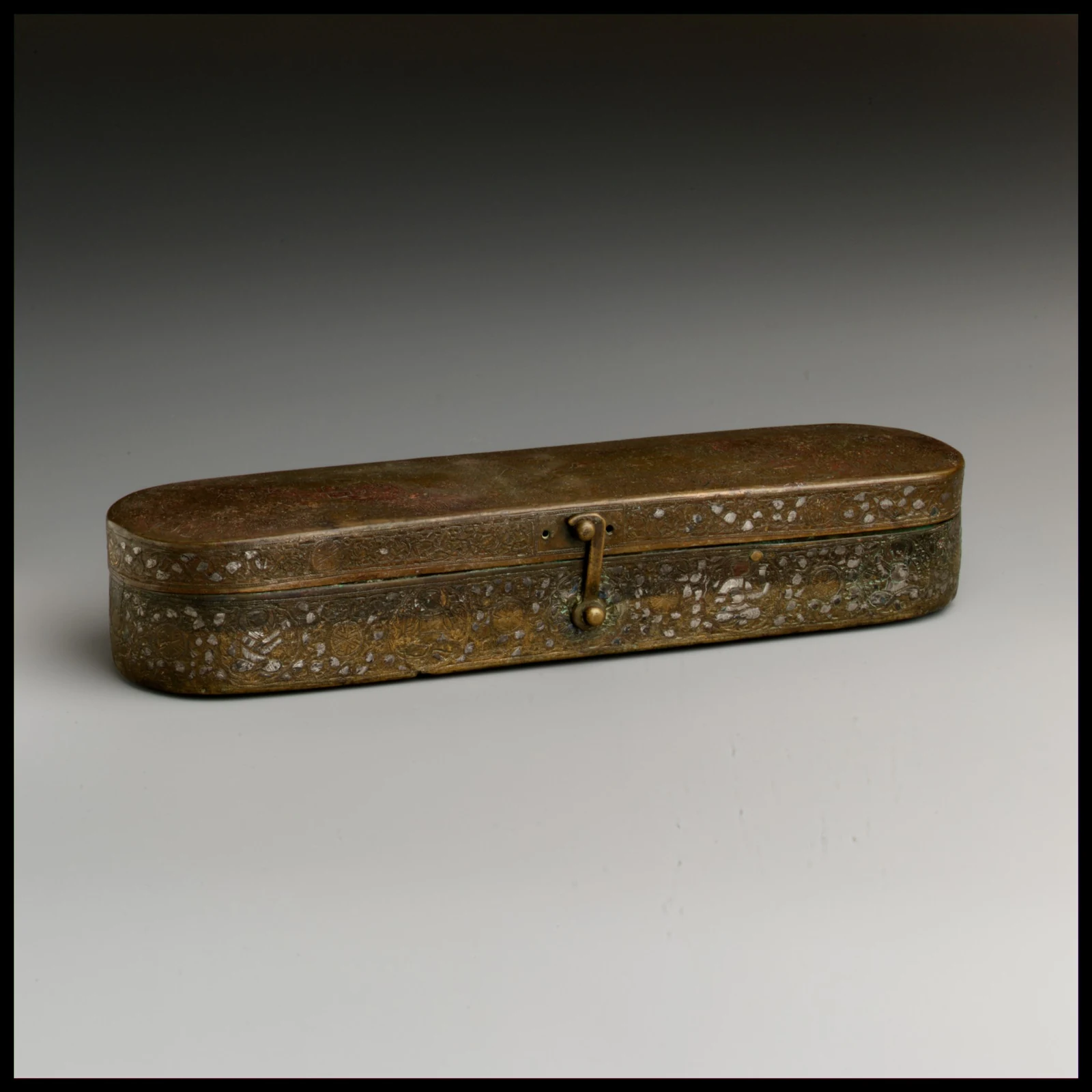
This thirteenth-century pen box is attributed by the Met to northern Iraq or western Iran, Al-Jazira. Silver decoration extends both outside and inside. Its compartments accommodated writing equipment, including an inkwell, reed pens and penknives. The museum interprets the lid’s planetary imagery as probably connected with the owner’s birth and gives the Moon a protective significance. That proposed meaning is an interpretation, not an identified owner’s surviving explanation. The closed view shown here does not display the interior.
Compare the long, low box with the ewer’s swelling volume. On the box, the ornament follows a compact container held near the hand; on the ewer, it wraps around a vessel. The shared material description accommodates very different forms. Our engraving guide helps distinguish a cut design from an added filling.
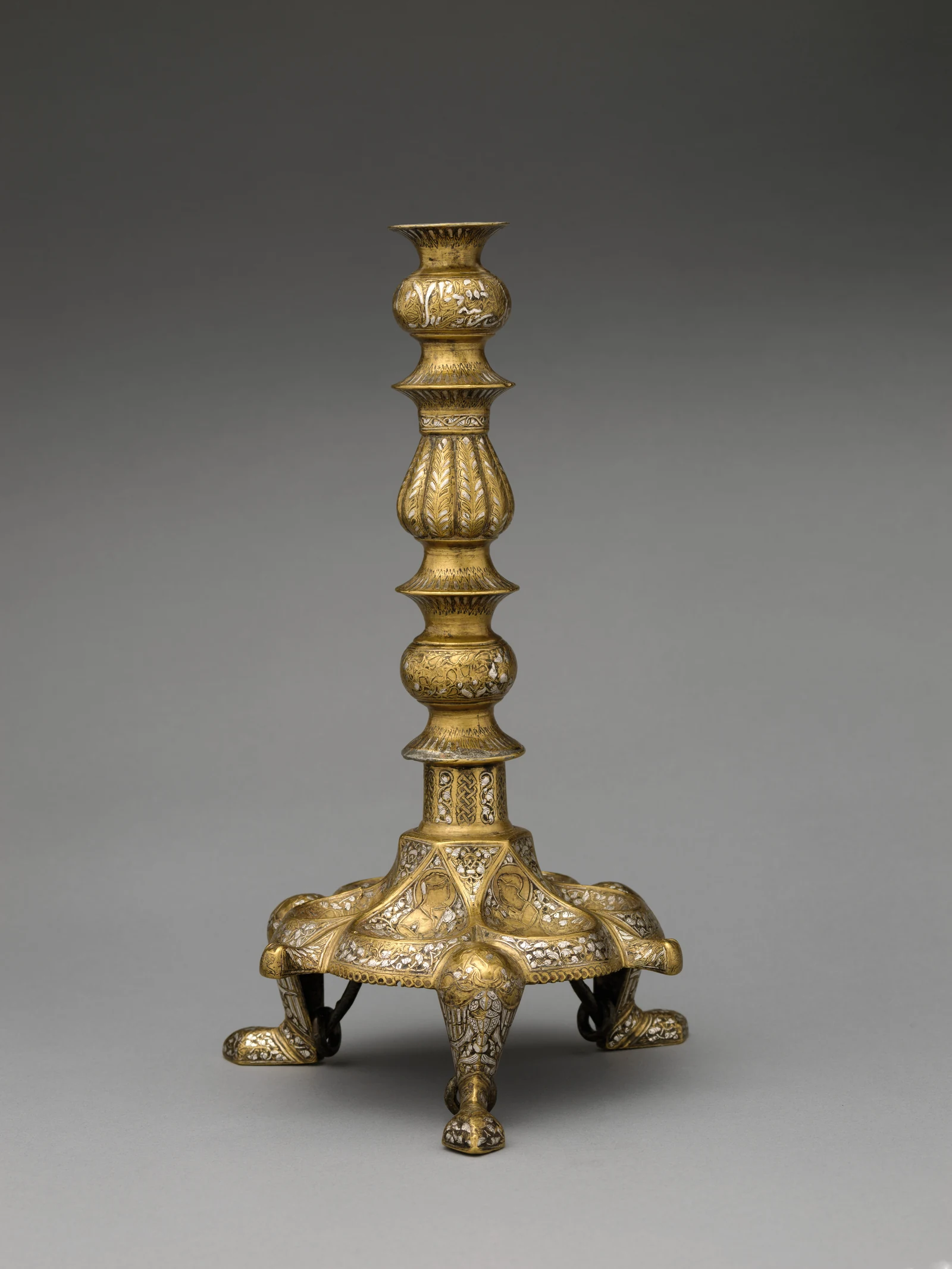
The Met dates this tripod candlestick to 1250–1300 and attributes it to probably Syria or northern Iraq. Its brass carries silver, gold and black compound. The museum identifies its patron as Sharaf al-Din ‘Abd al-Rahman, an affluent Mamluk, but describes the stacked forms on the stem more tentatively: perhaps flower vases or mosque lanterns. The patron attribution and the proposed visual resemblance have different levels of certainty.
Look first at the three feet and the alternating narrow and swelling sections. Then follow the small areas of ornament. Silver participates in the surface without turning the entire object silver-colored. Nor does the possible resemblance to lanterns establish that this candlestick stood in a mosque.
A surface can have a second history
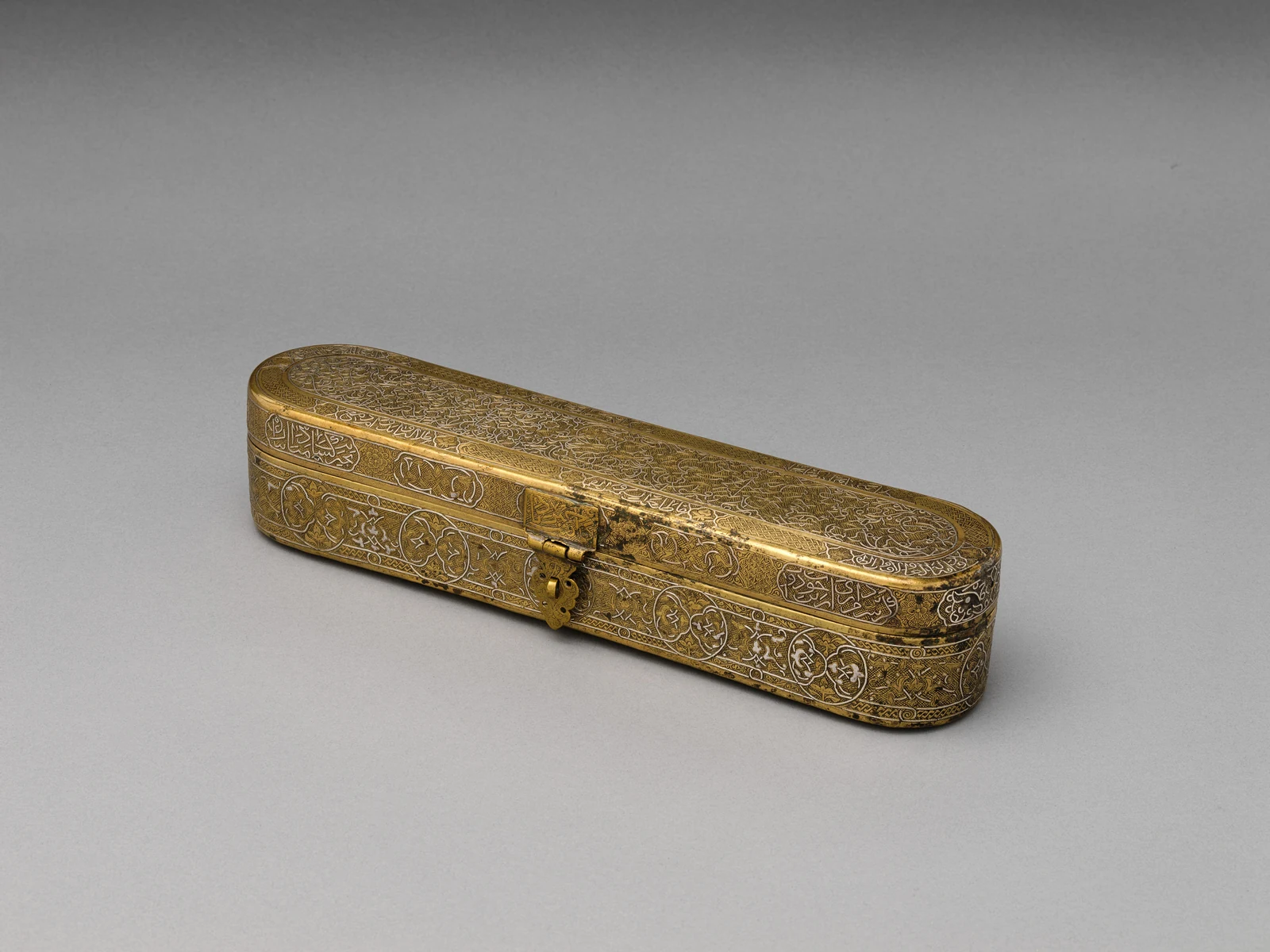
The Met’s inscribed pen box, 91.1.536, makes alteration part of the story. Its catalog date spans the fourteenth century, with changes shortly before the mid-fifteenth; the descriptive text more specifically calls the original box late fourteenth century. The geography is layered too: probably originally northern Iraq or western Iran, with an attribution to Afghanistan, probably Herat.
The museum reports that the exterior was burnished to remove earlier decoration and then redecorated; the inside preserves evidence of the earlier design. The inkwell and its surrounding insert came later still. Its recorded materials include silver, gold and black compound on brass. The exterior photograph shows the object’s present appearance, not a view of all these phases at once.
Beside Cleveland’s later lid and foot, this box makes a useful point: an object date need not date every feature now visible. Replacement, redecoration and repair are different claims. Record the institution’s precise wording, and leave unanswered questions open rather than supplying an appealing history.
A later comparison: Deccan bidri, early eighteenth century
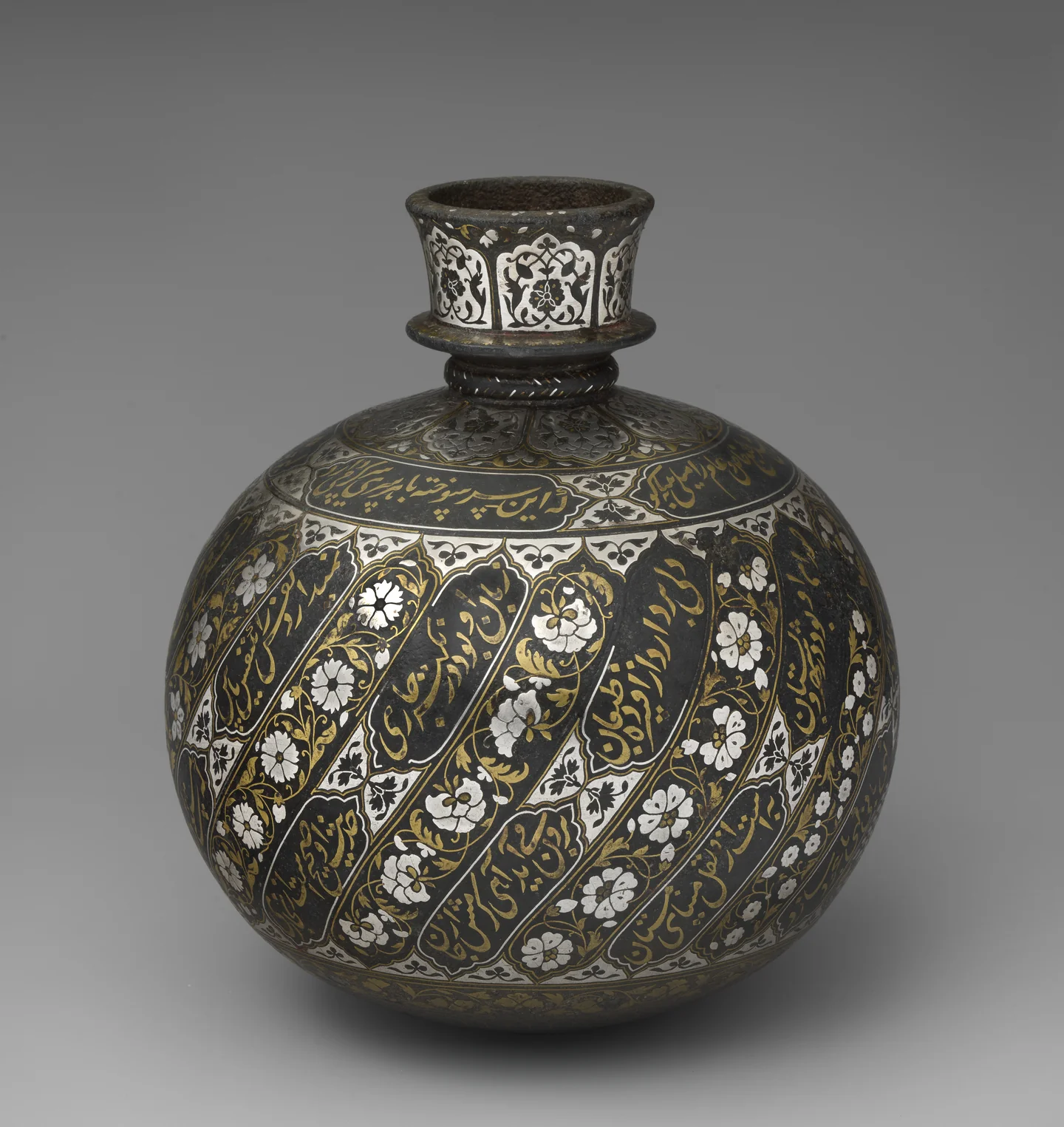
This water-pipe base is not medieval. The Met dates it to the early eighteenth century and locates its manufacture in the Deccan, India. It offers a later comparison in the use of contrasting inlaid metals, not evidence of the same workshop or a direct line of descent from the objects above.
The dark body is zinc alloy, not solid silver. The museum identifies the added metals as silver and brass and calls the technique bidri ware. The pale flowers and warmer-toned lines make that contrast visible, but the photograph alone cannot establish the composition of every individual line. No maker is identified in the museum record.
The Met describes Persian verse about tobacco among the decoration. This photograph shows the exterior of the base, not a complete assembled water pipe or a documented history of its use. Keep the museum's material identification separate from what a single view can demonstrate.
Source for this later comparison: The Metropolitan Museum of Art, 2003.271, checked 16 November 2026. The primary public-domain photograph is shown full-frame with proportional resizing; no crop or retouch has been applied.
What to carry into your own looking
- Start with construction. Name the supporting metal separately from inlay, coating, attachments and fillings.
- Locate the evidence. A shoulder inscription, handle signature and scratched ownership mark can tell different stories. Record where each occurs.
- Keep dates attached to components. An original body, replaced foot and altered decoration may require separate entries.
- Describe before interpreting. A pale area is visible; its composition, age and reason for survival require more evidence. A photograph does not authenticate an object.
- Ask for the history behind the surface. Catalog entries, condition reports and documented ownership can answer questions that a polished appearance cannot.
Use Documenting collectibles to organize that evidence. A careful record can preserve uncertainty without diminishing an object’s interest. In these works, silver’s role is precise and expressive: it gives another metal lines, images and words.
Sources & further reading
Object identifications, dimensions and qualifications follow the linked museum records, checked 15 November 2026. Photographs are the museums’ own open-access images; they have been proportionally resized for this article. No documentary image has been generated or reconstructed.
- Cleveland Museum of Art, 1956.11, including its full API record for inscriptions, provenance and bibliography.
- The Metropolitan Museum of Art: Pen Box, 89.2.194; Tripod Candlestick, 91.1.572; Inscribed Pen Box, 91.1.536.
- British Museum, Blacas ewer, 1866,1229.61, for a documented technical and geographical comparison.
- Julian Raby, “The Principle of Parsimony and the Problem of the ‘Mosul School of Metalwork’,” 2012, pp. 11–85 in Metalwork and Material Culture in the Islamic World. The Smithsonian-hosted version provides the chapter and bibliography.