
More than an inkpot
An inkstand is easiest to understand as an arrangement rather than a single container. The interesting question is not just where the ink went, but what the other compartments allowed a writer to do. A vessel with holes in its lid need not have served the same purpose as its neighbor.
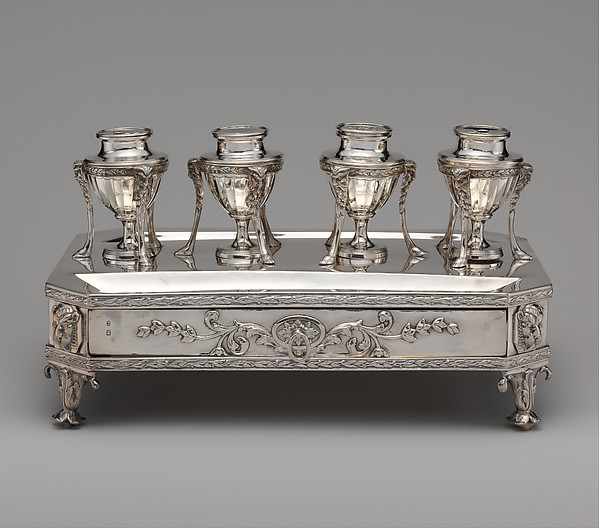
John Plimmer’s London inkstand of 1802 offers a particularly legible example. The Metropolitan Museum of Art catalogues it as silver, 33.5 centimeters wide. Four vase-shaped containers sit above a rectangular base. The museum identifies two with openings for pens and ink, a third with a perforated cover for sand used to dry ink, and a fourth that probably held sealing wafers. Deep slots run along the long sides; a separate tray accommodated other writing equipment.
The word “probably” matters. An object can preserve its compartments more clearly than their former contents. The catalogue supplies a functional reading, not a surviving inventory of what someone kept inside.
Drying is not sealing
Sand and sealing wafers belong to different stages of handling a written sheet. In the Met’s account, the sand helped dry the ink. The wafers proposed for the fourth vessel would instead have helped close a letter. Neither function should be confused with keeping a pen supplied with ink.
What was a sealing wafer? A National Archives conservation account describes a thin adhesive disc made with starch, binders and pigment. Moistened and pressed between surfaces, it held papers together. A small red seal on an old document therefore need not be wax. The Archives illustrates wafers not only closing or joining papers but securing documents within other records. That broader history explains the usefulness of a wafer compartment without proving that Plimmer’s particular inkstand contained them.
Imagine the practical sequence rather than a particular writer: a wet line, a pause to dry it, then a sheet folded and sealed. Read the four vessels as a sequence of tasks, but resist inventing a biography around them. We do not have a named writer or a letter connected to this object. Its fittings make the work of correspondence imaginable without giving us permission to supply the correspondence itself.
A small workshop, a complex object
The Met notes that Plimmer appeared as a “small worker” in a 1773 Parliamentary report. It also suggests that relief elements could have come from a supplying silversmith, while the vessels were within his workshop’s capabilities. Possible trade supply is not a documented subcontract.
Even a decorative detail can have a job: the Met identifies the front ring as a drawer pull, framed by a rosette. Ornament and equipment meet in the same small feature.
For a collector, that distinction is useful beyond this one desk object. A maker’s name does not automatically identify the hand behind every component. Nor does a suggestion of shared production make a piece less coherent. The question is which parts of the manufacturing story the evidence actually establishes.
Keep the parts and the questions together
When documenting an inkstand, make a separate note for each pot, lid, visible slot and tray. Photograph what can be seen safely; do not pry fittings apart to complete a checklist. Record missing or inaccessible views as such. Similar decoration alone does not prove that every loose part originally belonged together.
Separate observation from interpretation: “perforated lid” describes a visible feature; “sand container” records an identification. “Probably for wafers” preserves a reasoned uncertainty rather than converting it into a fact. The documentation guide’s Coney inkstand study offers another way to organize the object record.
A boat-shaped inkstand from Jaipur makes a revealing comparison. There, a writing object becomes a miniature scene; here, the distinct jobs of the desk remain the central puzzle. Compare the silhouettes: Jaipur’s pavilion breaks the outline like a building in a miniature landscape; London’s row repeats four related vessels. What looks like a scene in one becomes a set of tasks in the other.
Sources
The Met’s object record supplies the object identification and qualified account of its fittings and manufacture. Rachel Bartgis’s National Archives account supplies the general history of adhesive wafers, not a provenance for this inkstand.