
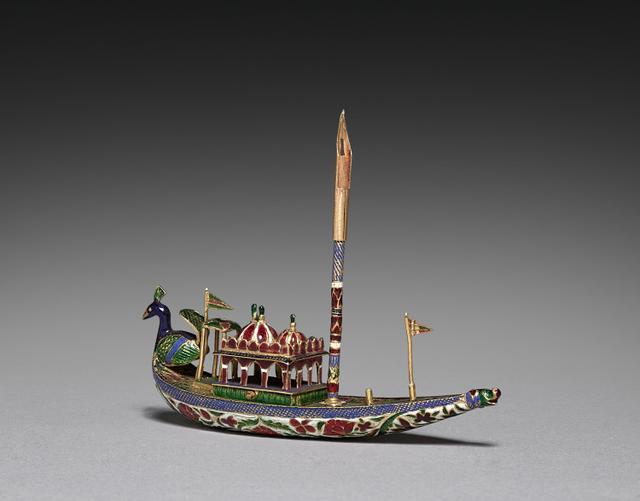
A long, narrow hull carries a small pavilion beneath a tall upright element. Tiny flags interrupt the outline, and a bird-shaped end rises above bands of green, blue, red and white. The boat is easy to recognize in this photograph. Its purpose is less obvious: the Cleveland Museum of Art catalogues it as an inkstand.
A silver core beneath the gold
The museum specifies a silver core covered in gold leaf. That is a description of layered materials, not a solid-gold object. The enamel supplies another part of its appearance. Neither the golden edges nor the saturated colors in this view disclose the thickness of those layers or the metal’s purity.
Look first along the hull: light-colored fields separate red and green ornament, while a darker blue band follows its upper edge. Then move to the pavilion, where narrow supports alternate with open spaces. Keeping color, contour and structure in separate notes makes it easier to describe what is present without treating a bright highlight as a material test.
A writing object imagined as a pleasure boat
The museum connects the fanciful boat form with poetry, calligraphy and sensory pleasure. It also describes a lotus on the underside, relating the floating flower both to imagined water and to ink inside the vessel. That underside is not shown here; the lotus belongs to the catalogue evidence, not to an observation made from this photograph.
There is a second boat in the object’s history. The museum says Jeptha Homer Wade II and Ellen Garretson Wade bought the inkstand while touring India aboard their pleasure boat, Wadena. This records a purchase, not a commission or an identification of the inkstand’s original user.
Keep the view and the record together
The museum associates the inkstand with Jaipur and labels its date “1800s.” No maker is identified in this study. When documenting a similarly elaborate writing object, record its function alongside its depicted subject: “boat” describes the form, while “inkstand” describes the catalogued use. Keep unphotographed surfaces explicitly unexamined rather than guessing at their decoration or condition.
Explore silver decoration for other ways materials and surfaces interact, or use the documentation guide to organize separate views. Material, place, date and interpretive statements above follow the Cleveland Museum of Art record.