
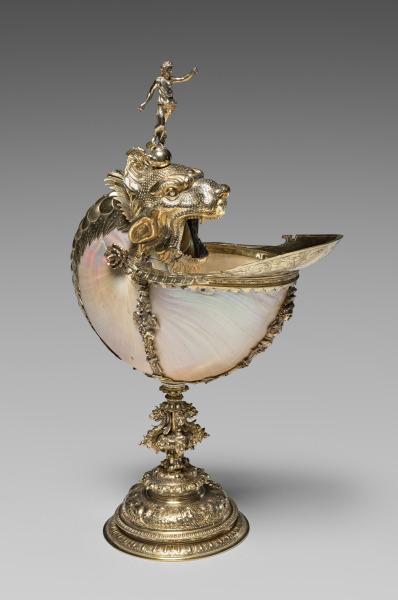
Start with the pale curve at the center. Then follow the warm-colored metal around it, down the stem and out across the circular foot. This cup is not a single material worked into a shell shape: a real shell and an elaborate metal mounting meet in one object.
The record behind the photograph
The Cleveland Museum of Art identifies the maker as Cornelis Jansz van der Burch, working in Delft, and dates the cup to 1607. Its materials are silver-gilt and nautilus shell; its overall height is 33.3 cm. The gold-colored mounting is therefore catalogued as gilded silver, not solid gold.
The museum explains that nautilus shells reached the Netherlands from Indonesia and were mounted by Dutch silversmiths for wealthy collectors. It associates early Dutch examples particularly with Delft and notes their dramatic sea-monster heads. That broader history is context for this cup, not a complete record of this individual shell’s journey.
Three places to pause
The shell: its broad, luminous surface contrasts with the closely patterned metal. Look at the changing color rather than expecting a uniform white.
The opening: a toothed head rises above the rim while a small standing figure crowns the composition. Compare their silhouettes with the smooth sweep of the shell below.
The support: follow the narrow stem to the spreading foot. The object becomes visually wider at the bottom, while dense ornament continues around the base. A single photograph shows that arrangement, but not every attachment or the underside.
What the view cannot settle
Separate visible features from questions that need examination. Where do the mounts meet the shell? Are joins, repairs or losses recorded? What does the underside reveal? This photograph does not establish the silver’s fineness, the gilding process or the condition of concealed areas. A striking silhouette is the beginning of an object record, not a substitute for one.
Continue with gilding and other silver surfaces or documenting a collectible. Compare the photograph with the museum’s object record for its catalogued identity and materials.