
The unveiling
On May 30, 1893, a woman identified in a newspaper report as Mrs. Rickards pulled a silken cord in Chicago’s Mines and Mining Building. The American flag slipped away from the figure it covered. The band played “America,” and the crowd cheered. The actress Ada Rehan had lent her likeness to the figure, but the woman standing in front of the crowd was not Rehan. She was Montana’s silver statue of Justice, sword in one hand and scales in the other. The Dalles Daily Chronicle’s report of the unveiling
Ten years later, Justice turned up in the newspaper again. There was no band this time, not even a long article. A few lines in an Illinois paper said she had been sent to a smelter.
Three metals in one exhibit
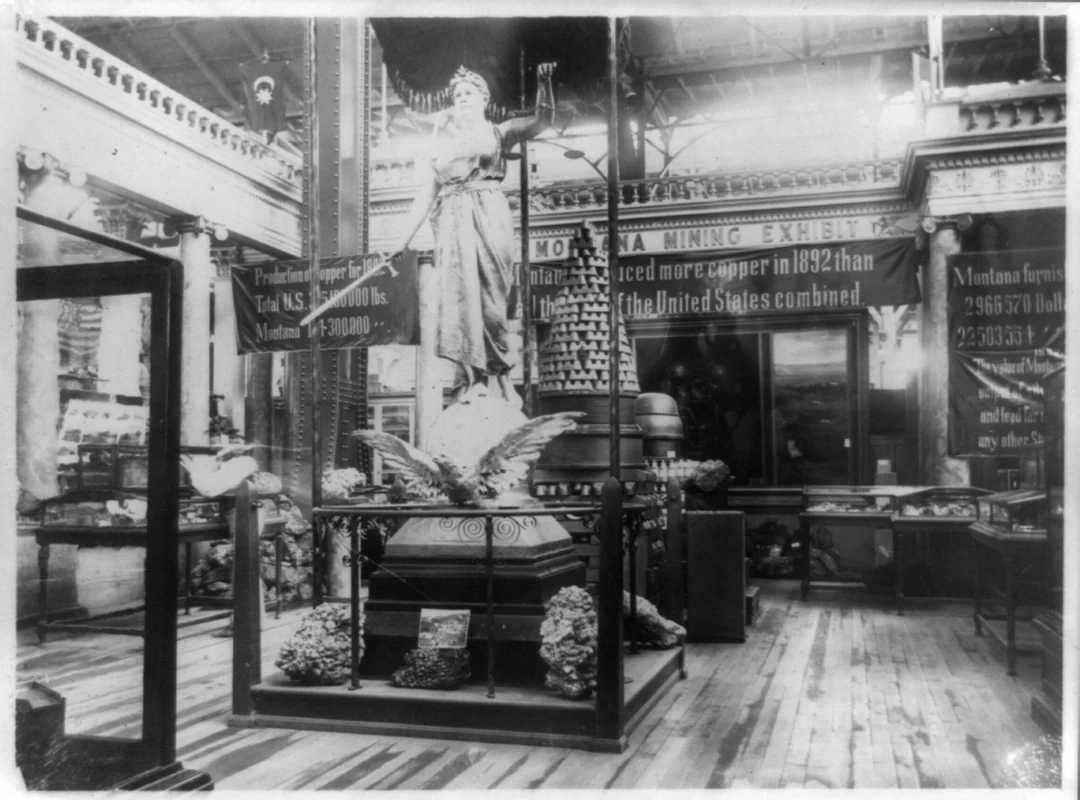
Justice didn’t stand on the bare floor of an exhibition hall. The surviving photograph shows her high above the glass cases and the railing, standing on a globe that rests on an eagle. Behind her, banners tout Montana’s mining output and a stack of copper bars rises about as high as the eagle’s perch. Even in black and white, there is plenty to look at before you ever read a number off a sign.
The contemporary Book of the Fair describes a separate gold plinth above the ebony portion of the pedestal. Silver made the figure; gold lifted it; copper stood behind it. A visitor could then turn to the actual rocks and ores arrayed nearby. The statue gave Montana’s mining exhibit something a case of samples could not: a sight someone could describe to a friend and send them off to find.
Period accounts offer differing estimates and do not always specify the same parts of the display. The figure, globe, eagle and separate plinth are not interchangeable measures. We don’t have a verified net weight for the finished statue to put on a modern list of sculpture records. March newspaper account · Later unveiling coverage
The actress and the scales
The sculptor was Richard Henry Park, whose work in Chicago also includes the Benjamin Franklin monument in Lincoln Park. For Justice, he had a model who knew how to hold the attention of a room: Ada Rehan, an actress with an international reputation. The Book of the Fair identifies her as the model, not as a sculptor or donor. The distinction matters because newspapers sometimes used her name as shorthand for the object itself. The report that sends Justice to the smelter, for example, calls her the silver statue of Ada Rehan. Chicago Park District · The Book of the Fair
There was one more thing to notice once you had looked up at the figure. The scales were not empty. The Mining History Journal describes them as holding gold coins on one side and silver coins on the other, in balance. In 1893, Congress was arguing over whether to repeal the Sherman Silver Purchase Act. You don’t have to read the statue as a formal declaration about money to see why that pair of metals, visibly poised against each other, would have meant more than a cast set of empty pans. Mining History Journal, pp. 34–35 · Contemporary newspaper coverage of the repeal debate · Collect Silver’s silver dollar guide
From the fair to the furnace
The display didn’t stay together once the fair closed. According to the Mining History Journal, the gold base went back to its donor and Justice toured for a few years on a copper base. The statue could still be presented to crowds, but in 1896 a legal dispute opened between the two men who owned the silver. Their interest was in the same metal, even if that metal happened to have a face, a sword and scales. Mining History Journal, p. 35
On November 6, 1903, the Chatsworth Plaindealer reported that Justice had been taken to an Omaha smelter to be reduced to bullion. That is the date of the report, not necessarily the day the statue went into the furnace. The later mining history supplies the outcome: a 1903 agreement led to the statue being reduced to bullion and the proceeds split. November 6, 1903 newspaper · Mining History Journal, p. 35
By then, there had long been another way to bring Justice home. The mining history notes that Montgomery Ward offered two sizes of replica in 1895, one for $2.95 and one for $6. A small figure on a shelf, if one of those turns up, should not be confused with the original display. The photograph at the top is a different kind of survivor. It shows Justice while she was still standing over those rocks and cases, before its owners divided the proceeds from its silver instead of keeping the figure intact. Mining History Journal, p. 35