
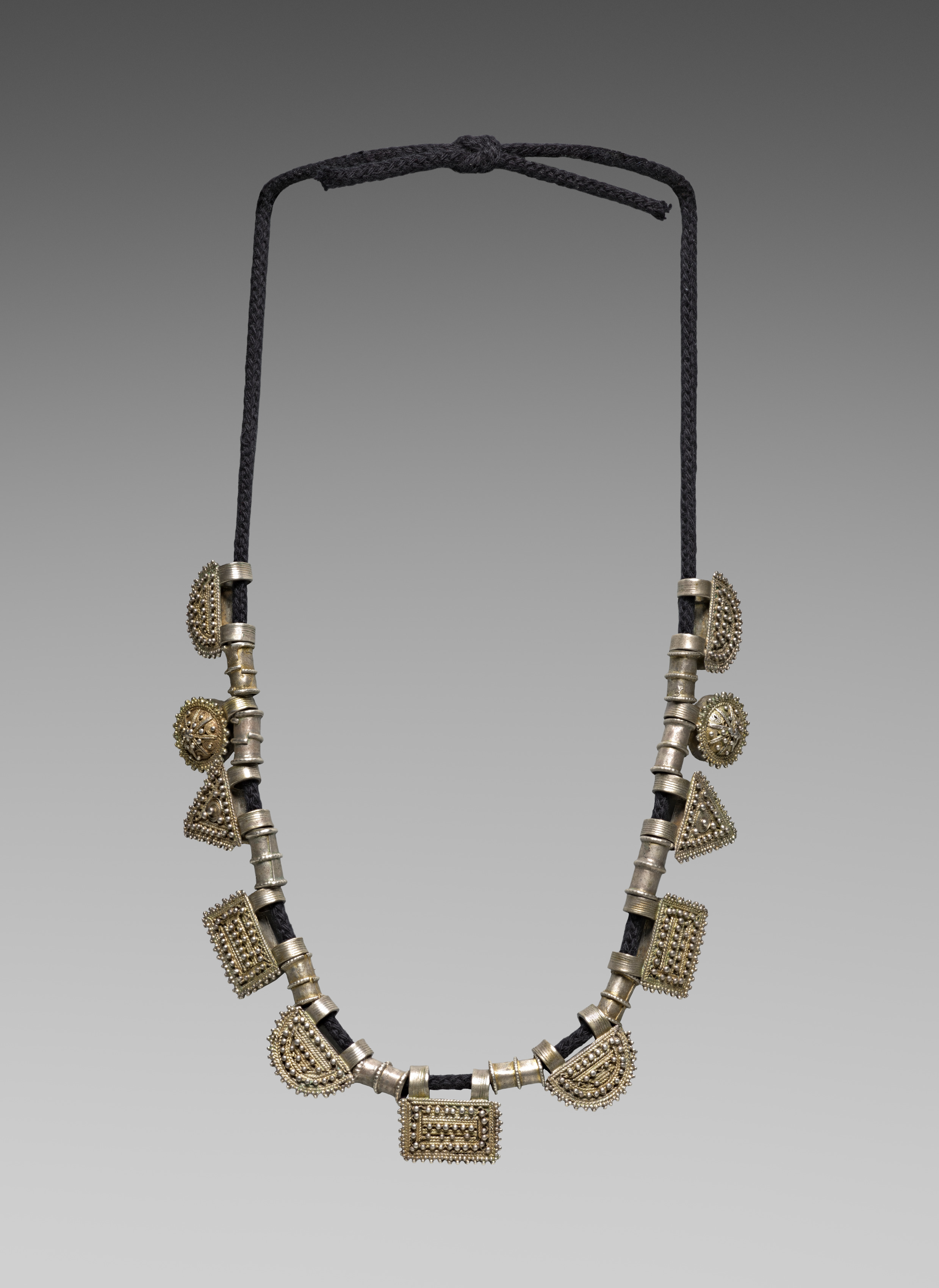
A dark cord draws a long loop around an open center. Along its lower half, bright forms gather in pairs: rounded shapes, triangles, rectangles and semicircles. A rectangular pendant marks the lowest point. From a distance, the arrangement feels orderly; close up, each surface breaks into rows of tiny rounded details and curling lines.
Jewelry intended as protection
The Cleveland Museum of Art identifies the pendants as tälsäm, amulet boxes intended to protect against the evil eye and other dangers. Its interpretation connects them with Islamic amuletic practices, in which such boxes could have meaning with or without texts inside. This is a description of belief and use, not a claim that we know what these particular boxes contain.
A maker whose name is not recorded
The museum dates the necklace to the late 1800s or early 1900s and identifies an unknown Ethiopian silversmith. It describes the material as silver alloy. That does not establish a sterling standard or a precise silver percentage.
The record associates the fine filigree and granulation with both Harar and Aksum, the latter an Ethiopian Orthodox Christian city. This comparison does not identify the necklace’s exact workshop, maker’s faith or original wearer. Keeping those distinctions preserves the difference between a useful cultural context and a documented personal history. These descriptions follow the museum record.
Look between the pendants
The small cylindrical spacers deserve attention too. Their simpler surfaces interrupt the dense ornament, while short stretches of dark cord keep the individual shapes legible. Try following only the outline of the necklace, then only the pattern inside one pendant. The first view reveals its overall rhythm; the second reveals how much variation fits into a small area.
Notice also that the photograph shows the cord continuing far above the metalwork. The undecorated space is part of the visible composition, not a missing section to be filled. A tightly cropped detail could show more texture while losing that relationship.
For a collector, the invitation is to appreciate the whole assembly without making its unknown history more certain than the evidence allows. Compare the guide to silver decoration for other objects where small-scale surface work changes the experience of the larger form.