
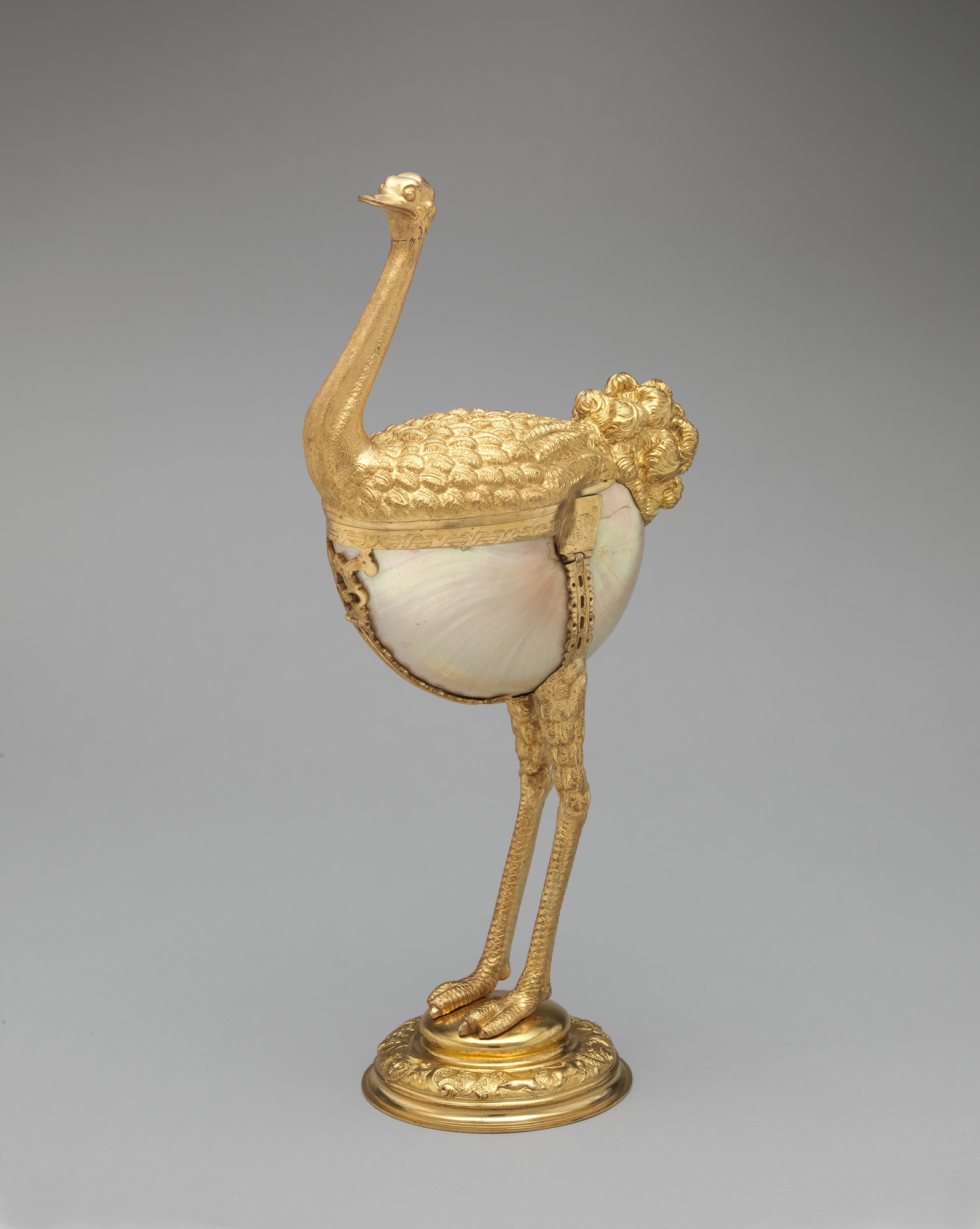
A long-necked bird rises above a pale shell, while two narrow legs support the vessel on a circular foot. Feather-like relief covers the top and curls into a tail. The shell becomes the bird’s rounded body: natural form and metal ornament work together to make the silhouette legible.
The date belongs to this object
The Met identifies the manufacturer as Elkington & Co. of Birmingham and describes this electrotype as a 19th-century work after a 17th-century original in the Kremlin treasury, Moscow. The earlier date belongs to the model, not to this cup. A reproduction can preserve an older design while remaining evidence of a later workshop and audience.
Start a catalogue entry with the object in front of you. Put the model’s date in a separate field or phrase, rather than allowing the oldest date in the record to stand for the whole. “After” describes a relationship; it does not erase the interval between two acts of making.
Why a museum collected reproductions
The Met’s historical account of electrotypes explains that such reproductions were among its early European decorative-arts purchases in the 1870s and 1880s. They helped bring ambitious historic goldsmiths’ work before the public and offered models for artists and manufacturers. Electroforming deposited metal into a mold using an electrical charge. This is broader context, not a claim that this particular cup was purchased in those early groups. Read the Met’s exhibition overview.
Appearance is not the material record
The catalogue’s wording is “silver on base metal; nautilus shell,” not solid silver. Warm-colored metal in a photograph does not override that description or establish a separate gilding history. Look at the contrast between the smooth shell and the patterned cover, then distinguish the visible effect from the recorded materials.
Compare the arrangement with Cornelis Jansz van der Burch’s 1607 nautilus cup. Both studies bring shell and metal into one vessel, but the Cleveland cup is not identified as the model for this Elkington work. The Met names a different original in Moscow. The comparison is about how a shell is framed, not a proposed chain of copying.
Keep those three records together but distinct: this object’s date, its stated relationship to an earlier model, and its materials. That is more useful than treating an old-looking form as proof of age or a bright surface as proof of substance.