
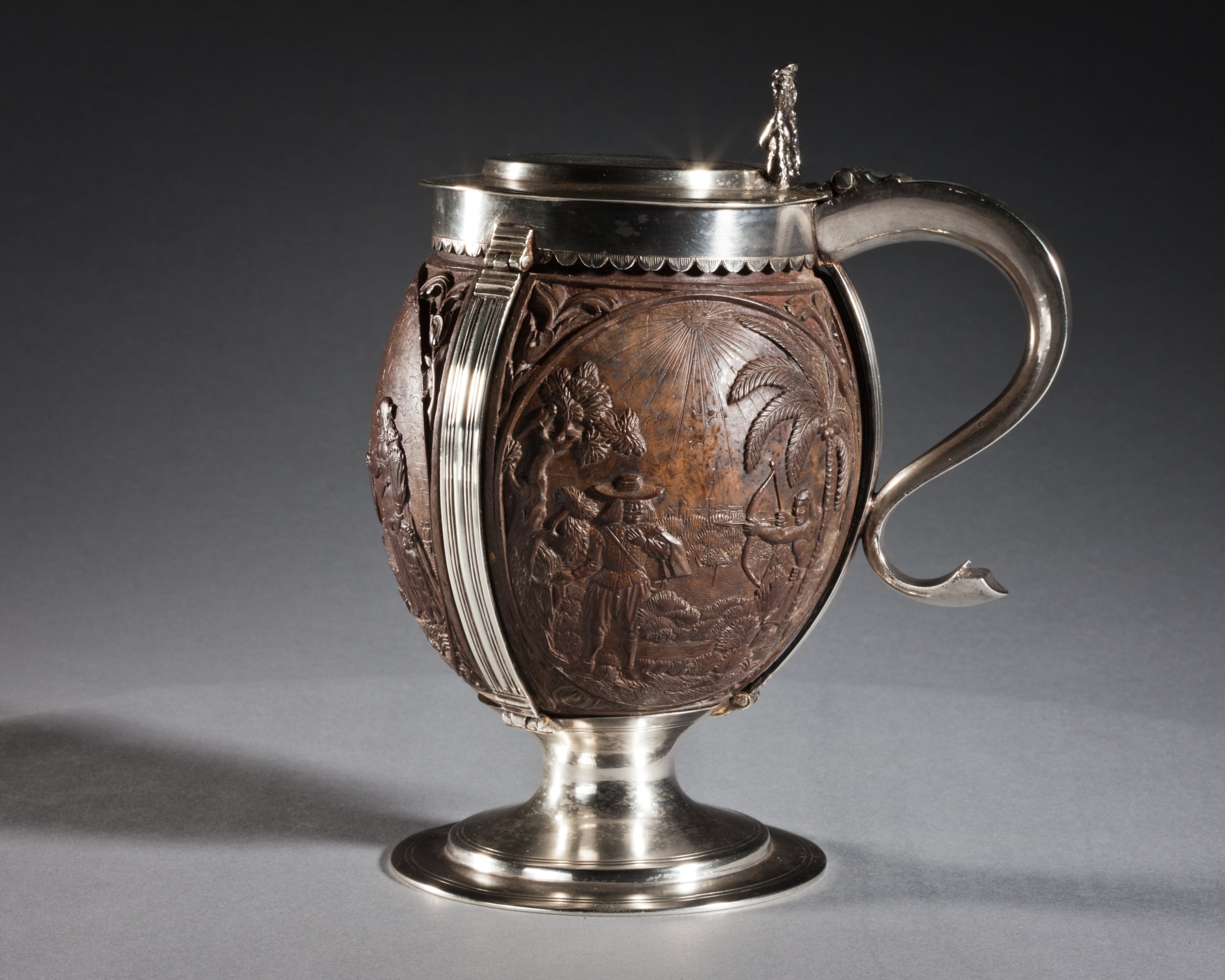
The dark, rounded body of this cup is crossed by bright metal strips. A broad handle curves away to one side, while a lid and a spreading foot frame the carved surface above and below. The eye reads a single vessel, but the catalogue asks us to keep its components distinct.
Attach the place to the part
The Cleveland Museum of Art assigns the carved coconut probably to the Netherlands and the silver mount probably to England. Both qualifications matter. Reducing this record to “Dutch cup” or “English cup” would lose the distinction between the two components and make a tentative attribution sound settled.
Those are proposed places of workmanship, not a map of the coconut’s growth or the vessel’s travels. The record does not give this study a named carver, silversmith or route between workshops. Keeping separate entries for body and mount is a way to preserve the evidence without filling its gaps.
Look at the meeting edges
Follow a vertical strip from the upper rim toward the foot. Its narrow, bright surface divides areas of darker carving; the broad handle creates a much larger open space outside the body. The differing textures make the components easy to describe, even where their full construction remains hidden.
The relief contains small figures and plant-like forms. This view supports looking at their placement and depth, but it does not by itself identify the scene, establish the origin of the carving or turn its imagery into a record of where the cup was used. Here the component attributions come from the museum, not from guesses about the depicted figures.
A donor’s memory is a different history
The credit line remembers the donor and her husband’s happy days in the Virgin Islands. That memorial belongs in the object’s collecting history. It is not evidence that the cup was made there. Keeping a credit line, a manufacture attribution and an ownership history in separate fields prevents one kind of place-name from becoming another.
Compare the maple mazer’s separately dated medal and vessel: that object raises a related question about which claim belongs to which part, not a claim of shared origin. For this coconut cup, a useful short record retains the material of the body, the material of the mount, both “probably” qualifiers and the museum’s approximate date. All object facts above follow the Cleveland Museum of Art record.