
Begin with the octopus
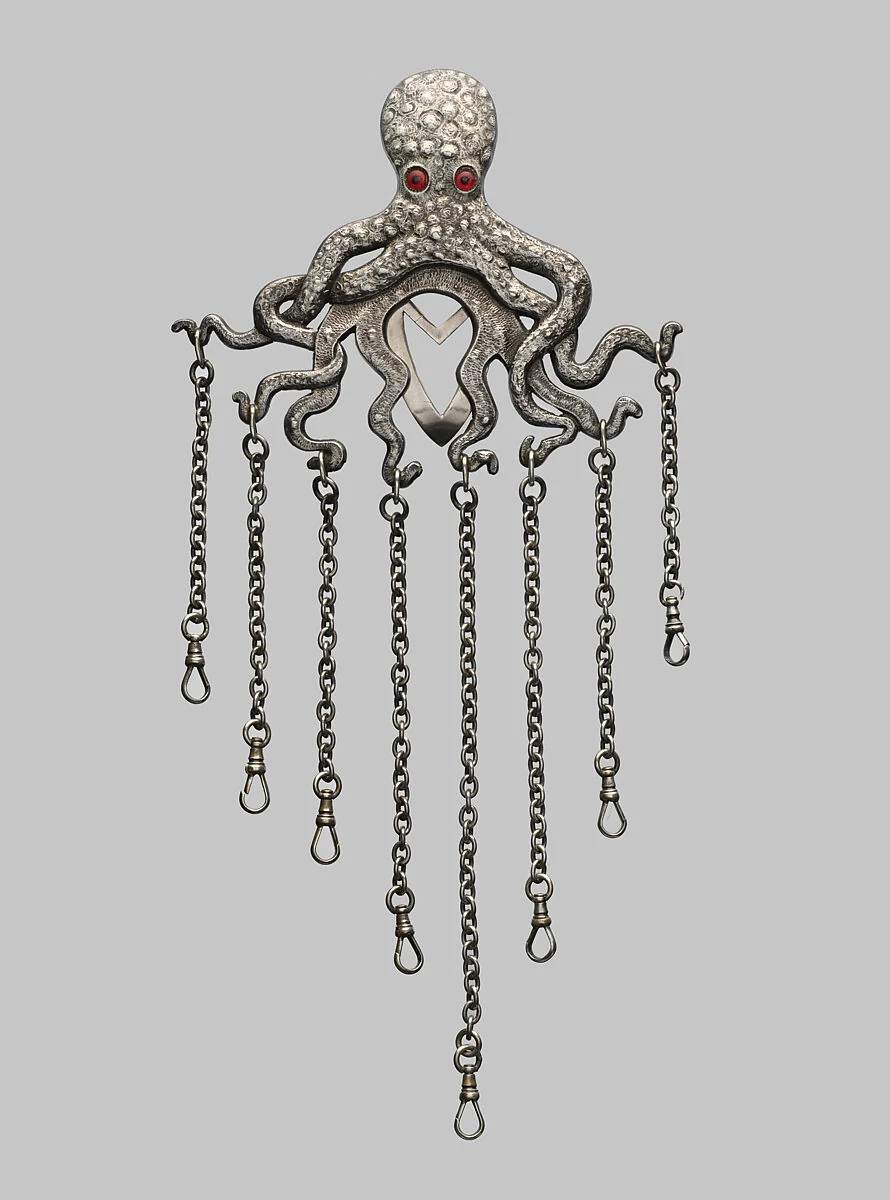
The octopus is a wonderfully literal answer to a practical problem: how do you carry several small things from one point on your clothing? Its arms curl around the top of eight hanging chains. Below that restless shape, the chains descend in a quieter rhythm, each finishing in a clip. An animal that seems all movement has become an organizer.
Gorham made this example in Providence in 1887. The Met identifies silver, red glass and black beads, not rubies or an all-silver construction. The photograph shows the suspension arrangement without a kit of tools. That absence is useful: it lets us see the connections before imagining what might hang from them. A list of accessories belonging to another octopus-shaped chatelaine would not establish this one’s original contents.
Our sewing-tools guide introduces this object alongside thimbles and bodkins. Here, the question is wider. What changes when useful objects are worn, displayed and selected as an arrangement, rather than placed together in a drawer?
Read it from the clothing outward
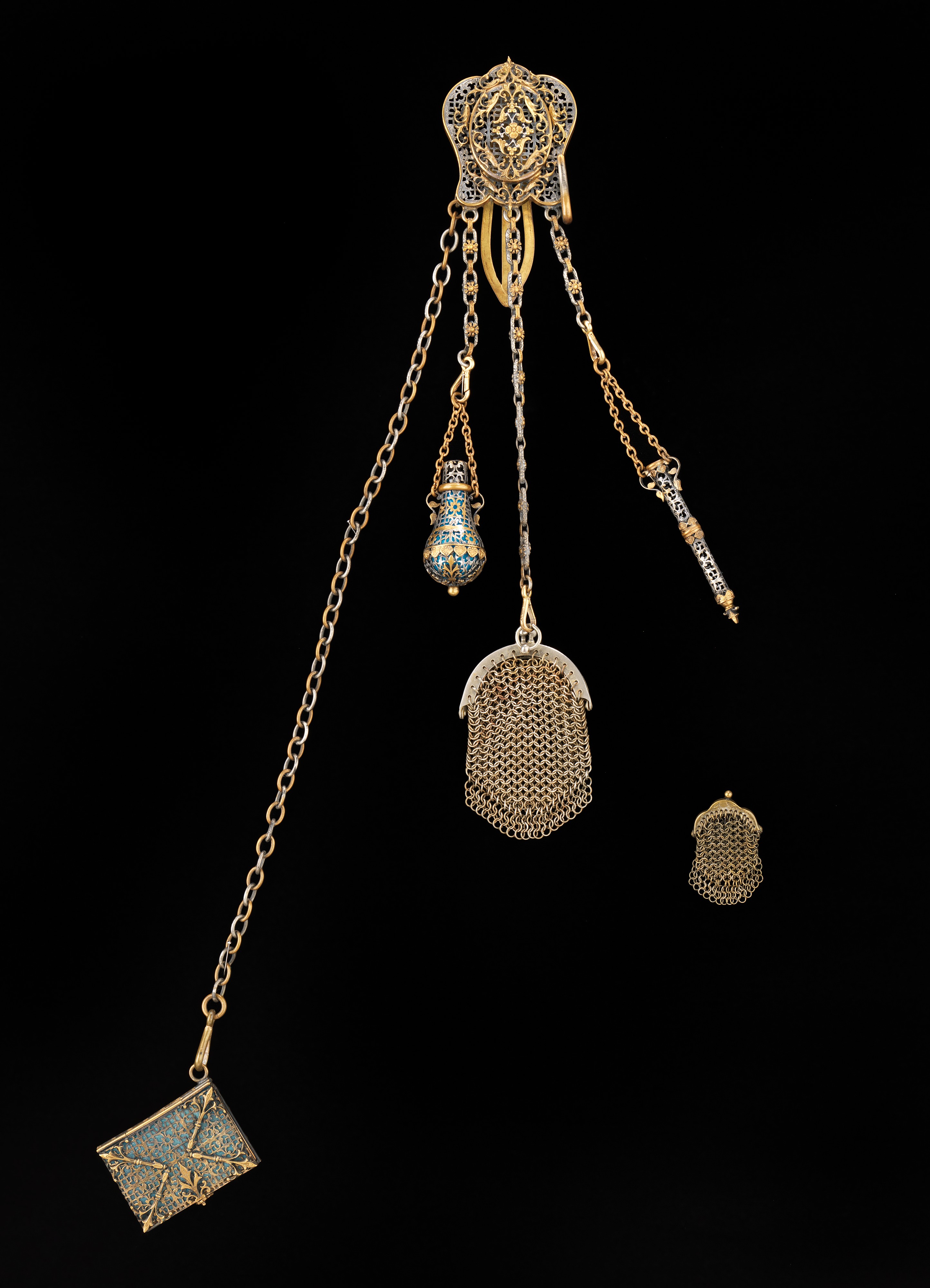
A chatelaine is the support and suspension arrangement, not a single standard set of accessories. Start with its upper fitting. A decorated front may conceal the part that actually engages with clothing; from there, chains lead to individual objects. The visible ornament and the carrying mechanism need to be understood together.
The Met explains the hook behind the central clip of a probably French example from the last quarter of the nineteenth century: it attached at a waistband or belt. Its suspended contents include a pencil, notebook, sealing-wax holder and chain-mail purses. The record lists metal, enamel and paper. Neither its silvery appearance nor its elegant decoration licenses us to rename that unspecified metal silver. See the museum’s object-specific description.
Look for three relationships: fitting to garment, chain to fitting, and attachment to chain. These are better starting questions than counting the number of dangling pieces. In a photograph, follow each connection separately. A chain crossing another can look like a shared connection when it is not. The reverse view may explain more than the most flattering view of the front.
Older than the Victorian label
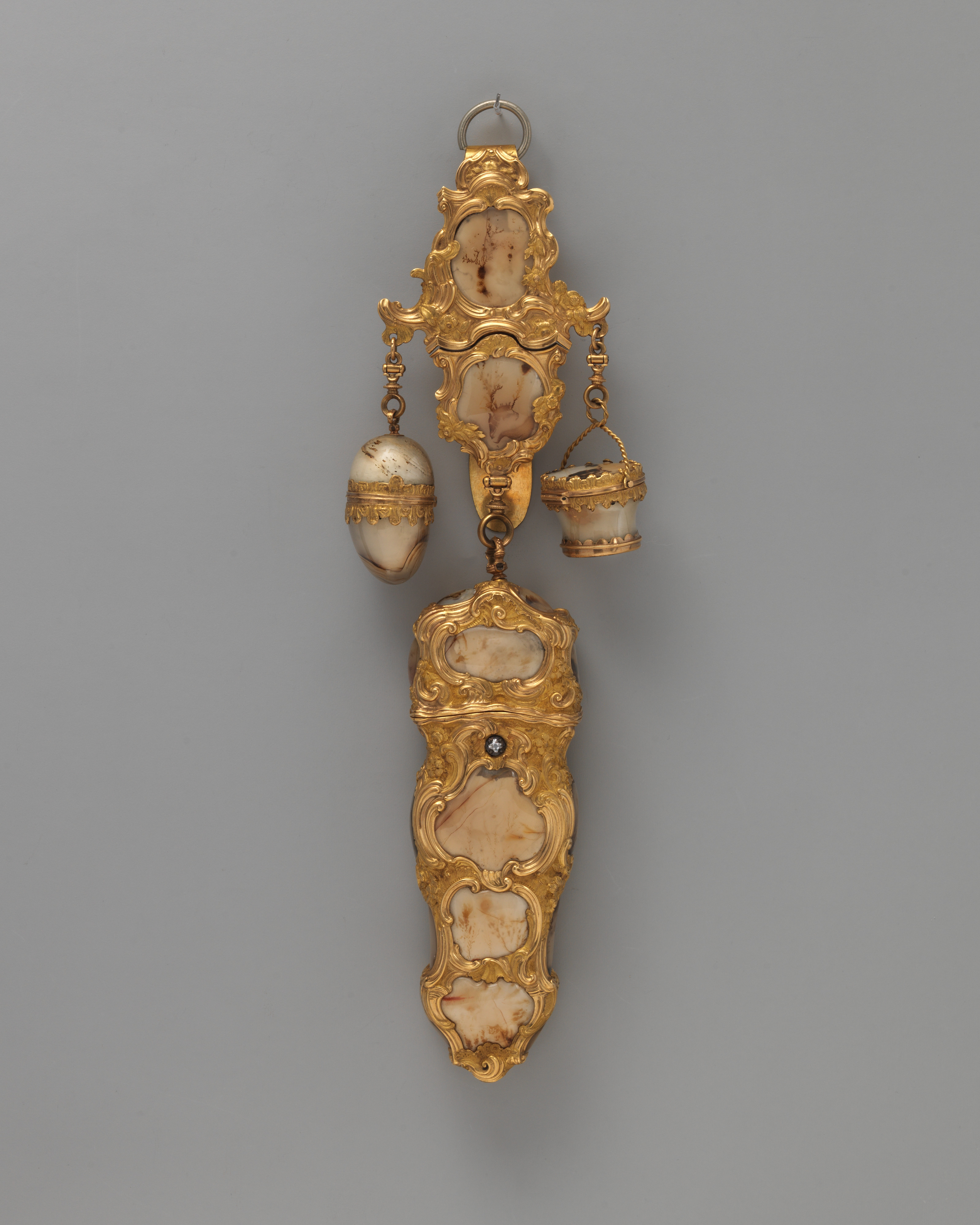
The octopus belongs to the nineteenth century, but the idea cannot be confined there. A British chatelaine in the Met, dated 1750–60, combines gold and moss agate. Its compact arrangement demonstrates a different material vocabulary from Gorham’s silver animal. The museum describes chatelaines as waist-hung carriers for sewing, writing or personal-grooming implements. British chatelaine, 35.102a–h.
There is also a distinction between the age of an object and the age of the name we now give it. Suzanne van Leeuwen’s study in The Rijksmuseum Bulletin identifies an early documented use of the accessory term “chatelaine” in 1828; earlier related arrangements had other names, including equipages. A modern museum title is therefore not proof that an eighteenth-century owner used the same word. Read the scholarly discussion, p. 336 and note 28.
Keep those two timelines beside one another. A label can be historically later than the object it helps us recognize. That is not a reason to discard the label, but it is a reason to avoid turning a convenient collecting category into a single invention story.
Put the arrangement back on a wearer
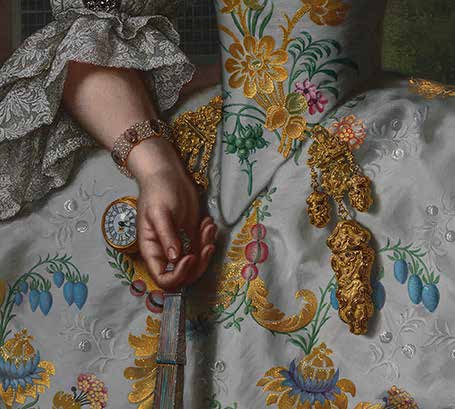
A museum photograph usually removes the body from the equation. Mattheus Verheyden’s 1755 portrait of Charlotta Beatrix Strick van Linschoten puts it back. Van Leeuwen identifies the accessory worn here as a watch chatelaine.
This is a painting, not a photograph of a Victorian wearer. Nor can the painted colour identify the accessory’s metal. Its value here is positional: it reminds us to read a hanging object in relation to dress rather than treating it as a small wall ornament. The portrait records a represented appearance, not an inventory of everything the sitter used.
When comparing a portrait with a surviving object, ask what each kind of evidence can actually supply. A painting may show placement and visual prominence; an object can reveal a fastening or a maker’s mark. Neither should silently stand in for the other.
A personal selection, not a mandatory kit
The contents alter the character of an arrangement. Sewing tools emphasize one set of tasks; the pencil, notebook and wax holder in the probably French example suggest another. A collector should not make every chatelaine a sewing kit simply because scissors and thimbles are familiar. Read each attachment’s working form before giving the entire ensemble a job description.
A small fitted case, or étui, is also not the same thing as the whole suspension arrangement. A case may group implements within it; chains may connect that case with other objects. Describe the levels separately: the carrier, its attachments, and any contents inside an attachment. That simple distinction prevents an appealing but vague label from swallowing the actual construction. The Met’s discussion of an étui gives examples of its fitted contents (p. 10).
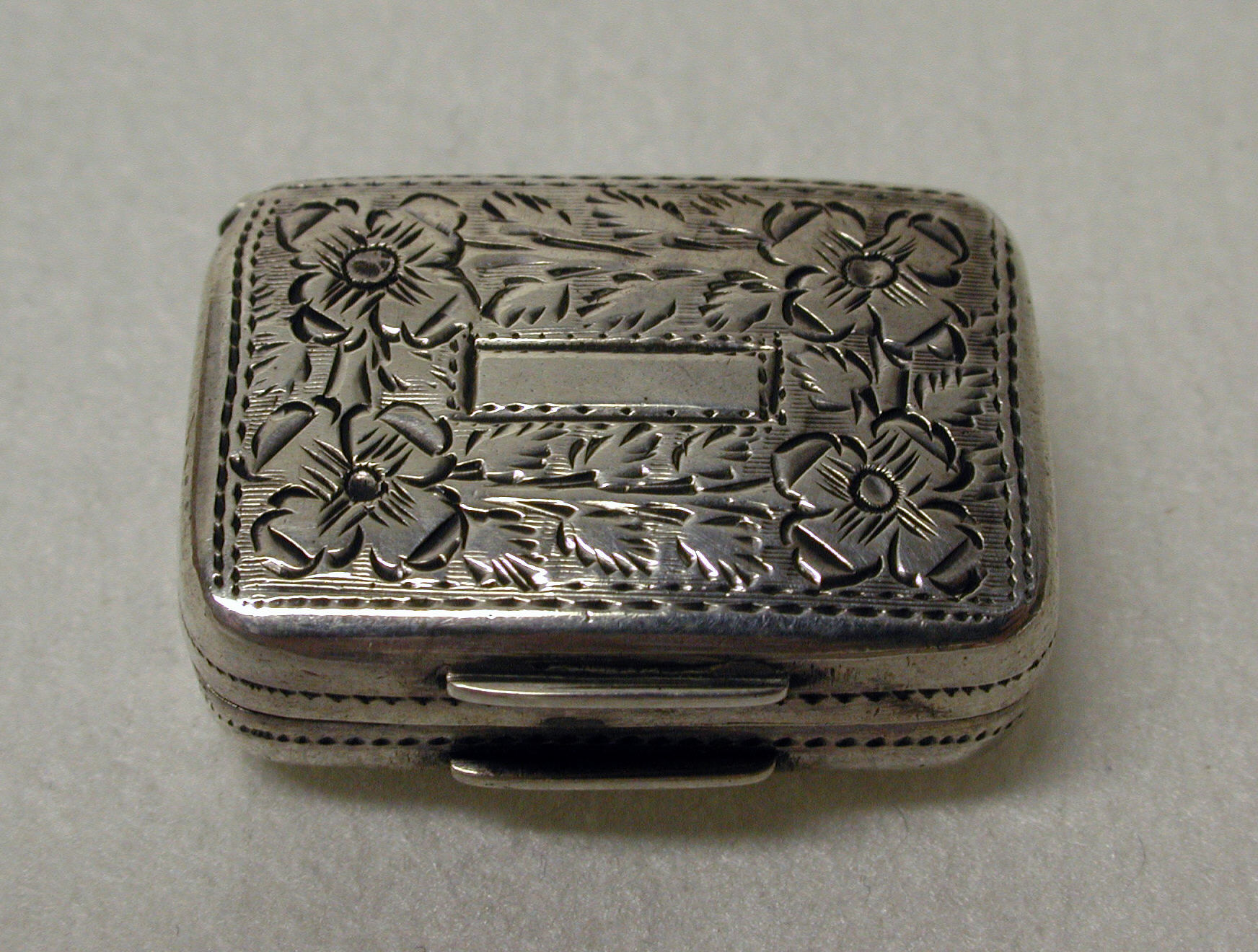
A silver vinaigrette dated 1817, probably by John Lawrence & Co. of Birmingham, shows how specific an attachment’s function can be. The Met explains that a small sponge held aromatic vinegar beneath a pierced inner grille. Its account also notes several ways of carrying vinaigrettes: at the waist on a chatelaine, at the neck, or in a pocket. The object type is not evidence that this particular example belonged to any chatelaine shown here. Vinaigrette, 1983.575.18.
The Canadian Museum of History supplies a different, documented working context: a chatelaine used by a nurse from the Toronto General Hospital Training School of Nursing. That example matters because it connects a surviving object with a particular occupational setting. It does not turn every chatelaine into nursing equipment, any more than the octopus turns every arrangement into a piece of animal jewellery. Explore the nursing example.
Silver is one possibility, not the definition
The contrast between the silver octopus and the gold-and-agate example is only a beginning. The Met’s French Chatelaine with calendar, probably late eighteenth century, is catalogued as steel and enamelled gold. A functional category can encompass very different materials, and a container can hold information as well as a tool. Chatelaine with calendar, 2011.580.1.
For a silver collector, this is an invitation to be more precise, not to narrow the field artificially. Record the material of each identifiable part. Keep a museum’s “metal” as metal when the record goes no further. Keep “probably” attached to an attribution or date when it belongs there. A richer description does not require a more confident claim.
Material also affects how an arrangement reads visually. In the octopus, the dark openings between the arms are as important as the bright surface: they separate the animal from the chainwork below. In an object with stone, a large uninterrupted surface may hold the eye before the fittings do. These are ways of looking, not shortcuts to identifying an alloy or reconstructing a missing component.
The pocket story is not so simple
It is tempting to explain chatelaines with a single claim: women had no pockets. The V&A’s research on tie-on pockets makes that explanation untenable. Such pockets were widely used from about 1650 into the late nineteenth century and sometimes later, worn separately from the garment and reached through openings in clothing. Bags and pockets also coexisted. Read the V&A’s history of tie-on pockets.
That evidence changes the question. Instead of asking what a chatelaine inevitably replaced, ask what carrying something visibly might offer in a particular setting. Accessibility, display and the selection of attachments are possibilities to investigate, not universal motives we can assign to an unknown owner. The surviving arrangement deserves its own explanation.
Matching parts do not settle the history
Van Leeuwen’s study shows why an ensemble needs component-by-component research. Eighteenth-century watch-chatelaine parts could come from different production centres and be assembled, personalized or replaced. Watch chatelaines were worn by men as well as women. A difference between components is therefore a question for investigation, not automatic proof of a recent dealer’s assembly. The Rijksmuseum Bulletin study.
The reverse is equally important as a collecting principle: visual harmony is not proof of an untouched set. It is possible to notice a matching motif without knowing when two objects were joined. Separate what the arrangement looks like today from what documentary or physical evidence establishes about its past.
A useful record gives every part a place. Number the attachments in a photograph, then record dimensions, marks, inscriptions and visible connections under those numbers. Keep the main fitting distinct from the suspended pieces. Where information conflicts, preserve both the observation and its uncertainty rather than silently choosing the tidier story.
“Associated” need not mean worthless, and “complete” needs a stated basis. Complete according to what: an early photograph, a fitted case, an inventory, or simply every hook presently being occupied? Asking that question makes a catalogue description more informative without pretending to settle authenticity from a photograph.
A closer look, without inventing a life
Return to the octopus and trace one chain all the way down. Its terminal clip is a point of possibility, not proof of a lost pair of scissors. Now look back at the upper fitting. The mechanical organization and the animal’s shape have been made to work as one composition. That is enough to admire before supplying an imagined owner or occasion.
For your own collection, begin with photographs of the whole arrangement, the reverse and each connection, without forcing a closure or suspending fragile parts under load. Note what is present before speculating about what is missing. If a mechanism, finish or repair is uncertain, seek qualified advice rather than making a practical experiment on the object.
Our object-record guide helps keep observations separate from claims. The existing sewing guide covers construction-led care, while the Gorham profile places the octopus’s maker in a wider history. The point of the deeper guide is not to replace those resources. It is to restore a different question: how did a group of useful things become an arrangement someone could wear?