
The most revealing date is 2015
An old silver object can acquire a new chapter without being altered. Sometimes the change is beside it.
In 1964, the Metropolitan Museum received a silver tea caddy by the New York maker Simeon Soumaine. In 2015, it purchased a matching caddy and sugar box, reuniting the three-piece ensemble. All three carry the Bayard family’s arms and crest. The museum identifies the octagonal containers as rare early American survivals influenced by contemporary English design. The Met’s account of the reunion
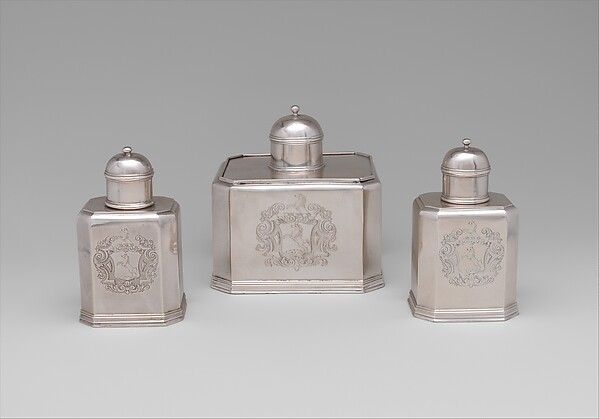
Component dates and credits
Sugar box, ca. 1720, 2015.93.1a,b; tea caddy, ca. 1720, 2015.93.2a,b: Purchase, Nancy Dunn Revocable Trust Gift, 2015. Tea caddy, 1725–40, 64.249.5a,b: Gift of E. M. Newlin, 1964. The two caddy accessions are not assigned left or right in this photograph. Public domain; museum photograph DP350322.
The interval between those acquisitions was 51 years. That is not a measure of how long the pieces had been separated. It is the distance between two documented moments in the museum’s collecting history.
For a collector, the distinction matters. The satisfying part of this story is not that somebody found three things that looked good together. It is that a recognized relationship could become a physical reunion. An individual acquisition changed how an earlier acquisition could be understood.
An older catalogue catches the story before its next chapter
The same 2013 catalogue describes the companion caddy and sugar box as privately held. It records the first caddy’s loan to the museum in 1933, before the 1964 gift. It leaves the precise family descent and the timing of separation unresolved, and proposes the original owners only as a possibility. Read beside the current reunion account, it preserves a useful before-and-after view of the collection. Met catalogue and current caddy record
The older book has not become useless because the objects moved. Its account of their location belongs to the moment in which it was written. Its construction observations and carefully qualified ownership discussion remain different kinds of information.
This is an unusually rewarding reason to keep earlier catalogues. They can show not only what people knew, but what had not yet happened. A modern collection is not a finished arrangement handed down from the past. It grows through decisions, opportunities and the arrival of objects that change the company others keep.
Three records, not one invented date
The Met currently dates the sugar box and the caddy acquired with it to about 1720. Its record for the earlier-acquired caddy gives 1725–40. Keep those dates attached to their respective records rather than quietly smoothing them into a single year. Sugar box, 2015 tea caddy, 1964 tea caddy
A group relationship and an individual catalogue date answer different questions.
A useful collection record can accommodate both. Give the group a shared entry, but retain a separate entry for each vessel. Record where the relationship is documented, when each piece entered the collection and what remains uncertain. If research changes a date later, the earlier reading should still be recoverable.
What should a reunion restore?
For a private collector, “complete” can become an expensive word. It can mean every space in a fitted case is occupied, every listed piece survives, or simply that an arrangement feels balanced. Those are not equivalent claims.
The Bayard story suggests a more useful ambition: restore context before chasing completeness. A missing companion may survive in another collection. It may be known only through an old photograph or inventory. Recording that connection can improve the understanding of an object even when the objects cannot be brought together.
Start with an ensemble sheet:
- Identify every known component separately.
- State who identifies the pieces as related, and on what published evidence.
- Distinguish acquisition dates from manufacture dates and from dates of separation.
- Preserve uncertainty about ownership rather than filling gaps with a neat family story.
- Keep photographs of the group as well as useful views of individual parts.
These are suggested documentation practices, not a claim that visual comparison alone authenticates a set. Our object-record guide offers a place to begin.
A different sugar-box story
Our earlier sugar-box article examines workshop attribution and a representation of cane harvesting. This reunion asks a different question: what becomes visible when a known component rejoins a larger whole?
The reunion does not recover the contents of the containers or a complete chain of custody. It does not reconstruct an evening at the Bayard table.
What the reunion restores is a documented relationship between surviving objects. The tea-set guide introduces the broader service; the Bayard ensemble reminds us that a service’s history can continue long after its working life. Sometimes the meaningful addition to a collection is the piece that lets an old acquisition stop standing alone.