
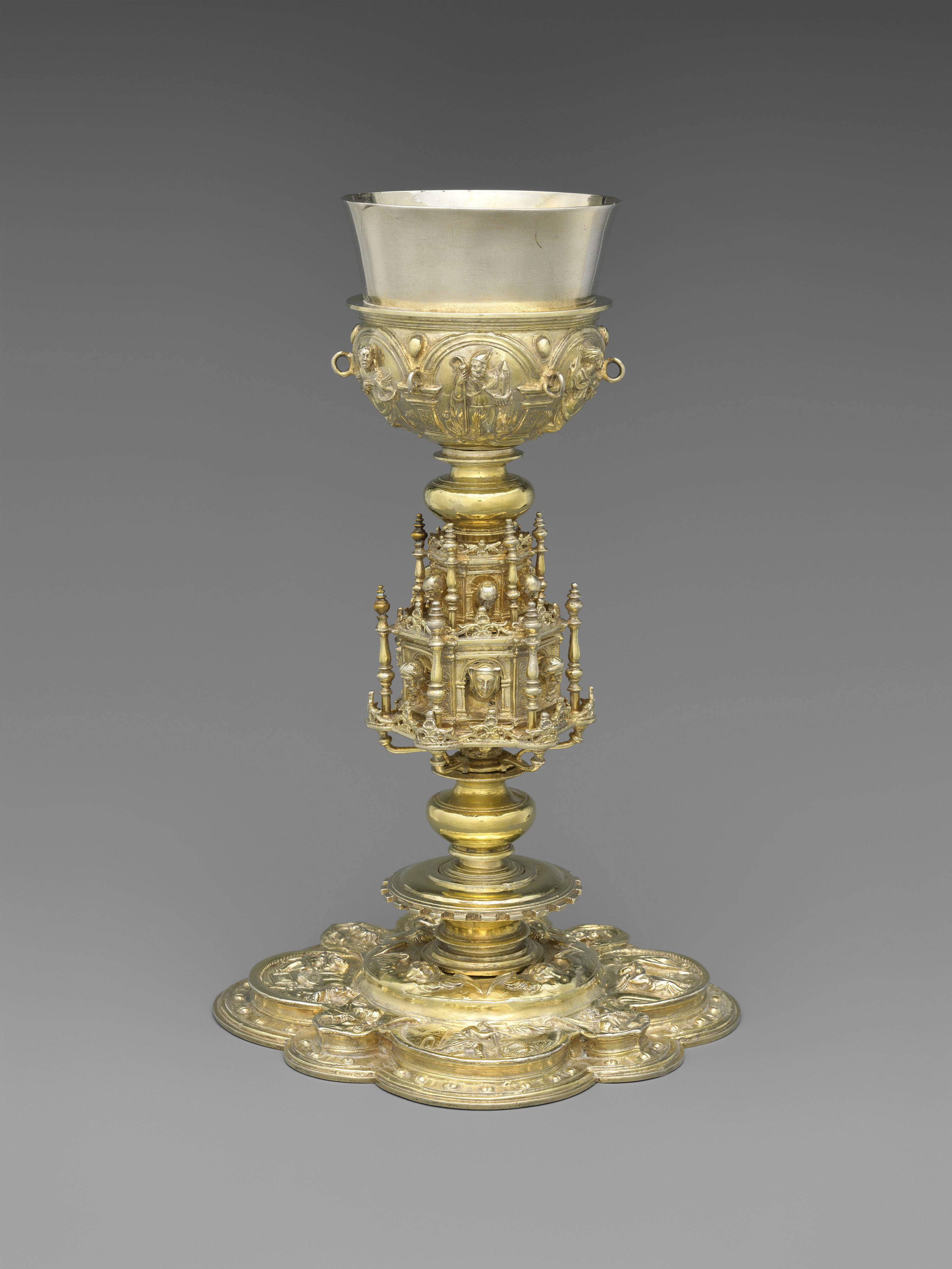
The smooth upper cup is almost a pause. Beneath it, figures emerge from arched compartments; farther down, a miniature tower of columns and finials fills the stem. At the base, raised scenes spread across a lobed foot. Follow the object from top to bottom and it feels less like one continuous surface than a sequence of places to look.
Made in Mexico City
The Met identifies the maker as Antón Dantés and dates the chalice to about 1560–1570. Made in Mexico City, it held consecrated wine during the Roman Catholic Mass. The museum connects Dantés’s elongated, expressive figures with Spanish mannerist sculpture. Those identifications come from the object record, rather than from guessing at the photograph.
Silver beneath the gold-colored surface
The record describes gilt silver, with repoussé, chasing, casting, lathe work and burnished punchwork. Silver-gilt is not solid gold: the description distinguishes the silver object from its gilded surface. Neither the photograph nor this catalogue entry gives us a basis for assigning a gold-layer thickness or silver fineness.
Look at the contrast between the nearly uninterrupted upper bowl and the crowded relief below. Light runs broadly across the first, then breaks into small highlights and shadows around the figures. The smooth rounded sections above and below the architectural stem provide another visual pause. Ornament is not simply applied everywhere with equal density.
Stories around the foot
The museum names four scenes on the foot: the Annunciation to Joachim, the Visitation, the Annunciation to the Virgin and the Nativity. It relates these to the Incarnation. The chalice stands 33 cm high, with a base 21 cm across.
A single frontal view cannot show every scene equally. Instead of forcing an identification onto each partly visible figure, begin with what the image makes clear: the alternating lobes, the stepped edges and the way the reliefs gather around the central support. These are useful prompts for close looking, not a substitute for the museum’s iconographic reading.
For a collector, this is a reminder to read shape, surface and purpose together. A material label matters, but it is only the beginning of the object’s story. Explore the guide to silver decoration for more ways of distinguishing worked surfaces.