
A leaf floats in the cup. The teapot has stopped pouring properly. One small silver object offers a possible answer to both problems, but neither end looks quite like an ordinary teaspoon.
Meet the mote spoon: a pierced bowl on a slender handle that ends in a point. Its interest is not simply the delicate metalwork. It asks us to imagine the interruptions in serving tea, not just the handsome service arranged on a tray.
Why does it have holes and a point?
Colonial Williamsburg describes the generally accepted explanation: the bowl skimmed leaves and other matter from a cup, while the pointed handle cleared leaves obstructing the internal strainer where the teapot body meets its spout. That is an explanation of the object type, not an eyewitness account of how every surviving spoon was used. Colonial Williamsburg, mote spoon
The location matters. Think of the entrance to the spout inside the pot, not of a straight tool travelling around the outside spout’s curve. This is historical interpretation, not a suggestion to probe an antique vessel. A fragile pot is not a test rig for an unidentified spoon.
The museum’s London example dates to about 1760. It is sterling silver, 5½ inches long, with a bowl one inch wide. Its marks include a maker’s mark and a lion passant. Those details give the explanation an actual object to rest on. They do not recover a particular owner’s tea table. Museum record
Was that what people called it?
A modern catalogue title is not automatically the name an eighteenth-century customer used. Colonial Williamsburg cites a 1697 London Gazette reference to “long or strainer tea-spoons with narrow pointed ends.” Its evidence connects the form to tea without establishing that the modern term mote spoon was then current. Museum discussion
That distinction is useful beyond this particular utensil. Keep the museum’s present identification in your notes, but give a historical quotation its own date and source. A name can make an object easier to find while also hiding changes in how people described it.
Is it the same as a caddy spoon?
No, the usual explanations put them at different moments in preparing tea. A caddy spoon transfers dry leaves from their container to the pot. Colonial Williamsburg notes that these accessories were often bought separately. The mote spoon’s accepted interpretation concerns leaves after brewing. Caddy-spoon record
Our caddy-spoon guide follows that earlier step. Read the two together and the tea service becomes a sequence rather than a collection of similar-looking silver objects: storage, transfer, brewing, pouring and drinking.
Do not turn this distinction into a rule that every pierced spoon must be a mote spoon. The caddy guide itself includes a museum-catalogued caddy with an accompanying pierced spoon. Holes alone cannot identify a utensil. Neither can a shell motif, a shiny surface or a dealer’s title. Look at the whole form and the documented context before choosing between a tea accessory, a sifter or another kind of serving spoon.
Two records, not one universal template
LACMA catalogues another London mote spoon, by an unknown maker, to about 1760–1780. Its recorded material is silver and its length is 5½ inches. The accession is M.62.46.20, a gift of Mrs. William Chilton. Notice the different precision: this record says silver, while Williamsburg explicitly says sterling. Preserve each museum’s wording rather than silently upgrading one to match the other. LACMA record
Krannert Art Museum offers a further comparison: an American silver mote spoon dated 1730–1735, also 5½ inches long, accession 1980-7-1. Its record describes an indecipherable mark. An unresolved mark is information worth retaining, not an invitation to supply a maker from a similar-looking example. Krannert record
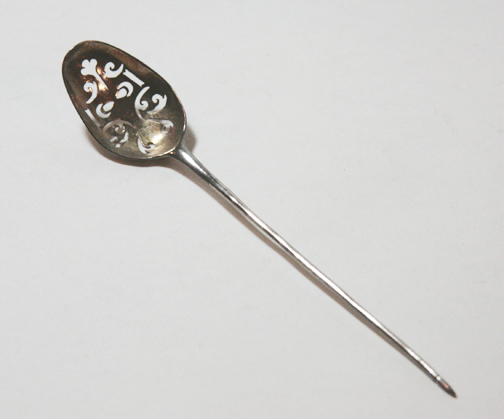
Image credit
Gift of Mr. & Mrs. Ross Mattis Camp. Krannert Art Museum. Open Access / Public Domain. Museum photograph reproduced unchanged.
What should a collector record?
Start with a question that a photograph can answer, then a question that it cannot.
- What can I see? Record the bowl outline, piercing, handle profile and terminal. Photograph both sides and the marks, with a scale beside the object.
- What is documented? Keep the accession or sale reference, stated material, date range and attribution together. Separate what a source says from your own comparison.
- What remains unknown? A plausible function does not identify an owner, prove that two pieces were a set or authenticate a loose object.
The pleasure of this spoon is the change in perspective. A grand teapot attracts attention; a small implement reminds us that serving tea involved little practical problems too. Return to the tea and coffee guide to place it among the larger vessels, or use the collection-record guide to keep your observations and evidence separate.