
Hoxne: a chest and the evidence around it
In November 1992 Eric Lawes was searching a Suffolk field with a metal detector when he encountered Roman silver and coins. He and farmer Peter Whatling reported the discovery, allowing the Suffolk Archaeological Unit to excavate the remaining deposit the next day. Small blocks were lifted for careful excavation at the British Museum. What survived of the arrangement mattered as much as the individual objects.
Spoons and ladles, small bowls, pepper pots and jewelry had been packed in a chest, with traces of textile and possible plant packing. Some spoons carry names and Christian symbols; gold jewelry includes a bracelet with an inscription naming Juliane. These marks invite questions about people and use, but do not prove that every named person owned the entire group or explain why it was buried. Coins dated 407–408 provide an earliest possible date for the deposit.
Counts must be tied to the stage of recovery. Suffolk’s historic environment record lists 565 gold, 14,191 silver and 24 bronze coins: 14,780 in all. That is an early recorded inventory, not a count of what Lawes recovered before the archaeologists arrived. Johns and Bland note that their later figure includes four gold and 81 silver coins found after ploughing in 1993; Suffolk Archaeology reports 14,865 coins for that expanded count.
The count did not stop there. The 1994 field investigation reported about 330 disturbed metal objects, mostly silver coins but also a few gold coins and fittings. Numismatist Peter Guest later described at least 15,234 coins in the treasure. These figures describe different stages and categories; the 1994 object total should not be added as though every item were a coin. The hoard was declared treasure trove and retained by the British Museum.
Galloway: a vessel inside a layered deposit
The Galloway Hoard was found by metal detectorists in southwest Scotland in 2014 and excavated by the council archaeologist. Buried around AD 900, it was arranged in distinct deposits. The lower level included a lidded vessel, a cluster of arm-rings with gold objects and a larger bundle of silver; a smaller upper deposit included a Christian cross. Leather and textiles preserve clues to how the contents were gathered and wrapped. Arrangement does not, by itself, reveal one owner or a single reason for concealment.
Conservators used imaging to reveal the vessel’s animal and fire-stand decoration beneath corrosion, and then emptied and conserved it. Early comparisons had suggested a Carolingian vessel, but the decoration pointed researchers toward Central or Western Asia. They tested samples of the silver alloy and black niello inlay. National Museums Scotland reports that lead isotopes in both match Iranian ores, with the niello pointing specifically to Nakhlak in central Iran; the silver-and-copper alloy is consistent with Sasanian metalwork. These findings support a West Asian attribution, but do not document every stage of manufacture, the vessel’s owners or its route to Scotland.
The vessel contained separately wrapped objects, including a rock-crystal jar and textiles. The museum acquired the hoard for the nation, and continuing conservation and research have changed earlier assumptions about the vessel. Its date of manufacture, earlier uses and route to Scotland remain open questions.
Hejiacun: treasure, records and a contested date
At Hejia village in modern Xi’an, a discovery in 1970 brought to light two clay jars and a smaller silver jar containing a remarkable range of objects. The deposit lay in a ward of Tang Chang’an. Gold and silver vessels, coins, ingots, gems and other materials connect the hoard with courtly production and administration as well as exchange across regions.
A handled silver cup with eight faces brings decorative traditions into view. Hansen describes its Sogdian-shaped form and pearl borders alongside scenes of musicians and dancers, and discusses Chinese-made vessels that adapted Iranian and Central Asian motifs. A shared design vocabulary is evidence of artistic connections; it does not establish that each object made a journey from the place associated with its style.
Valerie Hansen describes silver in several forms, from bars and lumps to finished vessels, and ink inscriptions that preserve weights and storehouse information. Qi Dongfang examines a gilded floral bowl and lid with both incised and inked weights, interpreting them as records from different stages in its history. An inscription is evidence to read in context: it is not automatically a maker’s mark or a complete ownership history.
The burial date and owner remain debated. An earlier interpretation linked the deposit to the An Lushan rebellion around 755–756 and Prince Li Shouli. Qi Dongfang challenges that attribution, arguing that some objects are later; he proposes an association with tax official Liu Zhen and concealment during the Jingyuan mutiny of 783. Hansen’s account identifies tax ingots dated 732, setting a boundary of that year or later, and suggests burial probably followed relatively soon because ingots were normally melted down. That expectation is an interpretation, not a dated record of the burial. Neither account settles the identity of the person who buried the jars. Hansen notes that the hoard was not published in full and that selected objects entered exhibitions after discovery.
Regensburg: a chest, an inventory and a dispersed group
In 1869 workers demolishing a Regensburg house found a wooden chest beneath a staircase. Its contents included silver drinking vessels, spoons, knives, adornments and documents, packed in paper. Art historian Allison Stielau places its likely concealment in 1632–1634, amid the Thirty Years’ War, while acknowledging that the exact circumstances remain uncertain. A seal and a spoon with initials support a connection to merchant Georg Hoffmann without reconstructing every decision he made.
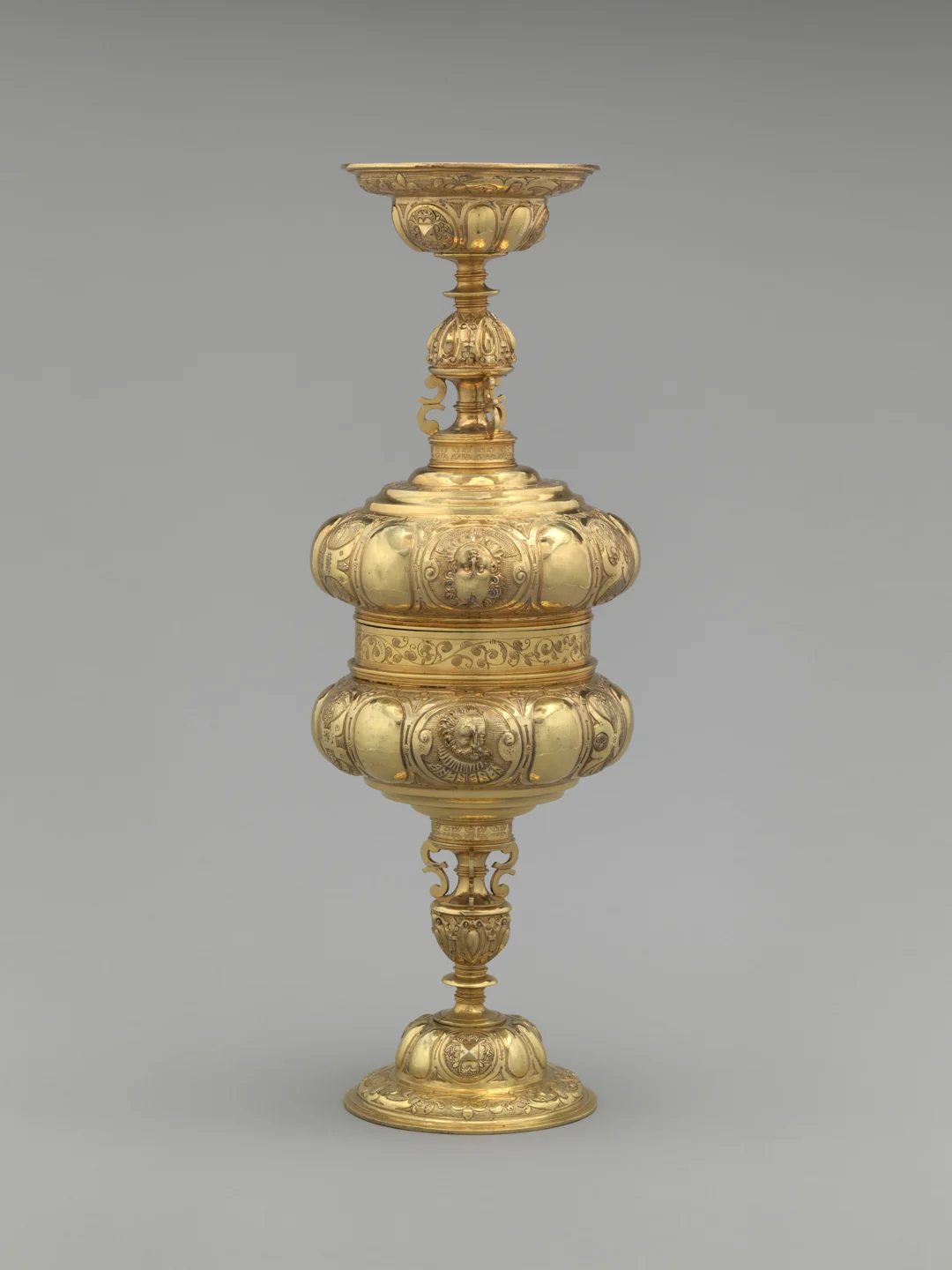
The gilded silver double cups pictured here are attributed by the Met to Simon Pissinger, about 1600. Their two halves detach into separate goblets. The object’s manufacture date is earlier than the likely hiding of the chest, and its polished display cannot show the paper packing or the relationships among the original contents.
The find was displayed publicly soon after discovery and an inventory circulated. It is a precious record but not a photograph of every object in place: descriptions vary and some identifications were mistaken. The group was dispersed by the end of the nineteenth century, making the inventory and later provenance research essential for reconnecting objects. The Met acquired these cups in 1911. Its object page describes a false wall, while Stielau’s archival study places the chest under stair treads; the difference is worth preserving rather than smoothing over.
What a group can and cannot tell us
A hoard is an interpretation of objects associated through a deposit. An excavation can document containers, layers and neighboring finds; an early inventory records what someone saw and chose to list after discovery. A museum grouping may bring dispersed objects back together on the strength of records and comparison. Each association has its own evidence and gaps.
For a research record, keep the find context, object date, proposed deposition date, discovery date, inventory and current custody separate. Note the source of an attribution and its qualifiers. Studying a public archaeological collection means preserving context and cultural heritage, not treating excavated objects as stock for purchase.
Sources & further reading
- Catherine Johns and Roger Bland: The Hoxne Late Roman Treasure
- Suffolk Historic Environment Record: Hoxne
- Suffolk Archaeology: The Hoxne Hoard
- National Museums Scotland: Conserving the Galloway vessel
- National Museums Scotland: A runic revelation
- Valerie Hansen: The Hejia Village Hoard
- Qi Dongfang: Not an Ordinary Hoard, in Ancient Coins and the Culture of the Silk Road
- Allison Stielau: The 1869 Regensburger Silberfund
- The Met: Two double standing cups
- National Museums Scotland: Distant origin of the vessel
- Kevin Forrest: 1994 Hoxne field investigation, Archaeology in Suffolk
- Peter Guest: Siliquae from the Traprain Law treasure (author’s research)