
A gift made to be remembered
A cup can be a drinking vessel and a public statement at once. Presentation silver gave a durable form to thanks, esteem, achievement or remembrance. A patron might commission a silversmith to make an elaborate object; a group might purchase one to honor a colleague; a competition might award a trophy. The maker, the giver and the recipient had different roles, even when their names appear together on the same piece.
Covered cups and standing trophies can look ceremonial; a ewer borrows the shape of a pouring vessel. Neither shape alone proves that a particular piece was presented, or explains the occasion. Engraving may supply names, dates and claims, while coats of arms, imagery and later records add context. Read each layer separately before joining them into a story.
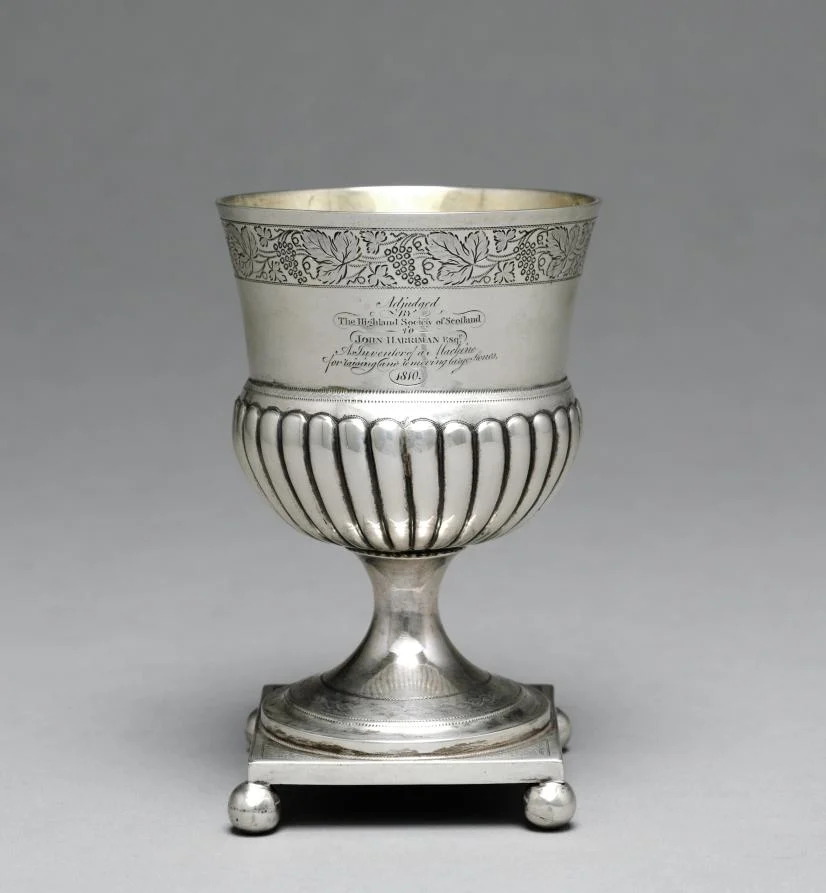
A Scottish prize cup made by George Fenwick in 1809–10 offers a contrast to the more ambiguous objects below. Its visible inscription names the Highland Society of Scotland, John Harriman and an 1810 award for a machine for moving large stones. The wording is evidence of what the donors chose to celebrate; it does not by itself explain the machine’s subsequent history.
A Boston cup with more than one layer
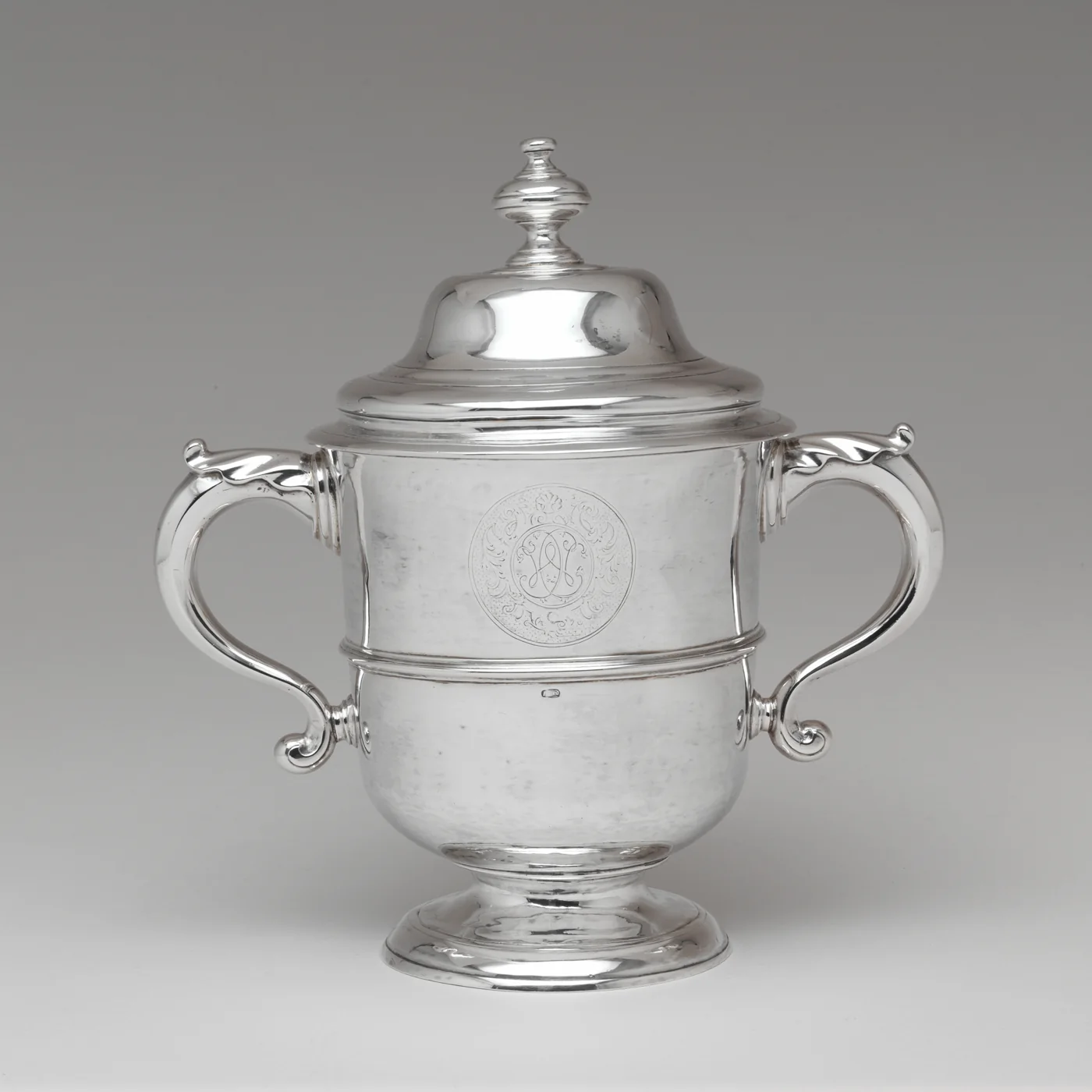
Jacob Hurd made this two-handled silver cup and cover in Boston around 1735–40. The Met notes that the form was favored for presentation in England but rare in colonial America. Its generous handles, domed cover and polished body give the engraving room to speak.
A 1983 Met publication says the original owner’s cipher is thought to be that of William Cave, a Virginia clergyman, and that the Cave and Petit arms on the other side were added later. “Thought to be” matters: it is an attribution, not a witnessed presentation. The publication describes such cups as usually presentation pieces, but does not establish the giver or occasion of this particular cup. Hurd is the maker; the identity of the commissioning patron and the circumstances of any gift remain open.
A trophy, a race and a careful inference
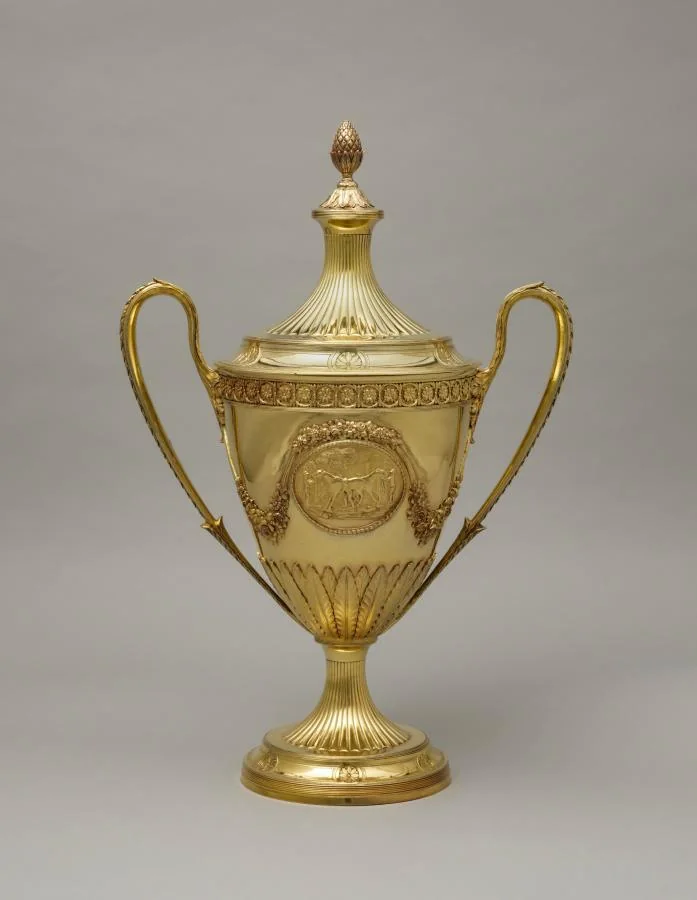
Peter Bateman and Anne Bateman made Cleveland’s silver-gilt trophy cup and cover in England in 1792–93. Its racing scene and engraved arms point in different ways toward the world around it. Cleveland identifies the arms as those of Robert Grosvenor and Lady Eleanor Egerton, who married in 1794, after the cup was made. The image shown here depicts the racing side; the arms are on the other side.
Grosvenor owned celebrated racehorses, and the museum considers it likely he received the trophy after a successful race. That is a persuasive interpretation of imagery and context, not an inscription naming a race, donor or winner. The museum’s published provenance begins with its own possession in 1968; that leaves much of the cup’s journey unrecorded in the online account. The makers’ names tell us who produced it, not who paid for it.
An ewer that names its cause
Princeton’s silver presentation ewer, made in Philadelphia by the partnership of Thomas Fletcher and Sidney Gardiner around 1820–25, tells a more explicit story. Its inscription identifies the presenters as friends of national industry in Philadelphia and names Eleazor Lord as recipient. It praises his efforts at Washington in support of American manufacturers during the first session of the sixteenth Congress.
Those are the presenters’ stated reasons, preserved in metal. They do not independently establish every detail of Lord’s activities or the circumstances in which the object changed hands. Princeton’s provenance identifies Lord on the basis of the inscription, then records Stuart P. and Sue K. Feld’s gift to the museum in 2021; the intervening ownership is not supplied in that account. The firm made the vessel, the named group presented it, and Lord was the named recipient. The museum’s record includes photographs and a full transcription.
The eagle-head motif and classical form also carry meaning. Princeton’s curator connects the design to ancient Roman metalwork and to the young United States. Form and inscription can be read together without treating either as a complete political biography.
How to examine a presentation piece
Record the words first. Photograph all sides in even light and transcribe the inscription, line breaks, spelling and punctuation as seen. Mark uncertain letters rather than silently correcting them. Keep the transcription distinct from identifications and historical interpretation. A date on the object may commemorate an event, while the vessel and its engraving may be older or later.
Look underneath and inside. Document maker, assay, standard or retailer marks where present, their positions and the whole object. Marks vary by place and period; an apparent mark, a name or a familiar shape alone does not authenticate an object. Compare the complete construction, dimensions and decoration with reliable records, and seek qualified examination when a purchase depends on attribution.
Study the surface and joins. Look for thin or uneven metal around erased inscriptions, different lettering, later plaques, solder, repairs, altered handles, replaced covers or a mismatched base. These observations suggest questions, not automatic verdicts. Gilding, worn edges and fragile attachments deserve care; repeated polishing removes material and may soften engraving. A conservator can advise on unstable parts and mixed materials.
Build a chain of evidence. Preserve receipts, catalogues, family accounts and photographs with their dates and sources. Distinguish a documented owner from a person merely named in a dedication, and record gaps. An inscription can lead to archives, but a matching name is a starting point for research, not proof of identity or provenance.
Continue with The Silver Table, silver water vessels, and documenting collectibles.