
Start with the beard
A face stares out of the middle of the dish. Dolphins thread through its hair, and what at first looks like a lavishly curled beard resolves into fronds of seaweed. The British Museum identifies the face as Oceanus. He takes up only the middle of the platter, but once you spot the dolphins, the rest of the silver starts to look less like a border and more like a world unfolding around him.
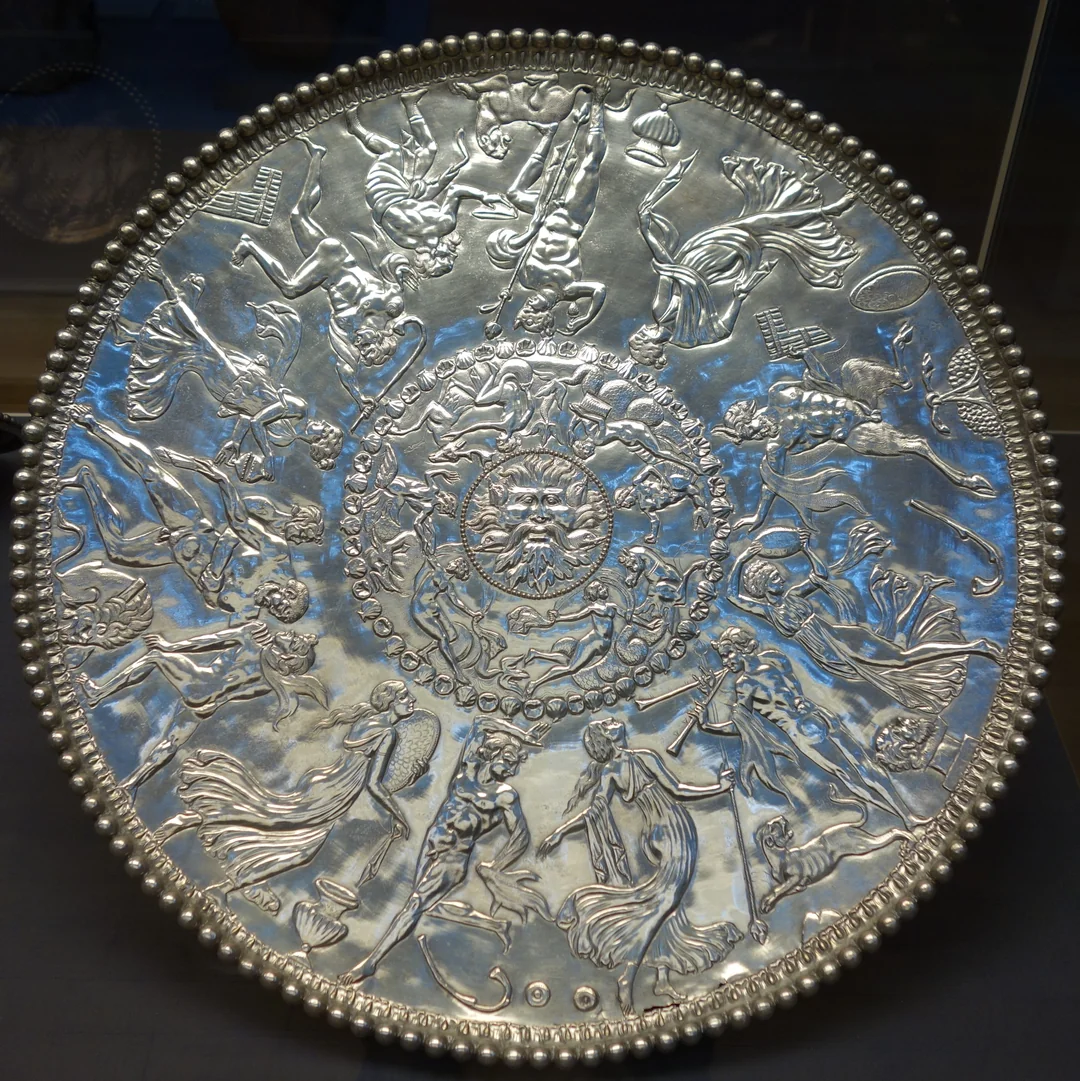
The Mildenhall Great Dish is a fourth-century Roman silver platter found in Suffolk, England. The British Museum’s catalog entry gives its diameter as 60.5 centimeters, just under 24 inches, and its weight as 8.256 kilograms, roughly 18 pounds. That is without anything on it. The shape is familiar, but set those numbers beside the dinner plate in your cupboard and it becomes easier to picture the effect this object would have had simply by being carried into a room.
Follow the sea creatures to the party
The first ring around Oceanus is edged with scallop shells. Look for the sea nymphs riding creatures that borrow their shapes from life on land and in the water. The museum identifies a sea stag and a ketos, a sea monster with something of a dragon about it. The shells make a boundary you can follow with your eye even before you begin to pick out the riders.
At the rim, the water gives way to a celebration. The figure with grapes and a foot resting on a panther is Bacchus, the god of wine. Not everyone at the party is holding up as well as he is. Hercules, the hero usually distinguished by his strength, has been overcome by wine. There is a joke in the contrast: here is a man famous for his labors who cannot hold his drink. Follow the rim rather than trying to take in the whole object at once and the big pattern breaks into incidents like that one.
Why put the sea on a dish about drinking? The museum reads the water and land scenes together as part of the world of Bacchus. That is a reading of the decoration, not evidence that the platter belonged to a temple, that its owner worshipped Bacchus, or that a banquet followed a particular ritual. What the scene does make plain is how much a widely recognized story could contribute to the life of a table object. You could get the joke without knowing the name of every creature.
What makes silver read like a picture?
Try looking at the face again, this time for the places where the metal catches light. The decoration uses both low relief and engraved lines. Low relief gives the faces and bodies some height above the surrounding surface. Engraving gives narrower details an edge. They do different jobs: a raised form can stand out from a distance, while a fine line can reward the person who leans in. You can see how much range an artist could get out of a material that is, at first glance, all the same color.
Was it actually a serving dish? The museum describes the Mildenhall find as late Roman silver tableware, but it does not tell us what was put on this particular dish, or how often it was used. A platter this large might bring food to a shared table; its dimensions and decoration would also give it a presence with nothing on it. Those possibilities are compatible. Notice, too, that food placed in the center would hide Oceanus first. It is hard to tell from the empty dish whether seeing the whole design was the point all the time. Our silver servingware guide looks at the same question in other settings: a vessel can play a practical part in a meal and give the people at the table something to look at.
What the find can tell us
The catalog gives the findspot as West Row, near Mildenhall, and puts the modern discovery in January 1942 or 1943. That uncertainty matters more than the temptation to pin the story to a neat date. Mildenhall is a name for a find, not the name of the workshop or the person who commissioned the dish. The place where buried silver was recovered does not, by itself, establish where it was made, whose table it was on, or what prompted someone to put it in the ground.
There is an instructive contrast with the clipped silver coins from the Hoxne Hoard. A coin with metal removed from its edge asks you to look at precisely the part that was taken away. This dish asks you to look at what an artist put there: a procession that gives a broad rim a reason to exist beyond containing what might have been served on it. Both finds survived in Suffolk. Neither gives us a complete account of the people who buried it.
Another Roman platter to look at
The Achilles Platter in the Hungarian National Museum’s online catalog offers a comparison. Its catalog records a diameter of 72 centimeters and a weight of 11.786 kilograms, so it is wider and heavier than the Great Dish. It belongs to the Seuso Treasure, a separate late Roman find. Look at how the center and rim divide its story, then come back to Mildenhall and see which details your eye finds first. For readers planning a visit, the museum lists its physical Seuso galleries as temporarily closed for renovations; the linked object catalog is online.