
The short answer: the torch that lit the flame at Olympia in 1992 was made with silver and ivory, according to the Games’ official report. The Barcelona 1992 relay torch was a different design, catalogued with aluminum, not silver, among its materials. Greek jeweler Ilias Lalaounis designed the first; André Ricard designed the second. Both carried the same flame at different stages. Olympic Museum: ceremonial torch replica · Olympic Museum: Barcelona relay torch
A small handoff before a long journey
On June 5, 1992, the Barcelona Olympic flame was lit in Greece, not Spain. The Hellenic Olympic Committee names Maria Pampouki as the High Priestess and Savvas Saritzoglou as the first relay runner. The Games’ official report describes Pampouki holding Lalaounis’s silver-and-ivory torch near a concave mirror. The mirror focused sunlight to kindle the flame, and a procession carried the flame in a bowl to the ancient Olympic Stadium, where Saritzoglou received it in his relay torch. Barcelona 1992 Official Report, vol. IV, p. 38. If you watched the Barcelona opening ceremony weeks later, you saw another handoff entirely: the one that ended with archer Antonio Rebollo’s flaming arrow passing over the stadium cauldron. Hellenic Olympic Committee: flame-lighting ceremony · Olympic Museum: Rebollo’s arrow
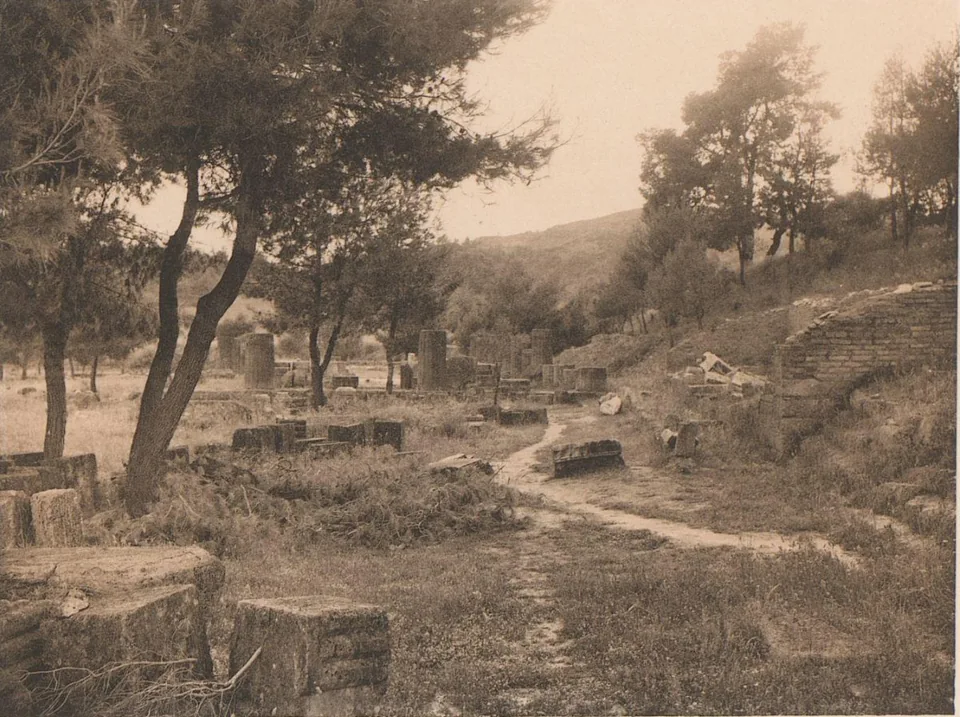
There’s an ancient setting and a modern ritual here. Olympia is the site of the ancient Games, but the Hellenic Olympic Committee dates the modern flame-lighting ceremony there to 1936. That distinction makes Lalaounis’s design more interesting. He wasn’t copying an ancient Olympic torch. He was designing a new object for a ceremony held among ancient ruins.
A temple column you could hold
The Olympic Museum points to the pillars of the Temple of Hera as the inspiration for the Lalaounis torch. The Hellenic Olympic Committee describes the ribs of classical temple columns and records that Lalaounis made the silver design for Juan Antonio Samaranch, to whom a torch was presented in 1992. The museum’s own silver example is a replica, not proof that the actual object used at the lighting now sits in that collection. Its record describes forged silver but does not give a fineness. The record does not establish that the silver is sterling, and the replica’s measurements do not establish the dimensions of the original.
That way of borrowing from antiquity shows up in Lalaounis’s jewelry too. In a 1978 necklace from his Shield of Achilles collection, now at The Met, the subject was Greek, but the workshop made its own change to an ancient chain-making technique. Instead of joining separate links, the goldsmiths wove a chain from one continuous wire. Lalaounis’s wife, Lila, gave the necklace to the museum in his memory. It is gold and rock crystal, not silver. Its relevance is how the workshop treated old forms as something to work with, not something to reproduce exactly. The Met: Shield of Achilles sautoir
Two silver-looking things, two different records
If you see a photograph or listing labeled “Barcelona 1992 Olympic torch,” start by asking which role it played. On its relay record, the Olympic Museum lists silver under color and metal and aluminum under materials. On the Lalaounis ceremonial replica, it lists silver under materials. Those fields answer different questions. Applied to a collector’s piece, the same reading habit helps separate what an object looks like, what it is made from, and what its paperwork can actually establish.
There’s a neat reversal in our Olympic medals story: a first-place medal can be called gold while most of the object is silver. With the Barcelona relay torch, a silver color doesn’t make it a silver object. At Olympia, the small distinction between appearance and material is also the difference between two designers, two objects and two moments in the same relay.