
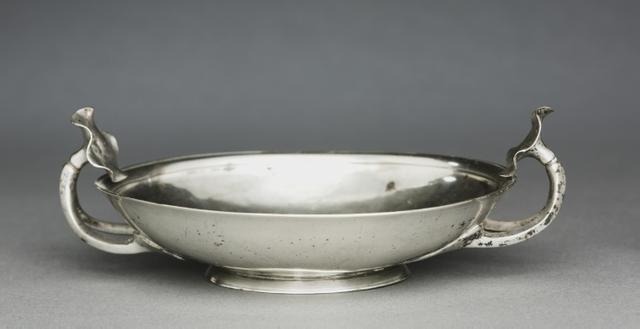
A low bowl and two branching handles give this silver cup a broad, open silhouette. It looks simple at first. The more useful question is how its surfaces meet: what appears to be one bowl is catalogued as a vessel made from two silver shells.
Construction the photograph cannot prove
The Cleveland Museum of Art describes two silver shells joined at the rim. It dates the cup to approximately the 200s BCE and identifies it as Greek. The recorded diameter is 15 cm; the overall dimensions are 6.1 by 18.2 cm. The museum explains that it served as a drinking vessel at banquets.
Double-shell construction is a catalogued fact here, not a diagnosis made from the photograph. A bright interior does not reveal the hidden space between surfaces. Nor does the apparent thickness of a rim establish how another cup was made. Keep the museum’s construction statement attached to this particular object.
Handles with small details
The museum calls the handles wishbone-shaped and identifies leaves at their bases and poppy flowers above. It also records a small pointed projection at the center of the interior. These details reward a closer examination than the overall silhouette alone.
In this view, follow each handle from the bowl outward and back. Look at how the narrow branches frame open spaces, then compare their curves with the rim. Small dark areas and highlights help the shapes read, but lighting is not a condition report.
A useful way to record a vessel
Keep three notes separate: the object’s catalogued construction, the features visible in the available view, and the details still unseen. For this cup, that means distinguishing the documented double shell from the visible handles and from questions about underside, joins or repairs. Do not turn an absent reverse photograph into evidence that nothing is there.
Explore how makers shape silver for a wider view of construction, or use the documentation guide to organize your own observations. Dates, dimensions and construction above follow the Cleveland Museum of Art record.