
1970 is the best-supported starting year for Gorham’s annual sterling snowflake series. But an ornament that looks like the first design isn’t necessarily a first issue. A 1977 newspaper item describes Gorham offering a sterling replica. The back, the original paperwork and the design each tell you something different.
The back was made to carry a memory
Gorham’s December 1970 advertisement in House & Garden introduced a new sterling tree ornament. It was 3½ inches across and advertised at $10. The announcement drew attention to the back: Gorham said it carried the year and left space for a personal inscription. The year told you which ornament you had bought. The extra space let you record what that Christmas meant to you. If you’re looking at one today, photograph the whole reverse before transcribing anything. Keep a factory mark and a personal inscription separate in your notes. Gorham 1970 advertisement, printed p. 100.
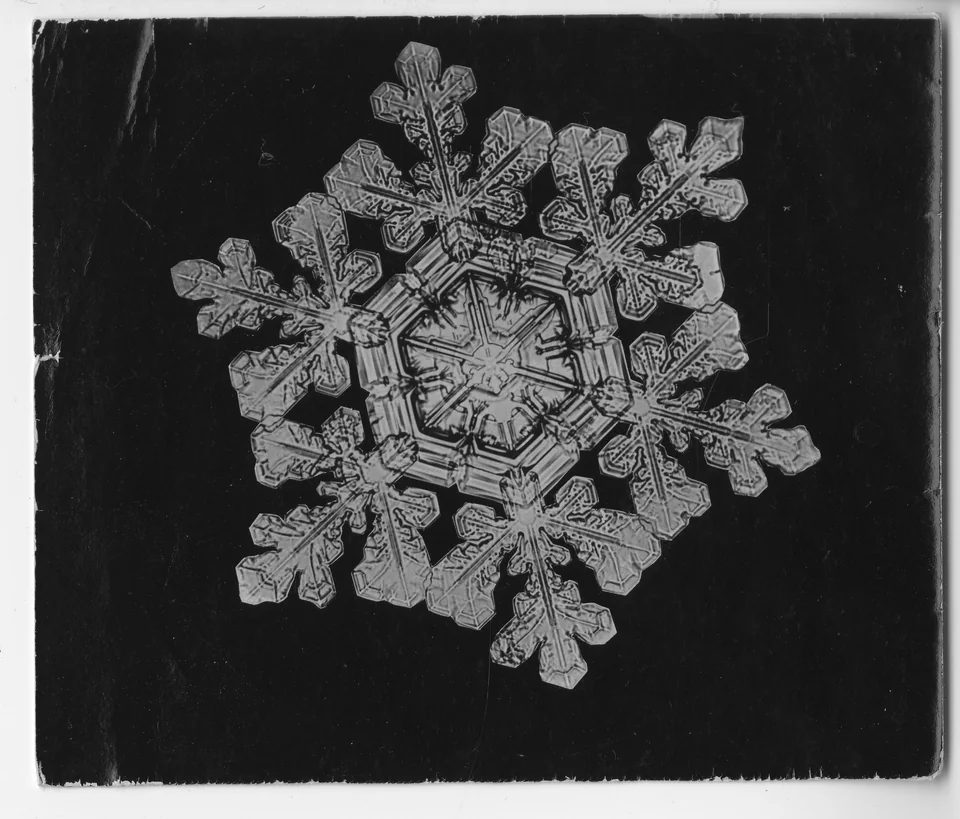
One reason the reverse deserves a whole photograph is that a date can be part of the design or part of the ornament’s life afterward. A transcription is easier to search, but a photo records where the letters sit relative to the year, the hanger and the maker’s mark. A Christmas inscription may connect the object to someone without telling you when the factory made it. If the ornament was a gift, save the name as carefully as you save the date. It may be the only reason a later owner knows why this particular snowflake stayed in the family.
The ads put 1970 ahead of 1969
Years later, former Gorham salesman Charles Osenton recalled a 1969 launch, including the Philadelphia jeweler J. E. Caldwell taking a substantial share of the run. That recollection gives us a view of how an ornament reached customers, but it doesn’t establish a dated 1969 issue. Replacements starts its catalogue in 1970. The December 1970 ad calls the ornament new, and Gorham’s own December 1976 ad calls that Christmas’s sterling snowflake the seventh annual edition. Count back from 1976 and you land in 1970.
There’s one catch: a retailer advertisement in the very same December 1976 issue calls the 1976 flake the sixth. It doesn’t explain its count. That’s why it helps to know who placed an ad. Gorham’s own announcement and its earlier description of a new ornament are stronger evidence for how the company counted the annual series. They still don’t tell us what Osenton remembered as happening in 1969. Gorham 1976 advertisement, printed p. 18 · Downs Collectors Showcase, printed p. 173 · Gorham Archive source trail.
There’s a second contemporary check that doesn’t depend on counting backward from 1976. A November 1972 retailer ad calls the Gorham sterling snowflake the third in the series. That count also puts the first in 1970. It’s still a retailer’s ad, not a company production record. What makes it useful is that it agrees with the first advertisement and Gorham’s later numbering. The same ad calls a Towle medallion the second in its own series. Keep the two counts separate: the Gorham and Towle labels referred to different ornaments on the same shopping page.
It also matters what 1970 answers. It is the best-supported first year for the annual series, not a complete timeline of when the design was sketched, ordered or shown to a retailer. The recollection and the advertisements can both be useful without solving every part of that timeline. A collector’s record can carry both: “first annual edition documented in 1970” in the main entry, and the unresolved 1969 recollection in a note with its source.
The first design came back
A December 1977 Summit Herald holiday feature, drawing on a Gorham executive, describes a sterling replica of the first snowflake. It doesn’t show us how the replica’s back was marked, give a production count or tell us how to distinguish an individual replica from a first issue. Its value is the fact of the offer: the company itself put the first design back into circulation. A match on the front can identify a design without dating the piece. A later replica offered by Gorham is not the same as a counterfeit. The Summit Herald, Dec. 1, 1977, printed p. 17.
A replica belongs to the maker’s history too. The surviving description tells us that the company thought the early design worth offering again. It doesn’t tell us whether the later offering was easy to distinguish in the hand. That makes a clear front view the beginning of an identification, not the end. It is enough to put two pieces side by side and ask the next question. It isn’t enough to give both pieces the same date.
Before you label one “1970 original”
Save clear photographs of both sides, copy every mark, and record dimensions and any packaging separately. Look for a year that is integral to the piece and distinguish it from a gift inscription. Compare against a documented example rather than treating an old-looking box as proof. If you can only match the shape, record “first design; issue unverified.” And don’t let the year stand in for the metal: the ornament series guide documents a 1980 silverplate example. A first design, a first issue, and a sterling ornament are three different claims.
When you compare records, give each piece a line of its own even if two examples share a photograph or seller description. Separate the observed words from your interpretation. “No date visible in seller’s photos” records a gap. “Undated” can sound like you’ve examined every surface. A saved ad supports what the company offered at the time; a receipt or dated gift note may help trace an individual piece. Those are both good clues, but they aren’t substitutes for one another.
Explore the ornament collection · Learn to document a collectible.