
A family’s Hanukkah lamp
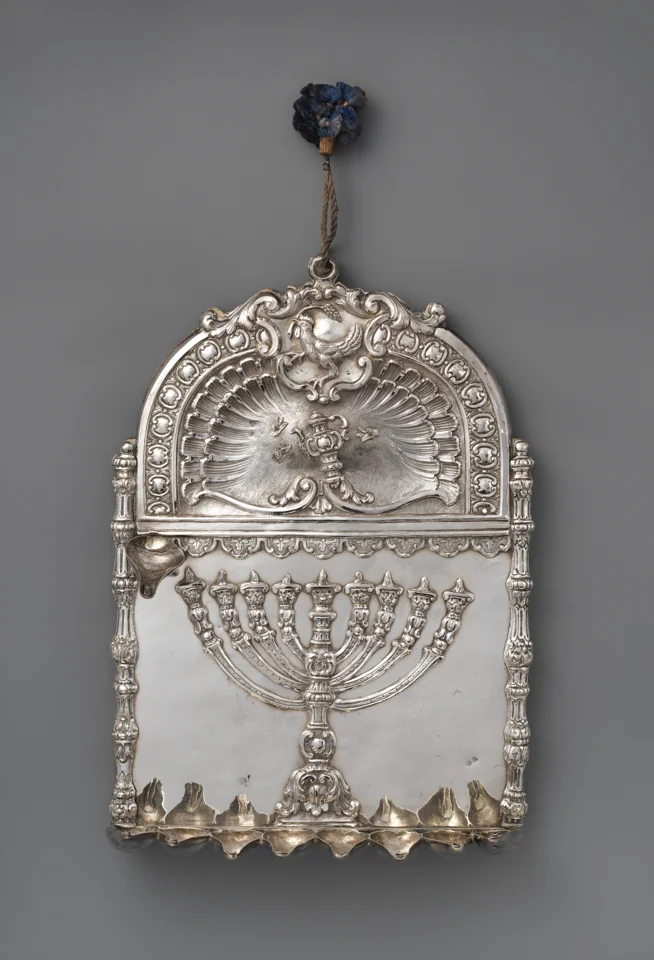
In the Jewish festival of Hanukkah, lights are kindled across eight nights. Practices and household objects vary. Chabad’s guide describes adding a light each night and using a separate shamash, or attendant light. Silver is one possible material for a lamp, not a requirement of the observance.
The Met identifies this Roman lamp as a commission for the Baraffael family. Gaspare Vanneschi worked its silver through embossing, engraving, and punching; a wooden support sits behind it. The family’s rooster crest and the bees the museum connects to Deborah Baraffael make the lamp more than an anonymous example of a form. A close look joins the festival’s recurring practice to one family’s particular history.
Finials for a Torah scroll
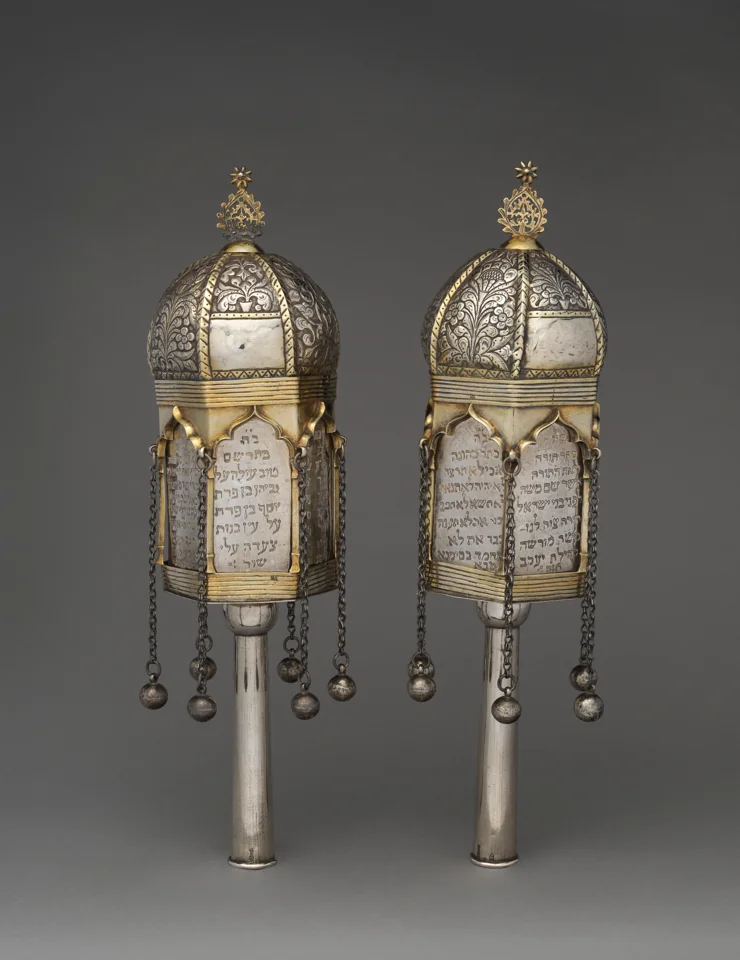
Torah finials, often called rimonim, can adorn the projecting handles of a Torah scroll. This pair was made in Tiflis, now Tbilisi, Georgia. The Met notes Hebrew inscriptions and a mixture of Jewish, Ottoman, and neo-Gothic motifs. Their architectural silhouettes and suspended bells reward a slow look at how a maker brought different visual languages together.
Ornament is not a substitute for the scroll or the reading of it. These finials show one documented artistic response to a tradition, rather than a single design shared by all Jewish communities. The museum’s acquisition credit begins the object record; it does not establish every earlier owner.
At the table and the close of Shabbat
The existing Passover seder plate study follows a Turin plate made for a meal of remembrance and discussion. Its gallery image is already part of the collection. A separate Havdalah candle holder and spice box connects silver to a ceremony marking the close of Shabbat; see its gallery image.
These are different occasions, with different objects and meanings. Together they make a useful invitation to look at inscriptions, forms, and the people who used them before assigning a meaning to the metal.