
Griffins, vines and a very small hunt
Start at the bottom of the engraving. Two griffins turn their heads back toward their wings. From there the vines curl up and around the vessel. Look again at the tiny figures among them. Some carry implements; one reaches toward a creature with a curved tail. A Victorian museum description, preserved in the Powerhouse collection record, calls the scene boys attacking shrimp.
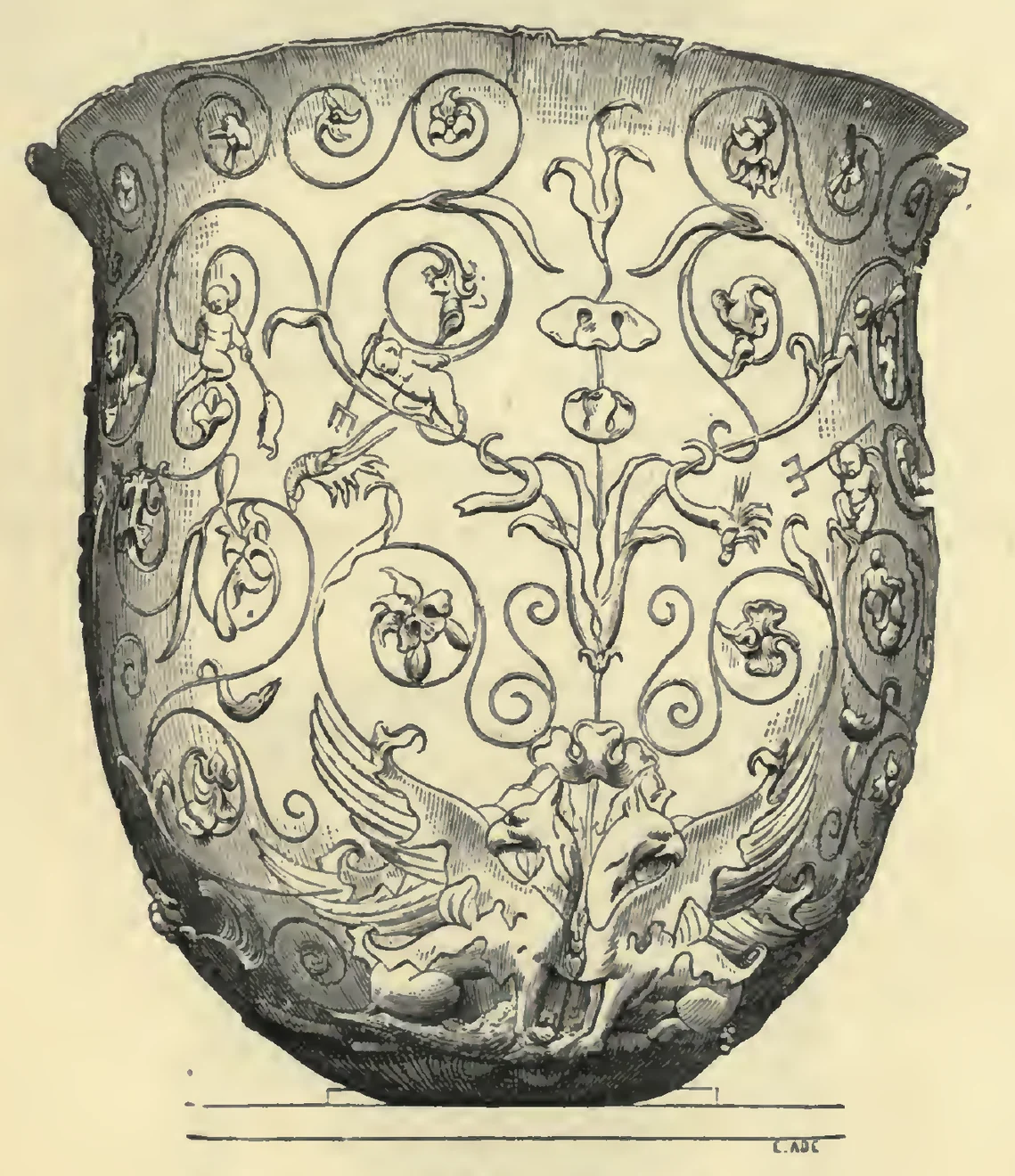
The scene decorated a Roman krater, a vessel for mixing wine. The original silver surface shown in the engraving is missing. What survived of the vessel is less showy but more revealing in another way: a silver liner and rim with an ancient inscription. The ornament and the words reached us by different routes.
What came out of the ground
Soldiers working on a shooting range in Hildesheim found the hoard in 1868. The Berlin Antikensammlung describes more than seventy pieces of Roman table silver, with smaller objects stacked inside larger vessels. Its Athena bowl record shows a different surviving piece from the same find. The arrangement tells us something about how the vessels were put away; it does not identify the person who buried them or explain why.
The krater had two silver walls with different jobs: the liner held the contents, and the decorated shell faced outward. A report published in 1868 describes the decorated shell already detached from the liner. Its author suggested a reason for the separation. The separation was observed; the explanation was a hypothesis.
The object changed again after excavation. Berlin’s loss catalogue records that restorers working between 1895 and 1901 reattached the handles and foot, filled losses with smooth silver, and reinforced the fragmented hollow foot with plaster. A later photograph can therefore show the result of that work as well as ancient metal. The engraving above does not show the foot at all.
A copy that introduces itself
Plaster molds were made in Hildesheim soon after the find. In a 1907 museum handbook, Julius Lessing explains that casts supplied iron and zinc-composition reproductions. Christofle took another approach: the firm checked and corrected the plaster casts against the originals, then used the models to make silvered copper reproductions by electroforming. Berlin silversmith Humbert used casts and worked in front of the originals to hammer copies of principal pieces in silver. The museum showed work from both shops. This is an account of the set, not a record of which details were corrected on the krater.
One individual copy still introduces itself. The Musée d’Orsay’s krater, DO 1985 3, is dated around 1870. Its reverse identifies it as a galvanic facsimile of the Hildesheim treasure and names Christofle and Bouilhet. The catalogue calls its body electroformed copper, silvered and partly gilded. The copper gives the copy its shape; the silver and gilding give it its finish. The makers donated the vessel to the Musée de Cluny in 1871 as part of a 27-object set.
The MAK in Vienna records another Christofle example, acquired in 1873. The Powerhouse in Sydney acquired an Elkington version in 1886. Those are acquisition years, not necessarily manufacture dates. The records establish separate copies, not that their makers used the same mold. For the technique, see why museums collected electrotypes; for another example, compare Elkington’s nautilus cup and its model.
The liner that survived
Berlin’s catalogue traces the surviving liner with material evacuated via Grasleben to Celle in 1946. Its separate entry for the decorated outer shell, Misc. 3779, 62, instead documents wartime storage in the Friedrichshain flak tower. It does not establish what happened to the shell afterward. Earlier accounts offered different fates; the catalogue does not make either account certain.
On the surviving rim, Berlin reads CVM BA[SI] P XXXXI […]: with the base, at least 41 Roman pounds. The last marks are incomplete; the catalogue notes additional numeral traces. That is a lower bound for the inscribed weight with the base, not an exact weight for the original and not the weight of the liner by itself.
What the copies preserve
Another copy kept a different inscription. An auction catalogue records a Christofle-marked example, numbered 201, with an 1892 dedication from Hildesheim to the painter Hermann Prell in grateful recognition. The catalogue describes this example as silver-plated brass, not the copper recorded for the Orsay vessel. Prell finished a series of town-hall murals that year, including an imagined scene about the silver hoard, documented by his contemporary Friedrich von Boetticher. The dedication does not establish the occasion of its presentation.
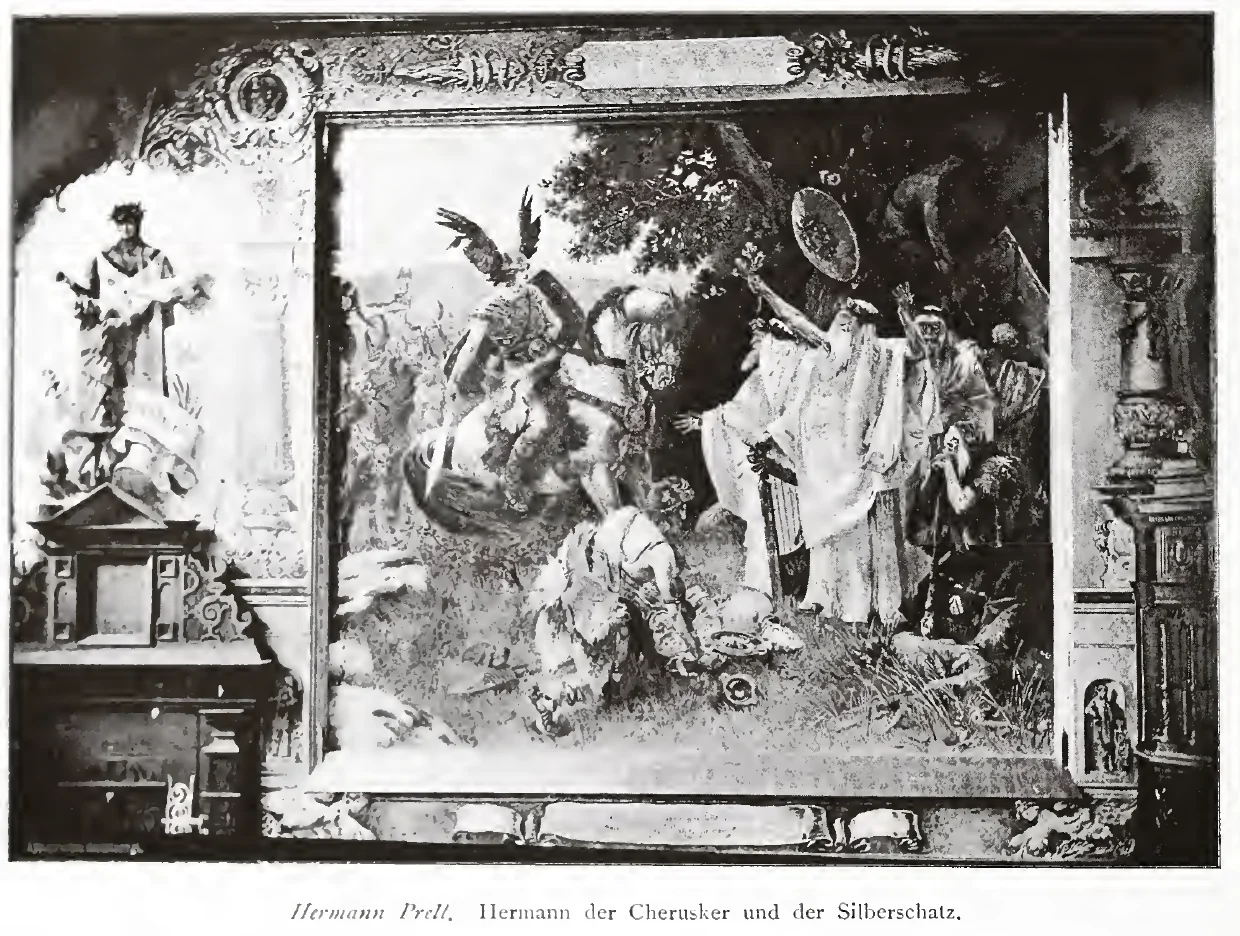
Three things can now be read separately: the Roman weight mark, a maker’s frank declaration that its vessel is a copy, and a city’s dedication to a painter. The first belongs to the ancient silver. The other two tell us what later generations did with its design. The same honesty that makes the copy plainly not Roman makes it useful: it keeps the relief available to see, while its own marks tell us who carried that design forward.
Keep following the evidence with the Christofle maker profile and what sits beneath silverplate. For a different kind of survival, see the cut Roman silver from Traprain Law.
Sources and image rights
Read the records behind the story
- Barbara Niemeyer, Berlin Antikensammlung loss catalogue, p. 253, Misc. 3779, 62: restoration, separate wartime records and incomplete inscription.
- 1868 report on the Hildesheim find and Berlin’s Athena bowl record: discovery and arrangement of the hoard.
- Julius Lessing, Gold und Silber (1907), p. 24: early casts, Christofle’s method and Humbert’s work.
- Musée d’Orsay, MAK and Powerhouse: the three catalogued copies. Their modern photographs are linked, not reproduced.
- Mehlis, lot 3171, and Boetticher, Malerwerke des neunzehnten Jahrhunderts (1898): the dedication and mural cycle.
Both reproduced images are U.S. public-domain printed illustrations, not present-day photographs of the surviving liner. The first is a crop of the complete engraved figure with the engraver’s mark; the second retains the figure and caption of the period reproduction.