
The fireplace that looked like silver
Inside the Metropolitan Museum of Art is a fireplace almost four feet high that makes a good argument against identifying silver by sight. The British basket grate and fireback date to about 1780. Even in the black-and-white photograph, the polished-looking ornament stands out from the back of the fireplace. Then comes the museum’s materials line: paktong and iron. The light-colored ornament isn't described as sterling or as silverplate. Its color belongs to a different metal altogether.
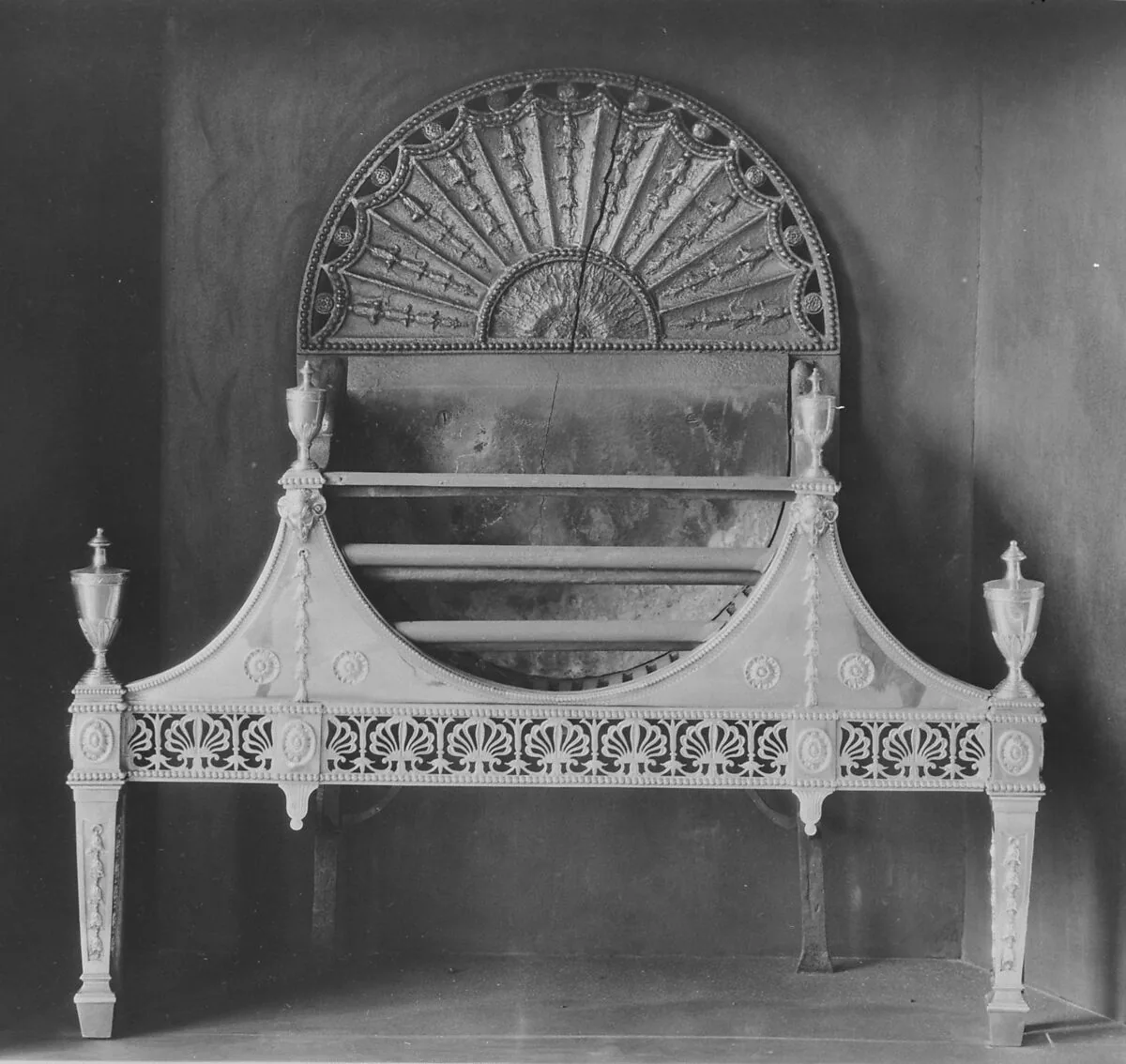
Paktong takes its name from the Chinese term for “white copper” (白銅). The name tells you something useful about how the metal was understood: this was copper that no longer looked the way a buyer might expect copper to look. Nickel and zinc helped give the alloy a pale color. In a Qing tiered box at the Met, the same kind of metal does a quieter job. The museum identifies paktong as the ground beneath the painted enamel. Both records name the alloy, but one object draws attention to the metal and the other lets it support something else.
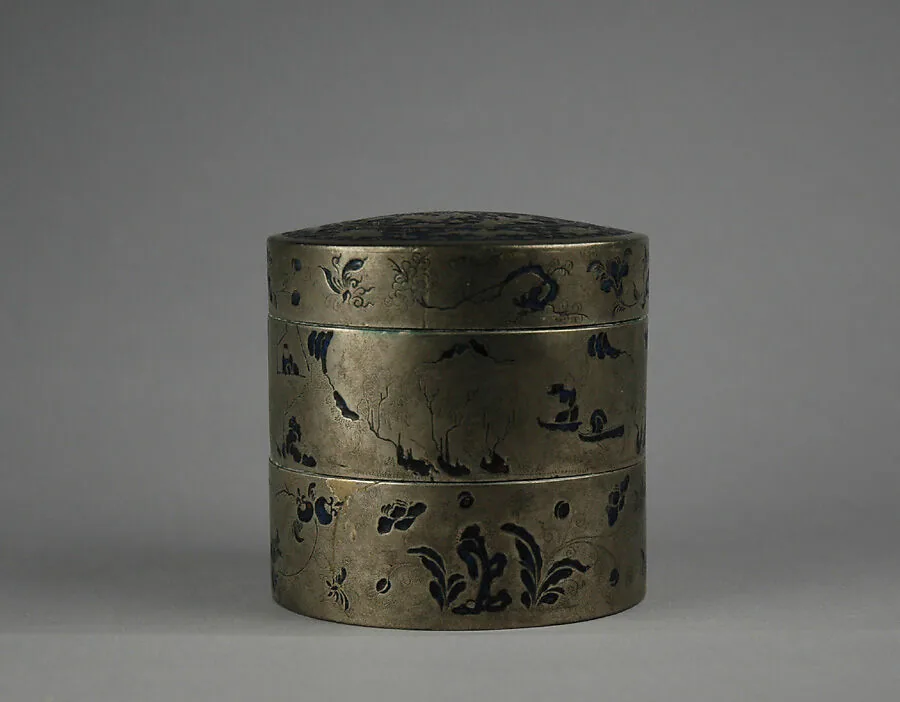
Neither object is an early piece of EPNS. There is no documented journey from this particular box to this particular fireplace, let alone to a Victorian spoon. The connection is that Chinese makers had worked out how to make a useful pale copper alloy long before European factories learned to manufacture related alloys at scale. British metalworkers first valued that color where it could be seen. Later they would value it even where it was supposed to be hidden.
That last use explains the seemingly contradictory mark EPNS, short for electroplated nickel silver. The nickel silver is the base metal. It is an alloy of copper, nickel and zinc, with no silver as an intended ingredient. The real silver is the coating. Once you know that, the interesting question isn't why a piece can be called silverplate. It's why a factory would bother to start with a silver-colored metal before covering it with silver.
What the metal carried from China
Historian Chao Huang traces a trade in Chinese white copper through Yunnan and Canton, now Guangzhou. What reached European buyers was not always a finished teapot or fitting. In the 1770s, the Swedish East India Company trader Peter Johan Bladh sent material for the Swedish chemist Gustav von Engeström to examine. Engeström's 1776 account described rough metal brought down to Canton in large triangular rings. His description suggests a useful distinction: the copper-nickel material from inland could still look reddish. The pale finished alloy was a further product of metalworking, not a white metal simply dug out of the ground.
The finished color was a controlled result. Chinese producers could combine nickel-bearing and copper-bearing materials and refine them before adding zinc. Huang brings together European travelers' and chemists' accounts with later metallurgical work, which is useful because the early reports do not tell us everything about the workshops. It also shifts the center of the story. Europe did not invent the metal and then trade it east. European traders and experimenters were trying to understand a material that Chinese producers already knew how to make and use.
Trade carried objects and samples sooner than it carried reliable instructions. Huang describes private orders in the records of Matthew Boulton's business, one reason official trade figures do not give a complete picture of how much paktong entered Britain. A bought sample could tell a chemist what was in that particular piece. It could not necessarily tell a metalworker where to get reliable nickel, which proportions to order for everyday manufacturing or how to make each batch behave the same at the bench.
There is a paper trail for that gap. In July 1822 the Scottish chemist Andrew Fyfe published an analysis of Chinese white copper. He reported about 32 percent nickel in his sample. Huang's comparison with later studies makes clear why that is evidence about a sample, not the formula for every object called paktong. Historical objects vary, and the compositions of European nickel-silver alloys varied as well. A modern material name is not enough to assign the origin of an unmarked object.
Factories needed a supply as well as a recipe. In Saxony, Ernst August Geitner experimented with a nickel alloy known as Argentan in 1823; a later manufacturing account places production in 1824. Nickel could be recovered from residues of the cobalt industry, which supplied the blue pigment known as smalt. The useful point is not a race for a single invention date. It is that a metal once arriving as a specialty import could now be made in quantity from a different stream of materials. By the time Birmingham platers looked for a pale base metal, they had an industrial supply to build on.
Why a copper edge gave the game away
Imagine looking across the rim of a salver rather than down at the polished center. In Old Sheffield plate, the craftsman started with layers of silver and copper fused and rolled into sheet. A cut through the sheet could expose the copper. A maker could fold the edge or apply a separate edging to conceal it. The rim was not just ornament. It solved a problem built into the material.
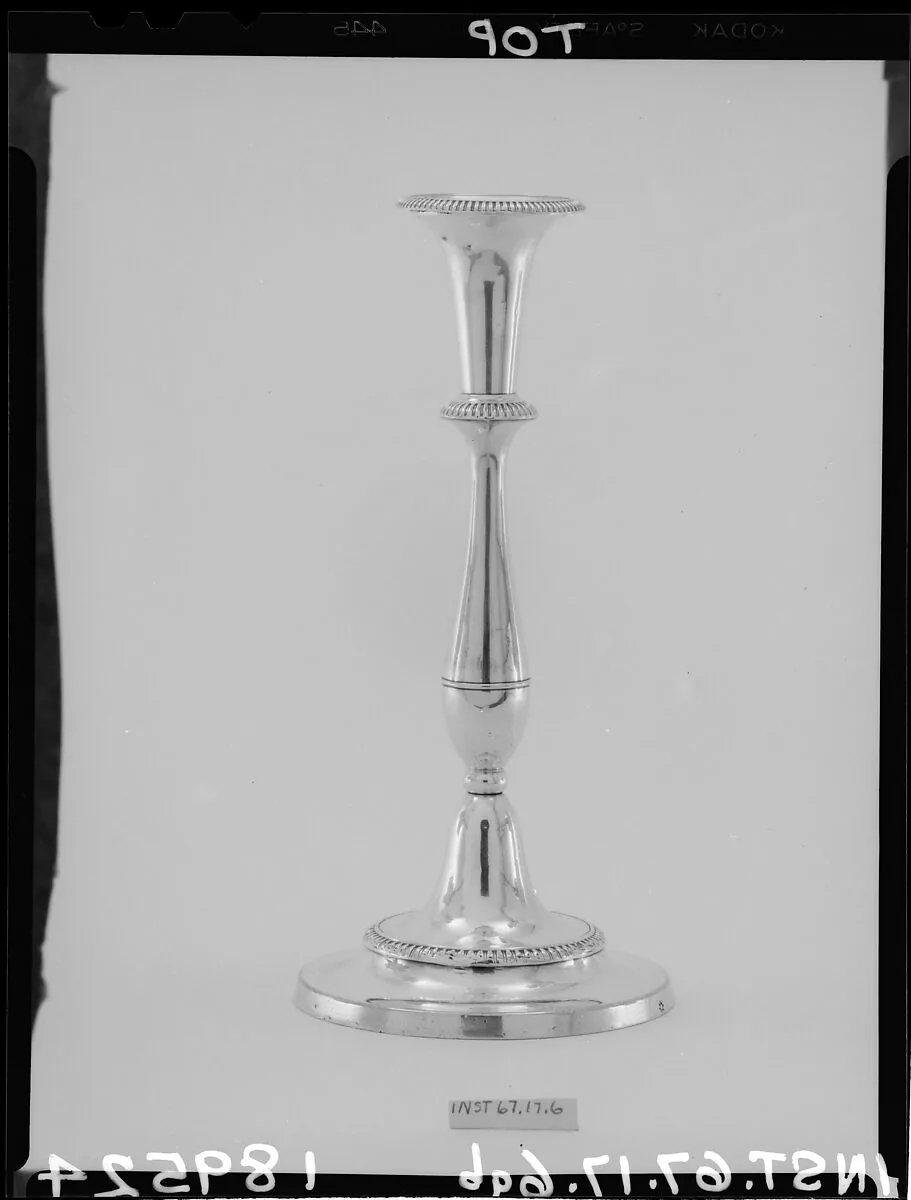
Even when the edge was dealt with at the workshop, use could uncover the copper later. A raised ornament or rim receives more contact during cleaning than a recessed surface. When the outer layer wears through in the right place, the copper may show as a reddish patch. That does not make the piece worthless or badly made. It is a record of how the object was made and what happened to it afterward. Not every piece shows that wear, and a spot of exposed copper does not establish a date or distinguish every fused piece from electroplate over copper.
A base of nickel silver changes that visual contrast. Wear can still take the silver off, but it exposes a pale alloy rather than red copper. That is one reason the pairing makes sense. Another is what the new plating process let a maker do: form the spoon, body or fitting first and then put its silver surface on. On an object made from fused sheet, the maker worked with the silver layer already in place before cutting and shaping it. On an electroplated piece, the layer could follow the shape. The order of work matters as much as the color.
There was no clean handover from one age to the next. Makers had several choices, including copper and tin-based Britannia metal, and a white substrate was not an inevitable result of electroplating. Britannia metal still appears beneath some plating, and it is not the same thing as the high-fineness alloy called Britannia silver. The names and materials can sit close together on a tea tray; the objects need to be read one at a time.
The surgeon behind the patent
By 1840, Birmingham's metal trades already had people trying to put precious-metal coatings onto less costly objects. What mattered commercially was not merely getting silver onto a surface but getting a coating that held well enough to finish and use. John Wright, a Birmingham medical practitioner, approached that problem through chemistry. As Jo Gane reconstructs in the Science Museum Group Journal, Wright drew on earlier observations by Swedish chemist Carl Wilhelm Scheele. His experiments with a cyanide-based electrolyte gave the trade a practical way to use an electric current to deposit an adherent silver coating.
Wright's name is easy to miss if you start with the patent. British Patent No. 8447 bears the names of George Richards Elkington and Henry Elkington and dates to March 25, 1840. The full specification was enrolled in September, after Wright and the cousins had reached an agreement that allowed his process to be included. The March date was not the date on which Wright was named a patentee. He wasn't. The distinction changes the story: the name on the patent tells you who held it, not who contributed every part of the process.
There was someone with a foot in both trades. In the 1830s Charles Askin partnered with Brooke Evans in a Birmingham business that refined nickel. In 1840, according to Alistair Grant's research in the Elkington archives, Askin introduced Wright to the Elkingtons and advised Wright to secure an agreement before disclosing his method. Look at the story from Askin's side and the leap from a pale alloy to a plated object looks less mysterious. The people who knew how to get nickel into manufacturers' hands were close to those trying to get silver onto the finished work.
Gane also follows an alternative that shows how unsettled the field still was. In 1842 John Stephen Woolrich patented a different electrical approach to plating. Gane traces it into the workshops of people preparing silver-coated plates for early photography. What mattered on a light-sensitive photographic plate was not necessarily what a cutlery maker wanted on a fork. In the same city, two trades needed controlled silver surfaces and had different reasons to care about how those surfaces formed.
The date 1840 matters for the history of the process. It does not tell us when anybody first stamped the letters EPNS onto a spoon. Nor did the patent make an electrotype the same thing as plated tableware. Our guide to electrotypes and electroplate explains the difference: in one case a deposit can become the new object; in the other it is a finish on a body that already exists.
The blanks and the finished pieces
An American catalog in the Met library makes the industrial division of labor unusually plain. The Connecticut firm Luther Boardman & Sons sold “18 pct. Nickel Silver Flat Table Ware Blanks (for Plating).” A blank was an article or part supplied for further work, not a finished sterling spoon. The 18 percent in the catalog title described the nickel grade of the alloy, not a share of precious silver. A buyer could order the pale supporting metal as a product in its own right, before the maker added the surface the customer would see.
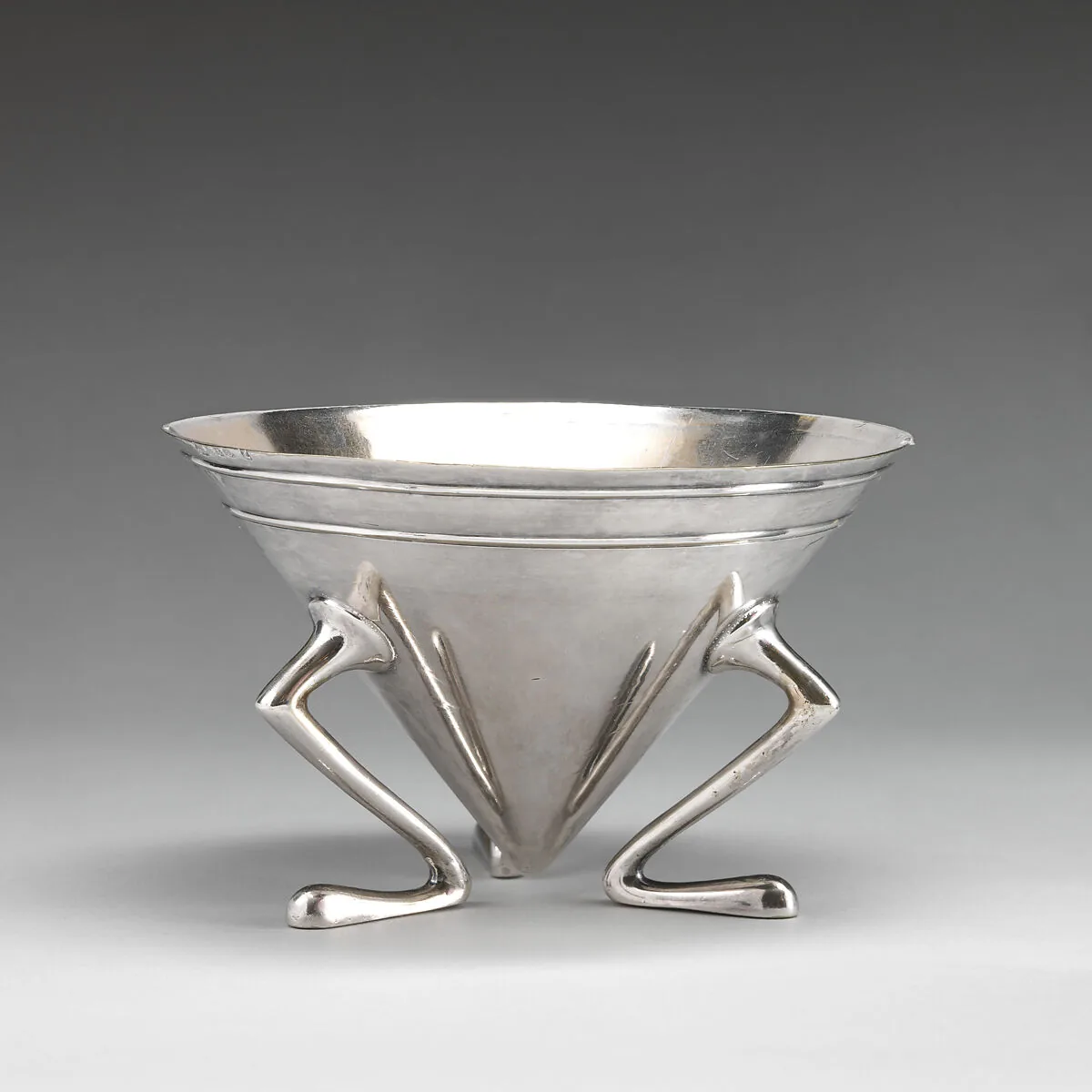
Compare two objects made by Elkington & Co. One is Christopher Dresser's geometric sugar bowl, with its pointed bowl and angular supports. The Met catalog calls the material silver-plated nickel. That is enough to call it silverplate here, but not to certify the precise alloy under the coat or claim a photographed EPNS stamp.
The other is an Elkington coffee pot at the Cleveland Museum of Art, dated about 1850. Its curved silhouette and ornament could hardly be more different from the Dresser bowl. Cleveland catalogs the pot in silver and ivory. The same maker's name appears in the records, but that name is not a material test for either piece. A collector who puts all Elkington under “plate” would miss half the lesson; a collector who calls every Elkington piece sterling would miss the other half.
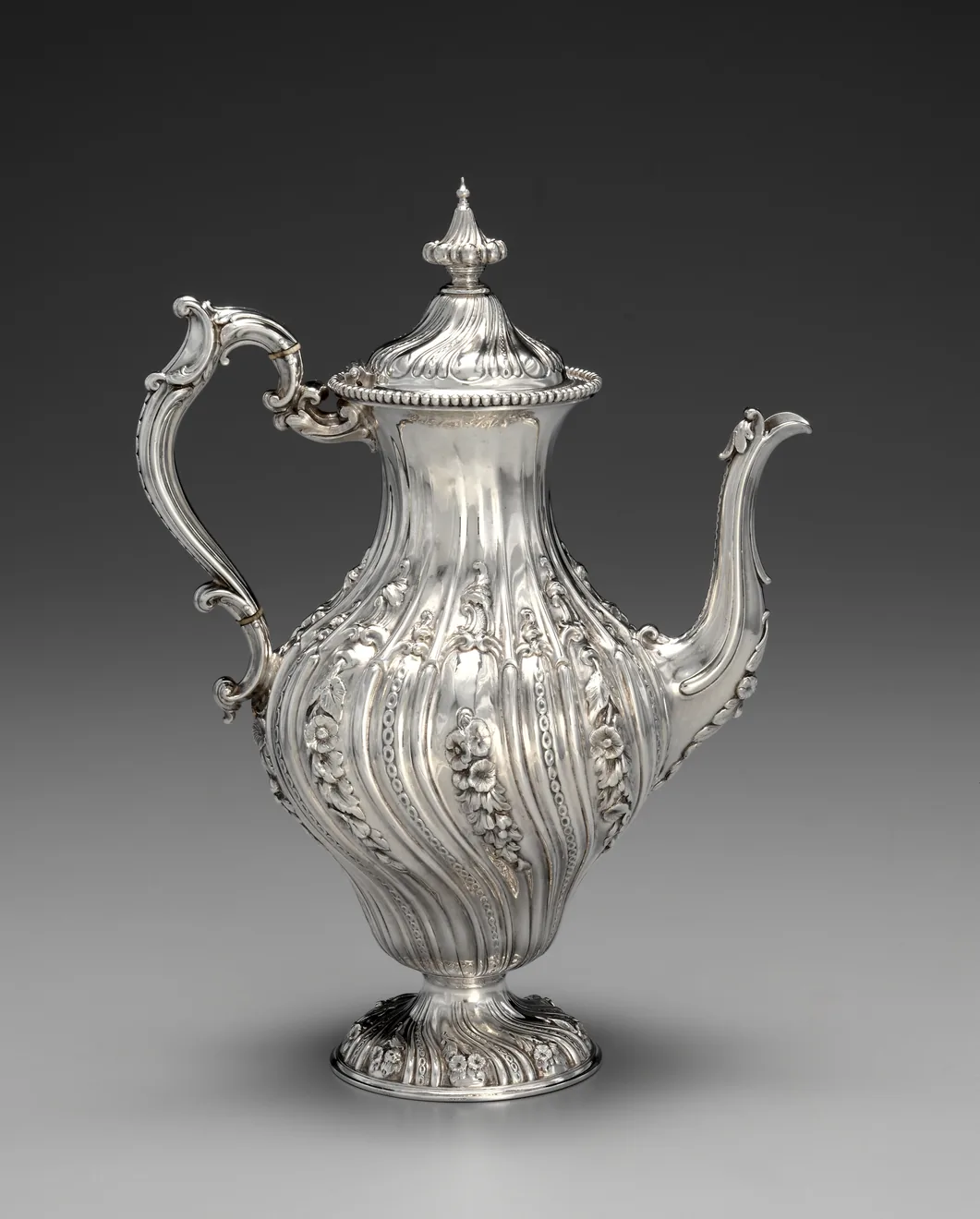
This is also why the history is more than a lesson about imitation. The fire grate shows a pale alloy used for its own look. The catalog shows that an alloy could be a commodity sold to somebody else who would finish it. The Dresser bowl shows the finish put to work in a design that is not pretending to be an eighteenth-century heirloom. Each object tells a different part of the story. None needs to do all the explaining on its own.
What to look for when you turn a piece over
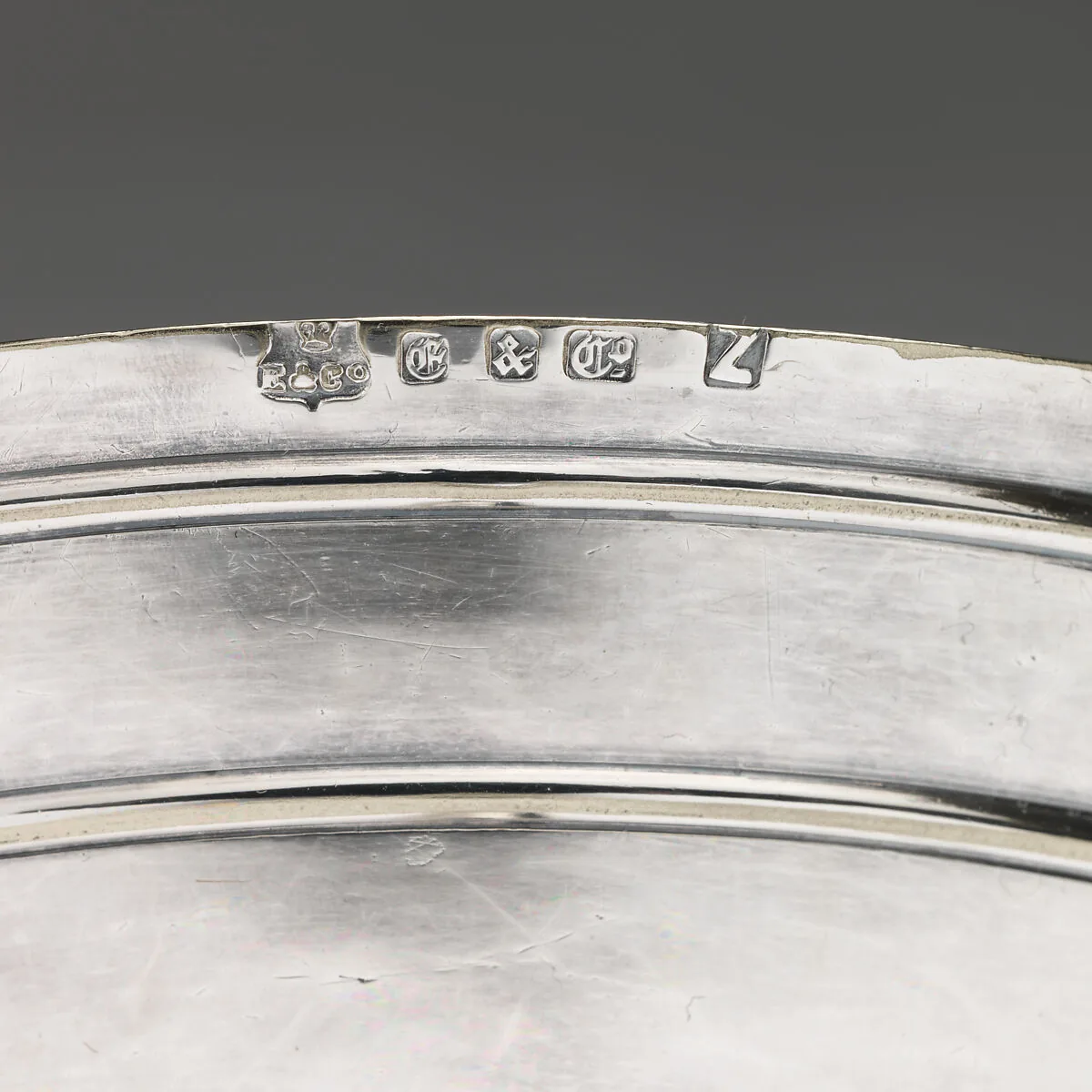
Start with the words as they were stamped. EPNS names electroplate over nickel silver. EP indicates electroplate without naming the base metal. EPBM names electroplate over Britannia metal. A numeral or trade stamp elsewhere on the piece may be a pattern number, a maker's grade, or part of a different mark altogether. A row of shields or ornate initials is not automatically an official hallmark. Photograph the whole group before chasing the single symbol that looks familiar, and compare it with the hallmark and material-mark reference.
Go back to the Dresser bowl and look closely at its rim. The marks form a neat, official-looking row. Yet the Met’s materials line still says silver-plated nickel. The photograph is not an EPNS example; it is a reason to resist treating a row of tidy punches as proof of sterling. Record the shape of each punch and its position, not just the letters that survive. If you cannot match the whole group to a reliable record, leave the mark unresolved rather than trying to make it fit.
Look under soft, angled light at areas that would have been handled or cleaned often: the back of a spoon bowl, the raised parts of an ornament, the lip of a pot. Changes in tone can help you decide where to look again, but under a silver-colored coating a pale base can be hard to spot. Lighting, tarnish and past cleaning complicate the picture. Do not create a test spot by filing or scratching, and don't work harder with polish to “bring it back.” If the coating is already worn through, polishing can't replace it.
Keep three descriptions separate in your own notes. A piece described as nickel silver can have a silvery color without a silver coating. An EPNS piece has silver at the surface. A sterling silver body is made from a silver alloy of the relevant fineness throughout the body, not just at the surface. That last description doesn't mean an entire knife or teapot is made of one material. Blades, handle fittings and bases can differ. The guide to tea-service components explains why a single mark should not be carried across a whole assembled set.
In the United Kingdom, the Hallmarking Act's exemptions distinguish an accurate, qualified description of a plated article from an unqualified description as silver. An EPNS mark is a material description, not an assay-office hallmark. For someone sorting an inherited service, the useful result is an honest description of what they know and what they haven't checked yet.
A worn silverplate spoon won't tell you the mine its metals came from, who polished it, or exactly how much silver is left. It can tell you something the polished face by itself cannot. Turn it over and those four letters name the two materials that had to meet before the spoon could look the way it does: the pale alloy carrying the shape, and the silver giving it a surface. The alloy that once caught the light on a fireplace ended up with a different job at the table. It was there to do its work without being seen.
Sources and object records
- Chao Huang, “Metallurgical Knowledge Transfer from Asia to Europe”, Artefact 8 (2018), pp. 89–110. Chinese production, the Swedish analyses, the trade in paktong and European alloy development.
- Andrew Fyfe, analysis of Chinese white copper, Edinburgh Philosophical Journal vol. 7, no. XIII (July 1822), pp. 69–71. The original analysis, distinct from the later correspondence.
- Saxon Biography: Ernst August Geitner and the nineteenth-century manufacturing account in Dingler's journal.
- Jo Gane, “Photography and Electroplate in 1840s Birmingham” (2023), and Alistair Grant's research on German silver and Elkington, especially p. 73 and note 56.
- Contemporary patent register and published Elkington patent abstract.
- The Met: grate and fireback 29.118.7a, b, Qing box 59.150.5a–c, candlestick Inst.67.17.6, Luther Boardman catalog 50.544.2, and Dresser sugar bowl 2021.7.2. Cleveland Museum of Art: Elkington coffee pot 2003.243.
- UK Hallmarking Act 1973, section 1 and Schedule 1, Part I.