
The bowl that came up first
On May 12, 1919, at Traprain Law in East Lothian, the excavation foreman George Pringle felt his pick catch on something. He tried again and brought up a metal bowl with a beaded rim. The crew exposed more silver, then covered the pit for the night. Alexander Curle, who led the excavation, arrived the next afternoon and saw some of the deposit still where it had been buried, over and between two large stones.
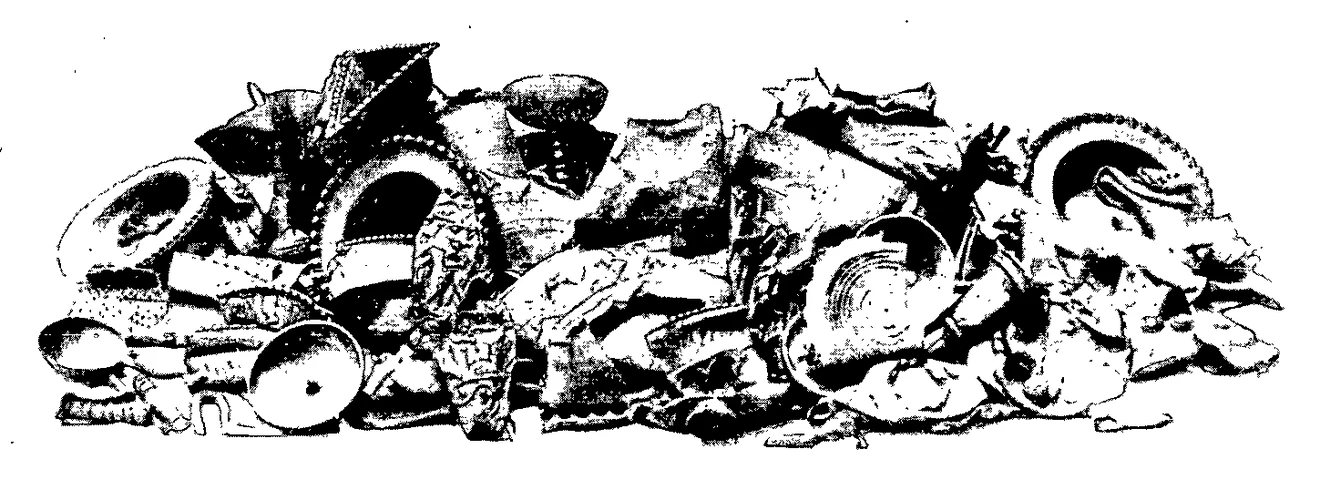
The general view in Curle’s report shows the state of the recovered silver. There are recognizable vessels, but their walls crumple inward and the fragments crowd together. The picture records what came out of the ground, not a dinner service laid out for use. Curle’s excavation report, pp. 102–104.
What is hacksilver?
Curle described crushed flagons, damaged spoons and pieces that had been folded and flattened. Archaeologists call deliberately chopped pieces of silver hacksilver. The word describes how the metal was prepared, not how pure it was. A broad decorated dish is useful for what it can hold and how it looks. Cut a piece from the rim and it can still be traded for the silver it contains. It doesn’t have to go through a furnace first.
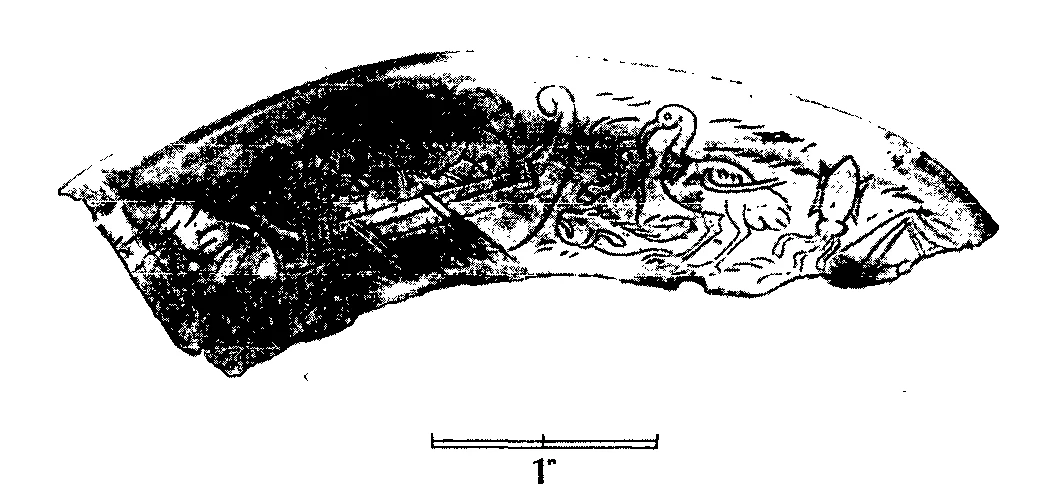
The border on this fragment shows that it came from a dish someone took care to decorate. Its broken edge shows what happened next. Both kinds of evidence are still on the same piece. For a sense of what could be lost when a dish was divided, look at the intact Great Dish from Mildenhall. It is from a different hoard, not a reconstruction of the Traprain fragment.
What weighing the pieces revealed
Curle initially considered the silver loot. Modern researchers asked a different question: do the pieces’ weights follow a pattern? Some fragments cluster around divisions of Roman weight units. Many do not. That fits a process with more than one step: pieces could be cut deliberately to weight and then some could be divided again. Hunter and Painter noted two decorated rim fragments from a single vessel that did not match the units individually but came within 1% of eight Roman ounces together. That is one possible grouping, not proof they were traded together. The figured rim elsewhere on this page isn’t identified here as either of those fragments.
The 2022 National Museums Scotland study argues that converting expensive tableware into bullion helped Rome make payments during uncertain times. The silver might have been used to pay for military service or to maintain alliances beyond the frontier. Traprain Law lay outside the empire when the silver was buried, but the weights don’t identify a payer or recipient, or show whether the hoard got there in a single transaction. Hunter and Painter, discussion of weights, pp. 86–88 · National Museums Scotland’s 2022 study.
Four coins help tell the time
The burial is generally dated to the fifth century. Four small silver coins accompanied the metalwork; two were found during excavation and two turned up as soil was washed off the objects. The Coin Hoards of the Roman Empire project records two as visibly clipped and the other two as too corroded to be sure. The latest issues date to the reign of Honorius. A coin’s issue date tells you the deposit couldn’t be older than the coin. It doesn’t tell you how long the coin passed from hand to hand before burial.
Clipping a coin and chopping a plate aren’t quite the same thing. A trimmed coin could keep circulating as a recognizable coin, as the Hoxne Hoard’s clipped silver shows. A dish fragment that changed hands by weight didn’t need to pass as a dish. Oxford’s Roman coin-hoard record, Traprain.
What record does Traprain hold?
Guinness World Records lists Traprain Law as the largest known hacksilver hoard, at 23.94 kilograms. Curle’s first report put the find at about 770 troy ounces. These are weights of the hoard, not measurements of fine silver content. The category matters: a coin hoard counted by number of coins and silver recovered from a shipwreck tell different stories. Four coins provide useful dating evidence at Traprain. Roughly 24 kilograms of recovered silver, much of it cut and crushed, make it extraordinary in its own category. Guinness record and find date.
A dish at dinner and a fragment on a scale can contain the very same metal. They are useful for completely different reasons. At Traprain, archaeologists can still read both uses in the silver.
Keep reading
- The Great Dish from Mildenhall shows how elaborate a late Roman silver platter could be.
- The Clipped Silver Coins of Hoxne makes missing metal part of the story.
- Where Recycled Silver Came From explains how the modern industry measures silver recovered from old things, a different process from weighing loose fragments.