
A piece of silver small enough to feed from
At four and a half inches long, the London silver vessel at The Met isn’t much bigger than a spoon. It has a shallow bowl and a broad lip; the inside is gilded. Catalogue it by silhouette alone and you might call it a miniature sauceboat. But the person holding it wasn’t necessarily serving dinner. An adult could hold the bowl and tip soft food toward someone who needed help eating.
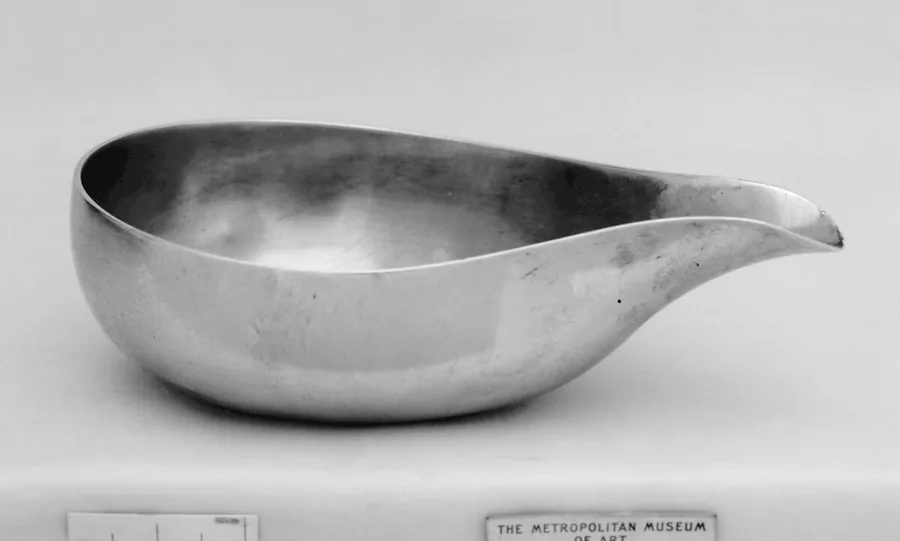
This was a pap boat. Pap was the name for soft food that could be fed to infants or people too ill or weak to feed themselves. Museum records describe preparations based on bread or flour, often with milk or water. The recipe is not the point here. The shape lets someone bring a small amount to the lip without balancing a separate spoon. That small change is what distinguishes this little vessel from the full-size serving silver it resembles.
The lip does more than the handle
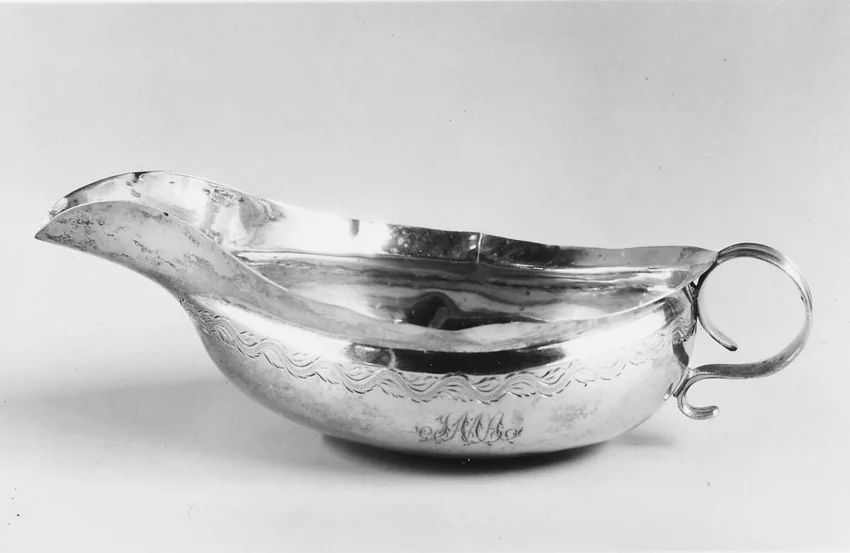
Compare the London boat of 1764–65 with one William Thomson made in New York around 1810. Thomson’s is just over six inches long and has a small loop handle. The two pieces don’t have to share the same silhouette in every detail. What they share is a shallow, open bowl extending into a lip. The part where food leaves is more useful for identification than the presence or absence of a loop.
Now look at Elizabeth Greenleaf’s deep silver spout cup. A tube projects from the side of that cup, whereas the pap boat’s lip is an extension of its open bowl. Either object invites questions about who used it, but one name shouldn’t be applied to every small vessel that can pour. And the large lips on a silver sauceboat direct sauce onto a plate. Scale, the height of the bowl, and how its edge meets the lip are what make the difference worth investigating.
Turn it over: whose name is it?
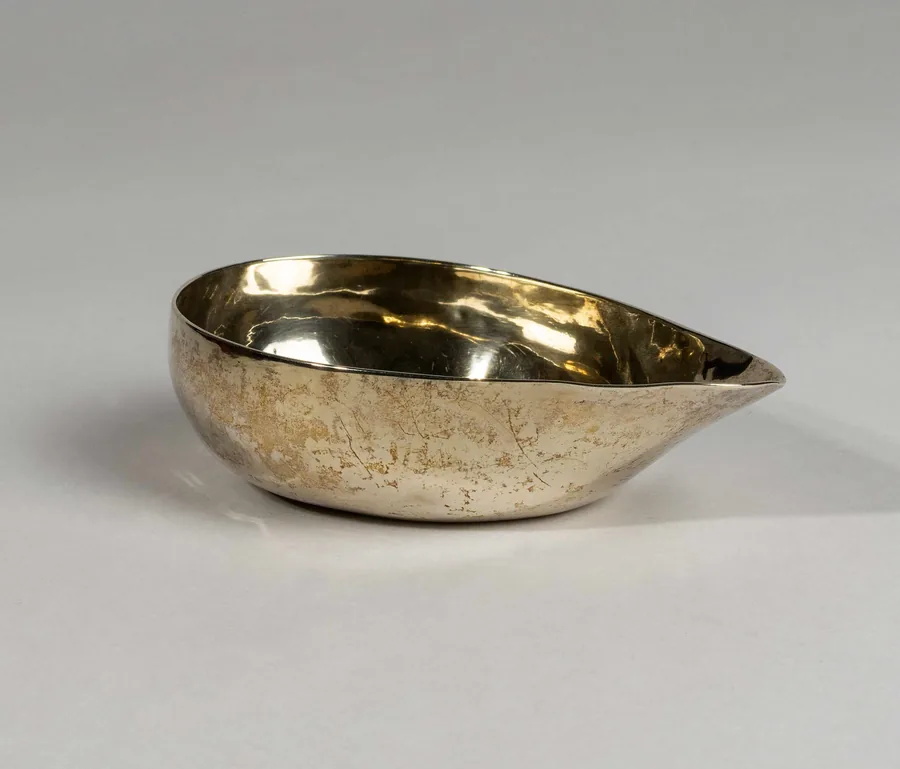
The Hunt Museum gives its Limerick example to Joseph Johns. It records a lion rampant struck twice underneath, Johns’s initials flanking the lion, and the word Sterling. It also records a separate pair of initials, W and I. The museum suggests the pair could point to a wedding or christening gift. The bottom of the bowl preserves a maker and the possibility of an occasion, not the identity of the person who ate from it.
Silver’s paper trail puts that small object in perspective. In their transcription of the Dublin assay returns for 1788, historians Alison Fitzgerald and Conor O’Brien found two items entered as pap boats and 631 entered as wine labels. The same set of records turned up one explicitly named argyle gravy warmer. These are counts of entries in one year at one assay office, not a tally of what households owned. Neither do they identify Johns’s earlier Limerick boat. What they show is that the objects we see in collections left very different traces even while they were new.
Two pieces made in Charleston tell the same lesson in different ways. The Museum of Fine Arts, Houston records JRB on the side of a boat made by Louis Boudo and the maker’s mark on the base. On a vessel it attributes to Nathaniel Vernon, the engraving is more explicit: J.E. Barksdale 1815 on the back, and N.VERNON below. The two kinds of mark answer two different questions. A name and date can be useful leads without telling you whether the subject was a child, a recipient, or an owner who added the engraving later.
The same job outside the silver cupboard
London Museum records a pewter example made for the Foundling Hospital. Its initials, FH, point not to a giver or child but to the institution. The crowned X in its bowl is another trap for a modern reader: the museum says it originally indicated a quality grade but was used indiscriminately by the time this piece was made. The crowned mark doesn’t make it silver. The shallow feeding form didn’t require a precious metal, or a household that could afford one.
The institutional initials also tell us something different from the private engraving in Charleston. One tells us who stocked a vessel; the other preserves a name associated with a piece. Neither records who sat beside the bowl and did the feeding. For a broader look at how heirlooms document families, see childhood and family silver.
Five things to record before naming one
- Measure the vessel from the end of the bowl to the tip of the lip. Note the bowl’s depth as well as its length.
- Photograph the profile to show whether the lip grows out of an open bowl or is part of a separate tubular spout.
- Look for a handle, but don’t rule a pap boat in or out because of it.
- Photograph any stamps underneath, and transcribe presentation engravings and initials separately. Don’t assume a crest or a crown is a silver mark.
- Compare the closest museum examples and document what fits and what doesn’t. Identification doesn’t require putting the piece back into use.
Once you know what to look for, a pap boat stops looking like a sauceboat made for a doll’s dinner. It was made to bring food the last few inches, when someone else couldn’t do that alone.
Object records and further reading
- The Met, London pap boat (13.41.64), 1764–65, silver with a gilded interior.
- The Met, William Thomson’s pap boat (38.120), New York, ca. 1810.
- The Hunt Museum, Silver pap-boat: Joseph Johns, the marks underneath, and possible gift history.
- Museum of Fine Arts, Houston, Louis Boudo’s pap boat (B.85.12): use, American workshop records and the JRB engraving. See also Nathaniel Vernon’s pap boat (B.97.53).
- London Museum, Foundling Hospital pap boat (79.470): pewter and institutional marks.
- Alison Fitzgerald and Conor O’Brien, The Production of Silver in Late-Georgian Dublin, appendix table 1: objects submitted in 1788.