
The little pot that wasn’t for tea
The pot in The Met’s collection could be mistaken for a small teapot. It has a lid, a spout, a handle and a stand, and it is only about six and a half inches tall. But the museum calls it an argyle. Around 1790–95, a Sheffield maker made it in fused silverplate, the material now often called Old Sheffield Plate. What the name tells us, and the shiny surface doesn’t, is that the pot belonged with the gravy.
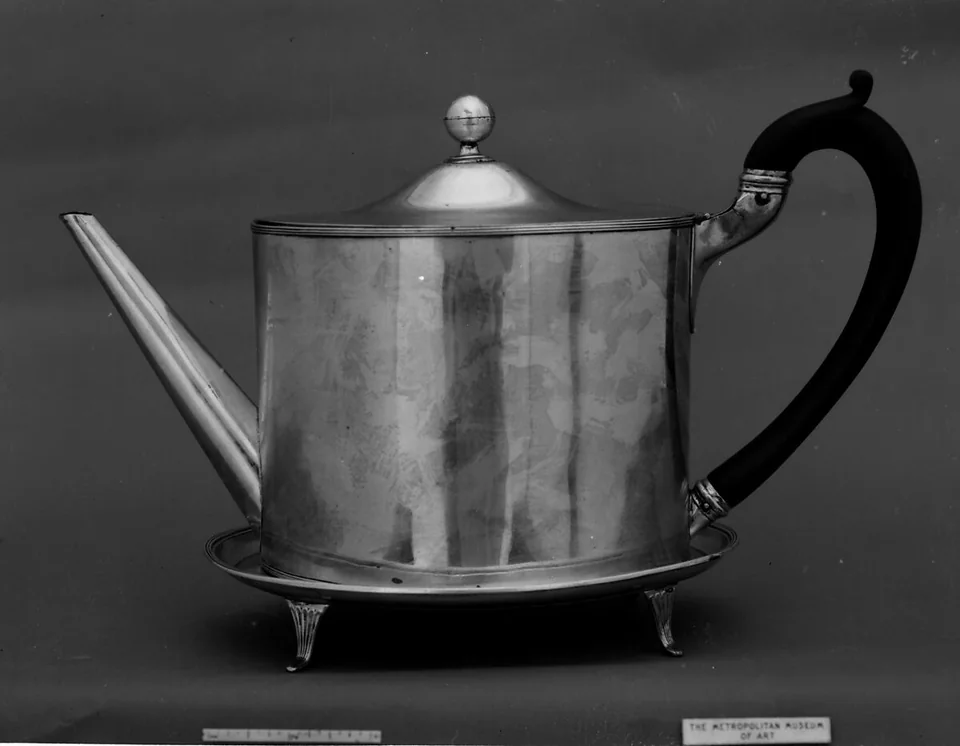
Gravy cools between the kitchen and the moment somebody pours it. An open sauceboat gives you a handle and a neat lip, but no separate place to store heat. An argyle, also spelled argyll, could keep a supply of heat apart from the gravy, in another part of the vessel. You could tip the pot at the table and pour the sauce without adding any water to it.
Follow the opening, not the shape
The clearest clue on Matthew Boulton’s argyle at Colonial Williamsburg is a hinged flap on the far side from the spout. It covers a little triangular opening. Pour hot water there and it goes between the outer wall and the inner chamber. The gravy and the water never need to meet. One opening fills the jacket; another pathway delivers the food. That is why a tiny second opening matters more than the familiar silhouette.
You can think of the jacket as a bath wrapped around the gravy. The heat moves through the separating wall while both liquids stay where they belong. It is a store of heat, not a stove. The Met’s photograph and catalogue establish the Sheffield pot and its stand, but don’t show us enough to identify its own internal construction. For the jacket and flap we have the documented Boulton example, not a reconstruction from the silhouette.
Three other ways to bring heat to the table
Colonial Williamsburg describes alternatives to the jacket: hot water in a cone toward the center, hot water in a compartment underneath, or a heated metal slug fitted in a tube. In each design there is a boundary between the heat source and the sauce. Where that boundary sits changes where you need to look: around the body, under the pot, or down inside.
One earthenware example in the National Gallery of Victoria uses the bottom compartment. Its spout also draws from near the bottom of the gravy, which the museum explains lets it pour while leaving fat floating at the surface. Those are two different jobs: the chamber slows cooling; the position of the spout determines which layer comes out first. It would be a mistake to expect that exact arrangement on every silver or silverplated argyle.
A chafing dish with a burner below it shows the other way to keep a dish hot: carry a source of active heat to the table. The argyle’s added compartment is a different solution to the same problem, and one small enough to live inside a pouring pot.
What the household actually called it
The 1864 Harlaxton Manor inventory lists an “Argyle jug with handle” at 19 ounces 7 pennyweights. The very next entry is a hot-water jug. Whoever recorded the silver knew them as separate kinds of objects. The inventory doesn’t tell us how often either one came out at dinner, what the argyle looked like, or which heating system it used. But it preserves a distinction that an unlabelled pot and its lid might not.
The name isn’t always that cooperative. Historians Alison Fitzgerald and Conor O’Brien counted just one item explicitly called an argyle in the Dublin assay record for 1788. They also noticed two entries for gravy pots that might have been argyles, and that Wedgwood marketed ceramic examples as gravy cups. The one count tells us what the clerk called something, not how often Dublin households had warm gravy or how many argyles were in use.
There is a familiar story that an eighteenth-century Duke of Argyll invented the vessel because his gravy kept arriving cold. The museum evidence supports a possible connection between the name and the dukes, not a documented inventor. We don’t need the anecdote to understand why the pot existed. The hidden compartment tells us more about the problem than the story can.
How to tell a warmer from a server
Start at the rim and the back. Is there a separate hinged fill opening or an obvious inner tube? Is the spout connected low on the body? Photograph the top, the underside, and the opening with the removable lid off if it lifts easily. A spout and a lid, or even a stand, do not automatically make a pot an argyle.
Keep material and purpose separate. Fused plate can do the same job as sterling, and the earthenware example proves the shape is not exclusive to metal. On a silver-colored vessel, compare the marks and construction before you call it sterling. Our guide to the folded edges on Old Sheffield Plate explains one place where construction may give itself away.
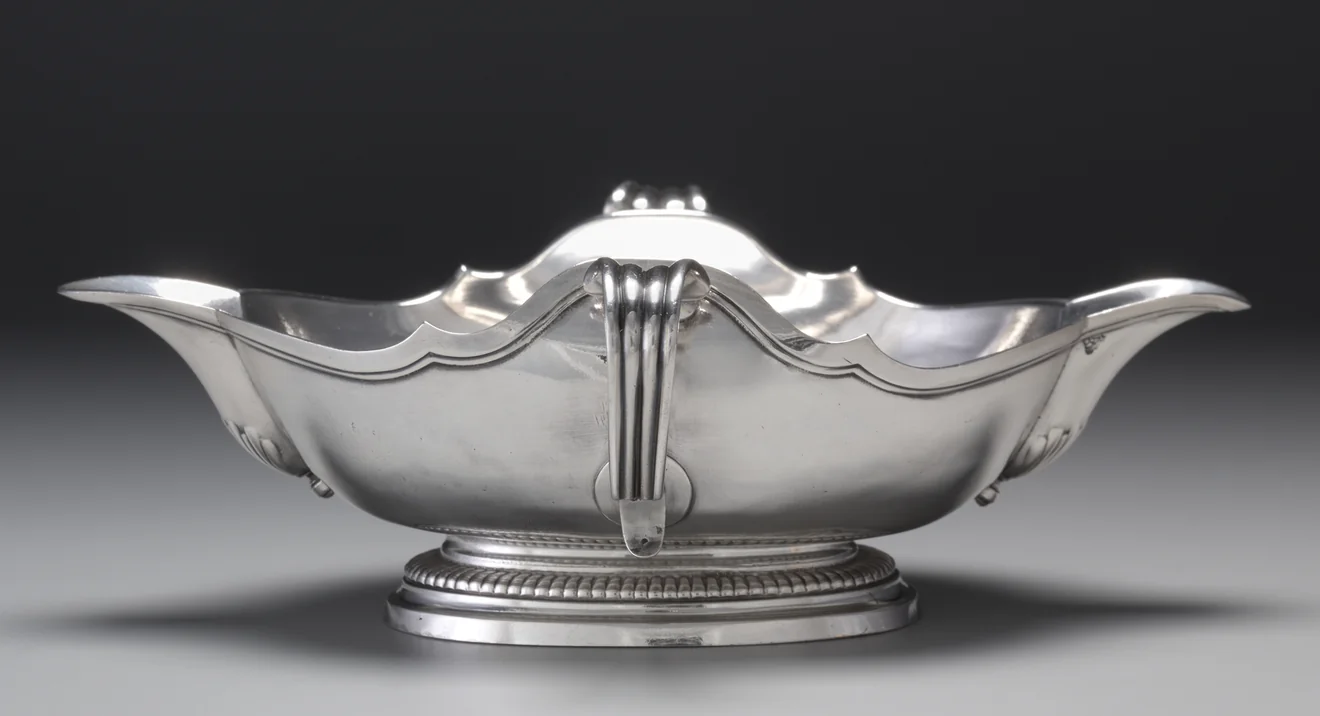
Skip the hot-water test. You don’t need to put an antique vessel back into service to identify it. Visible seams, a secondary lid and the path from that opening to the internal chamber tell you what to compare with a documented example. A seller’s “little teapot” may turn out to be a gravy warmer, but the clue is where the liquid goes, not what the pot looks like from across the room. For an open vessel designed simply to pour, compare our guide to silver sauceboats and gravy boats.
Object records and further reading
- The Met, Argyle and stand (10.204.1a–c), ca. 1790–95.
- Colonial Williamsburg, Matthew Boulton’s Argyle (1971-87,A&B): its fill flap and jacket, alternate constructions and the possible origin of the name.
- National Gallery of Victoria, Argyle (2024.248.a-b): an earthenware example with a lower reservoir.
- Harlaxton Manor 1864 room inventory, printed page 54, items 151 and 152.
- Alison Fitzgerald and Conor O’Brien, The Production of Silver in Late-Georgian Dublin: analysis of the late-1780s assay ledger and Wedgwood’s terminology.
- Cleveland Museum of Art, Nicolas Duclos’s Sauce Boat (1940.21): an open silver server for comparison.