
A bowl that could not hold soup
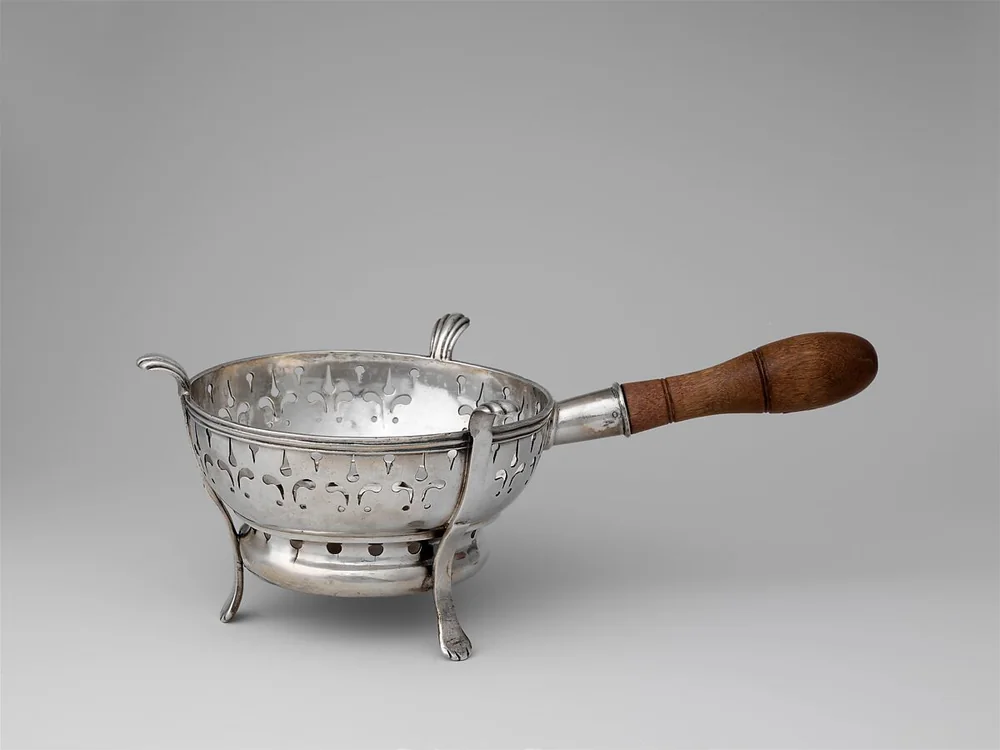
The holes are the first good clue. Look at the silver bowl Peter Van Dyck made in New York around 1725. Cutouts repeat around the wall, just below the rim. The handle is long and wooden. Small scrolls lift above the rim. If it looks like a serving bowl, ask what would happen to the soup.
The Metropolitan Museum of Art calls this a chafing dish, but it isn’t quite what that name suggests on a modern buffet. The pierced vessel was the warmer. Whatever needed the heat sat in or on a separate plate or bowl above it. Once you see the two pieces as separate, the little scrolls and the wall full of holes start to make sense.
The heat moves to the plate
The Met’s catalogue describes a bowl for coals, a removable inner grate and three raised supports for another vessel. The openwork was not an empty flourish. The museum explains that the holes let heat escape. The supports kept the plate or bowl above the fuel. The turned wood gave a person a part to hold that was not itself made of silver. The wood, the holes and the scrolls play three different roles.
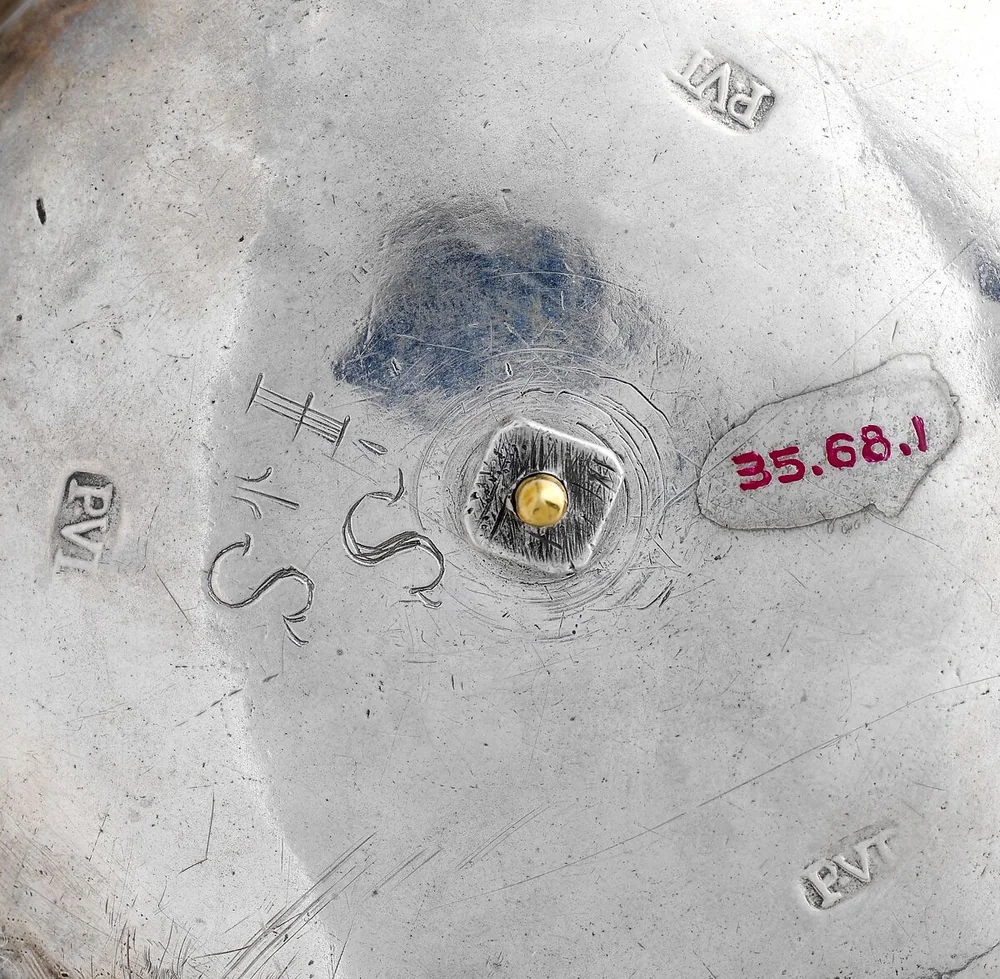
The join underneath solves a practical problem you cannot see in the profile. According to the Met’s construction notes, the grate attaches through a hole in the base with a silver-topped brass screw and a silver nut. A silver pin holds the wooden handle in its socket. So even this object catalogued simply as “Silver” includes other materials where they have jobs to do. Don’t assume an antique dish is fit for use if those pieces still turn up in the photographs; the catalogue describes how the object was made, not whether it is safe to heat now.
What Pepys paid for
On January 10, 1666, Samuel Pepys wrote that he had commissioned a silver chafing dish in London for warming plates. He described seeing Mrs. Stokes, the goldsmith’s wife, at the shop in Paternoster Row. That is the intended use in the customer’s own diary, not a guess based on the shape of a surviving dish.
In his February 2 entry, Pepys returned to ask after his silver chafing dishes, plural. They had already been sent home. The man at the shop initially refused his money, saying Mr. Wayth had paid. Pepys wrote that he would pay the money himself rather than accept a favor he did not think he had earned. Later that day he and his wife chose pieces of their plate to exchange for pieces they would find more useful. The diary does not establish why the January entry names one dish and February more than one. Nor does it establish what Pepys’s wares looked like. What it shows is that silver in a cupboard could be thought of as equipment, as a thing to show guests and as a gift one might be wary of accepting.
Turn the dish over
Van Dyck’s dish is a later New York object, not the warmer from the diary. Its underside carries a different record. The Met identifies three stamps as Van Dyck’s shop mark and reads the engraved group of letters as the initials of John Schuyler and Sara Walter, who married in 1729. The museum dates the dish itself to about 1725. Neither date proves it was made for the wedding. The location and character of the marks help keep the evidence separate: the little repeated punches answer a question about the maker; the engraving answers a question about ownership.
There is work from other hands here, too. The museum notes that the feet appear to have been taken off and soldered back on; it also records splits in the piercing and some separation at the handle. Those observations are not a record of the accident that caused the work. They tell you why an underside view matters just as much as the nicest angle of the pierced wall.
Another workshop, another silhouette
A silver chafing dish made in Boston by John Burt in 1740–45 gives the eye a useful second example. Its supports have a different outline, and the piercing puts a finer pattern into the metal. But it still combines a raised vessel support, an open wall and a turned wooden handle. The Met notes that historic chafing dishes were more often made of copper, brass, iron or pewter than silver. The figure and the ornament may tell you where to look next; they do not tell you the alloy.
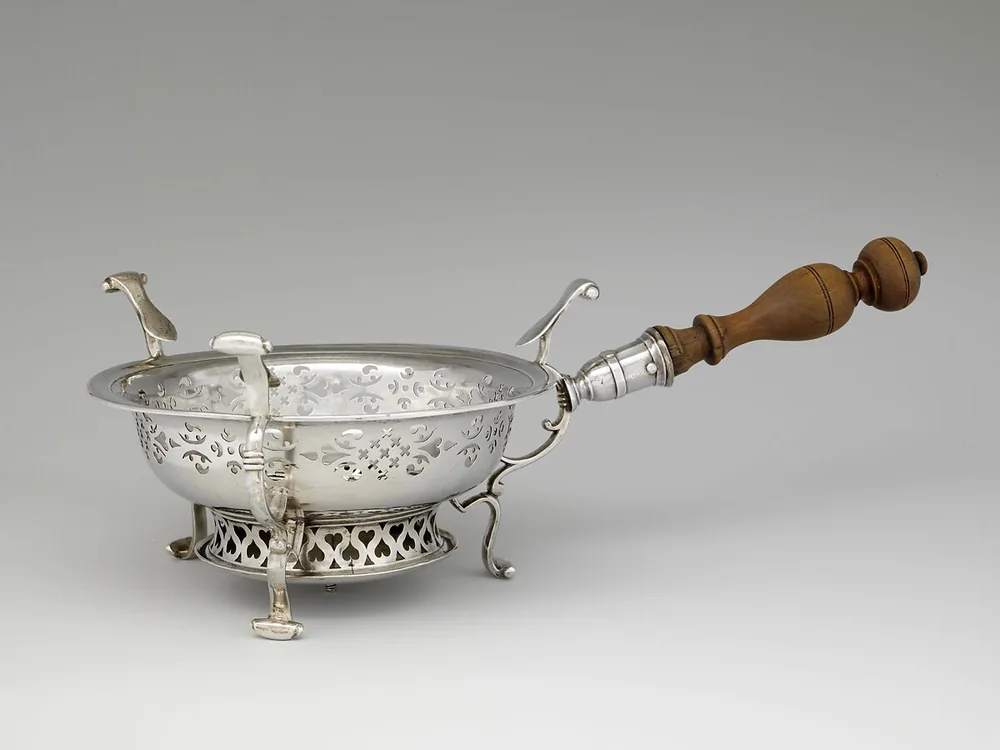
If you see one in a photograph, look for the stops above the rim, not only the holes below it. Ask what rests on the stops, what remains inside, and which parts are documented as original. A picture of an empty chafing dish is not necessarily a picture of a missing serving insert. It may be a picture of the part that did the warming.
Keep exploring
Sources
Diary, museum records and image credits
- The Met: Peter Van Dyck, Chafing Dish, 35.68.1. Form, use, early owners, museum date, exact two Public Domain photographs. New York, ca. 1725. Dodge Fund, 1935.
- The Met, Early American Silver, no. 52, pp. 142–43. Maker marks, ownership engraving, nuts and pins, heat through piercing, repair clues, and documentary sources.
- Samuel Pepys, diary, 10 January 1666; 2 February 1666. The dated entries are primary text in a transcribed edition; UC Press’s print edition sample corroborates the January entry.
- The Met: John Burt, Chafing Dish, 33.120.147. Boston, 1740–45, Bequest of Alphonso T. Clearwater, 1933. Exact Public Domain comparison photograph.