
A spout at either end
If a gravy boat makes it onto your holiday table, count the pouring lips. Most of us expect one lip and a handle at the other end. A boat that Nicolas Duclos made in Paris in 1743 looks as if both ends are the front. Each end flares into a pouring lip. The handles sit near the middle rather than at the end. Whichever way you turn the boat, you don’t lose the spout.
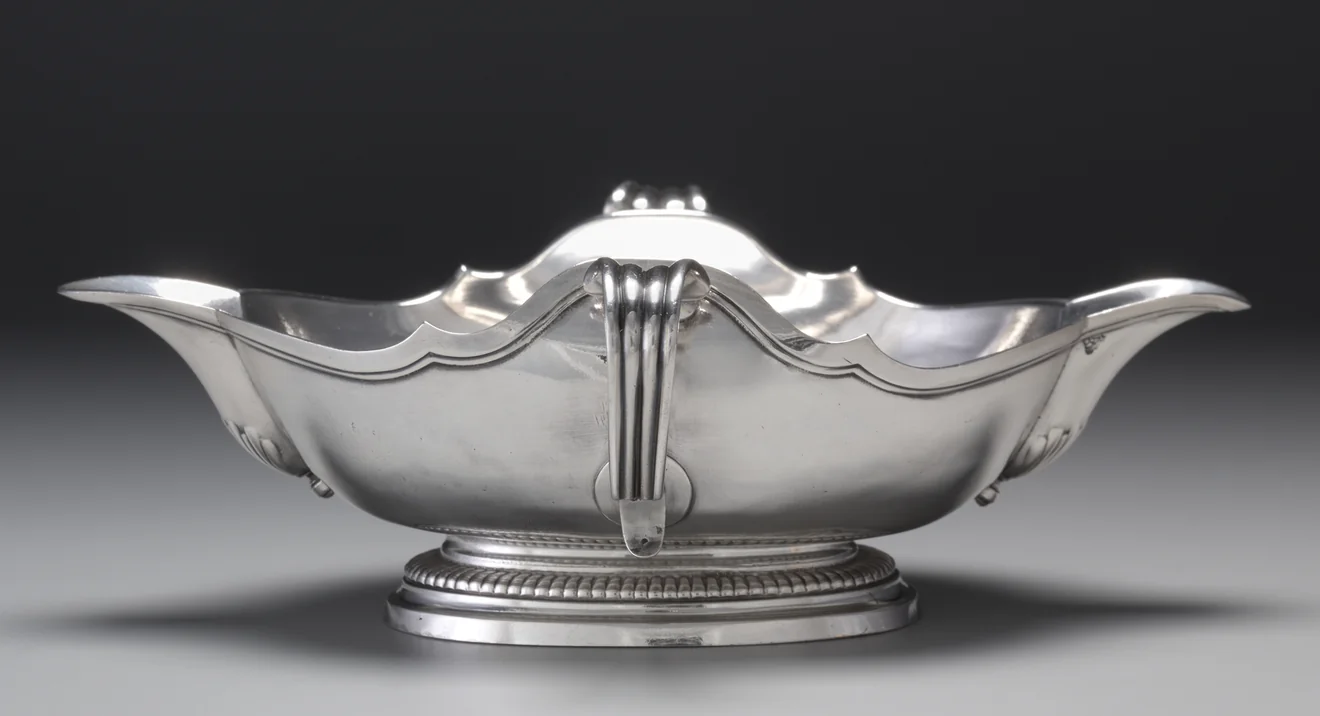
Cleveland’s curators trace the shape to ship-shaped condiment vessels called nefs. They put the sauceboat’s rise in the context of cooks sending warm sauces to the table separately from meat or fish. As the sauce became something a diner could add at the table, it acquired a serving piece of its own. The museum suggests that the Duclos boat once probably had a tray and a spoon to skim the sauce. Neither is shown with the boat in the museum’s online record. Duclos sauceboat, Cleveland Museum of Art, 1940.21.
Two spouts, or two sauceboats?
Double lips weren’t confined to France. The Met owns a double-spouted example Paul de Lamerie made in London in 1717/18, a different commission from the Franks silver service. The Met’s silver catalogue describes a double-spouted pair by New York silversmith Charles Le Roux, made between 1726 and 1730 for Pennsylvania governor Patrick Gordon. That puts two-spouted silver sauceboats in colonial America before the pictured Duclos boat. One pouring lip became usual in American silver by the 1740s; the French object shows why the date of an American style change isn’t a universal cutoff. The Met, Early American Silver, Richardson sauceboats, note 1.
Having only one lip didn’t mean the whole table had to share one vessel. The Met notes that boats commonly came in pairs, sometimes in fours, so people on different sides could reach the same sauce. The vessels could hold melted butter or other sauces as well as gravy. That is why you’ll also see them called butter boats. The size and shape tell you what the vessel could do, not what was in it on any given evening. The Met, Revere sauceboat, 46.40.1.
Paul Revere’s boat and its not-quite twin
Of the two Boston boats shown here, The Met attributes one to Paul Revere Jr. and dates it to about 1765. It has an open scroll handle, a scalloped edge, and a broad single lip. Turn it over and the initials link it to Ruth Coney and Mungo Mackay, who married in 1763. Another boat at The Met bears the same initials. You would be forgiven for assuming a household’s matching silver came from the same maker at the same time.
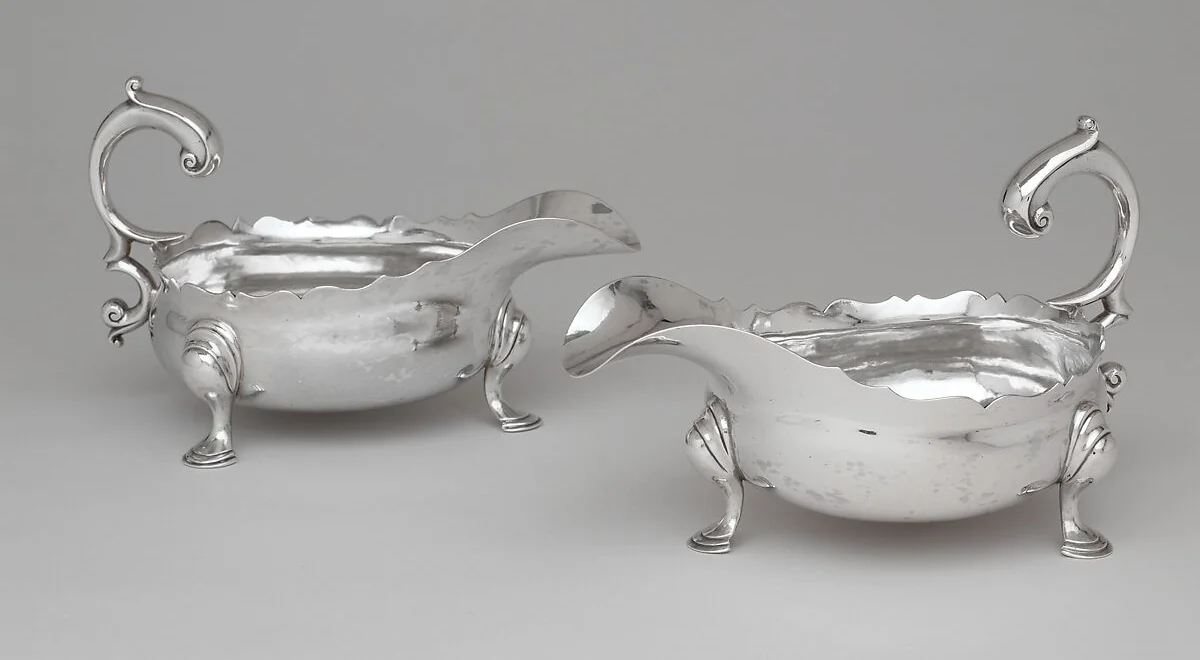
But the museum gives the other boat a more cautious attribution: possibly Paul Revere Jr. or his father. Its scholarly catalogue reports traces of an earlier engraving under the companion’s base. The earlier monogram is evidence that the companion’s life may have begun before it became part of the Mackay set. We know these boats belonged together in the family. Their resemblance alone does not settle whose hands made the second one. Pictured Revere Jr. boat · Companion with unresolved attribution · The Met, Early American Silver, pp. 162–164.
A serpent to hold, a ram to pour from
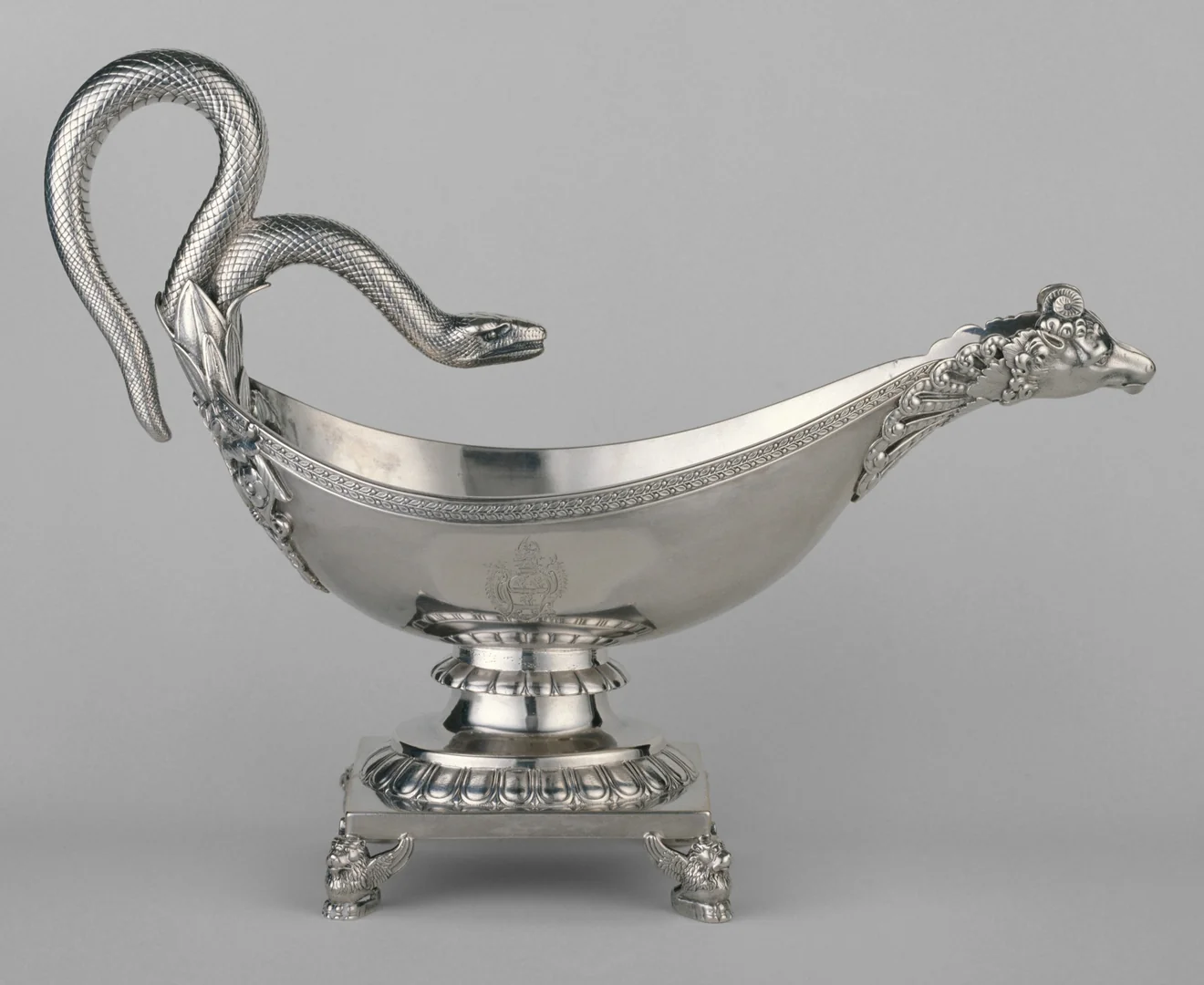
Around 1815, Philadelphia silversmith Anthony Rasch used the same handle-at-one-end, spout-at-the-other plan for a very different effect. Reach for the handle and you would be holding a cast serpent. Look at the spout and you see a ram’s head. The Met identifies the decoration with French Empire taste and the engraved arms with the Milligan family of Maryland. Both boats survive in the collection. The pictured one is 59.152.1. Rasch, 59.152.1 · Companion 59.152.2.
What to look for on an inherited boat
Start with the whole shape. Photograph both ends, the handle attachments, the underside, and any separate stand or cover. Set it on an even surface and note whether it rocks. Keep maker’s punches separate from initials or arms, which may point to a household rather than a shop. If two pieces look like a set, compare the marks, dimensions and decoration before calling them original mates. Record a lid or tray as present or absent without guessing its history from fit alone.
A single lip, two lips, or even a ram’s head is an identification clue, not a date stamp. If yours comes out for dinner, make one more note while you have it in front of you: who passed it down, what they served in it, and who still remembers. That is exactly the kind of evidence a photograph of the silver can’t supply by itself.
Keep reading
- Silver Servingware helps you distinguish forms and functions at the table.
- The Silver Table connects objects to the rituals around them.
- What “Pure Coin” Means on Antique American Silver compares the marks on two pieces from one household.