
At the end of the spout
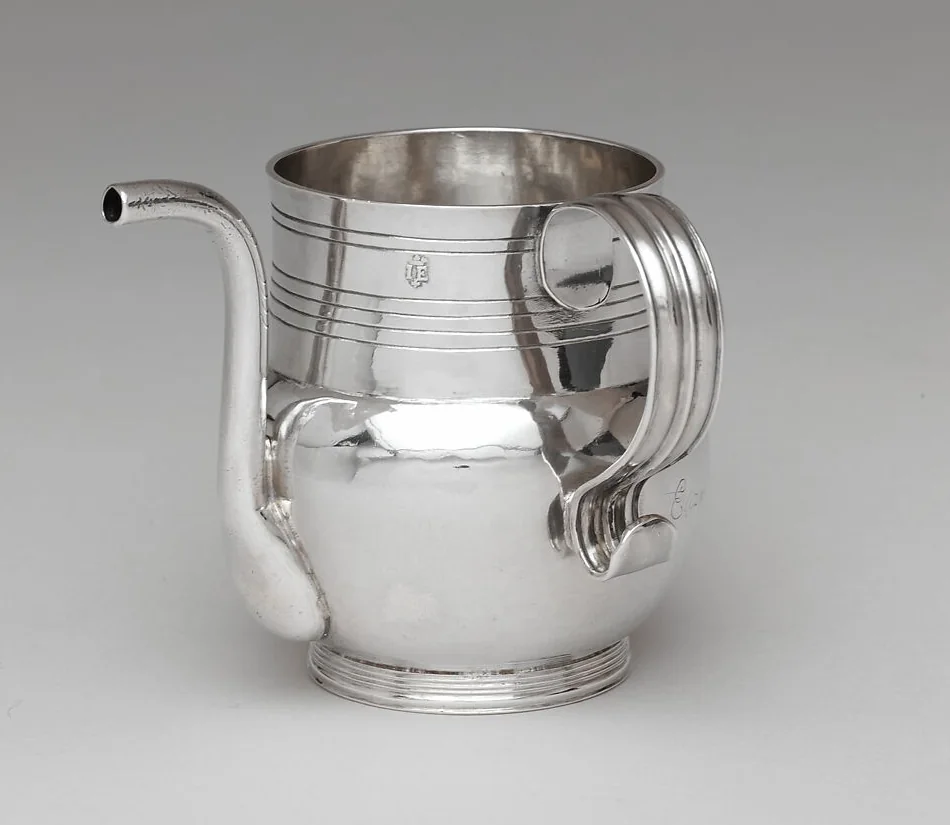
The smallest marks on Elizabeth Greenleaf’s silver cup may be the easiest to miss. They aren’t the silversmith’s initials or the name someone engraved on its side. Look where the long spout opens. The Metropolitan Museum of Art identifies tooth marks there.
Boston silversmith John Edwards made the cup between 1700 and 1725. It is roughly nine centimeters tall, with a rounded body and a handle that sits to the side of a thin, upward-curving tube. If you saw it without a label, you might imagine the tube was for pouring into another vessel. Its actual purpose was more intimate: the form helped a child or someone confined to bed drink when using an ordinary cup was difficult.
The marks bring a person into view, just barely. They don’t identify the drinker, reveal what was in the cup, or tell us whether the same person left every trace. They’re the kind of detail a photograph of the nicest side can miss and a condition note can save.
How the cup was held
Look at the cup as if it had two fronts. The spout faces the person drinking. The handle sits at right angles to it, where another person can hold and tilt the vessel from the side. The handle and the tube are parts of a design for two people, not independent flourishes.
The opening at the top makes the cup look unfinished by the standards of the form. The Met’s catalogue says that Edwards’s spout cups usually had fitted, removable covers meant to limit spills, and identifies this cup as an example that has lost its cover. In a photograph, the absence is easy to overlook: the open rim looks quite ordinary. Comparing it with a museum description is what tells you to ask about the lid.
Both details change the way you read the object. The tube is not a decorative novelty; its placement gives one person a way to help another. The missing lid is not just a break in symmetry; it is a missing part of how the cup was meant to work.
The woman named on it
The cup has “Elizabeth Greenleaf” engraved in script to the right of the handle. The museum also records “EG” beneath it. It identifies her as Elizabeth Gookin Greenleaf, who lived from 1681 to 1762. Its provenance names her, then later collector Charles Allen Munn, whose bequest brought the cup to The Met in 1924. Those named points are useful, even without a complete record of the time in between.
Greenleaf’s profession adds another reason to look closely. The Met’s silver catalogue says she opened an apothecary shop in Boston after the family moved there in 1727. The museum describes her as an early woman apothecary, often credited as the first in America. By contrast, Jonathan Greenleaf’s 1854 family genealogy puts the opening of an apothecary shop under her husband Daniel’s name. Its account was written long after both had died. The difference is a reason to attribute the accounts, not to use the initials on the cup to decide who first opened the door or who worked behind the counter.
There’s another chronological clue: the museum dates the vessel’s manufacture to before the family’s 1727 move. That doesn’t tell us when Elizabeth acquired it. And neither her occupation nor the cup’s shape establishes that this particular object was used in the shop. We can put a name to its owner without putting the cup on an undocumented shelf.
A cup or a pap boat?
Compare the deep, tubular-spouted cup with another American silver object: William Thomson’s pap boat, made in New York around 1810. Thomson’s vessel is low and open. One end of its bowl stretches into a broad, shallow lip. Edwards’s vessel brings liquid to the mouth through a tube; Thomson’s supplies a channel that is open along the top. Both forms are associated with assisted feeding, but the profiles make them easy to distinguish once you know where to look.
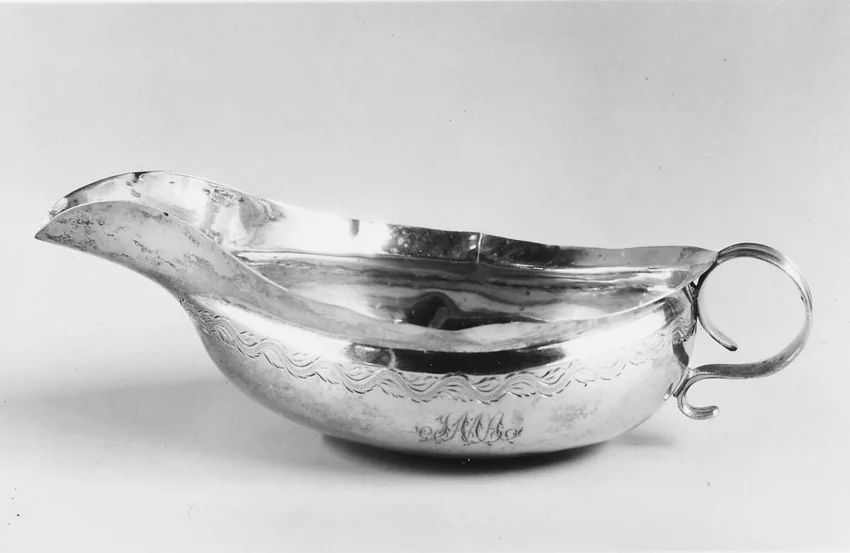
“Pap” was a historical name for soft food; museum accounts describe feeding boats for small children and people who were ill. The London Museum has examples in pewter as well, including one made for the Foundling Hospital. Silver is therefore one material in the history of these objects, not what made the form useful. The purpose was to help someone deliver food or drink more neatly. This is a look at historical equipment, not advice for feeding or caring for someone today.
Three kinds of evidence
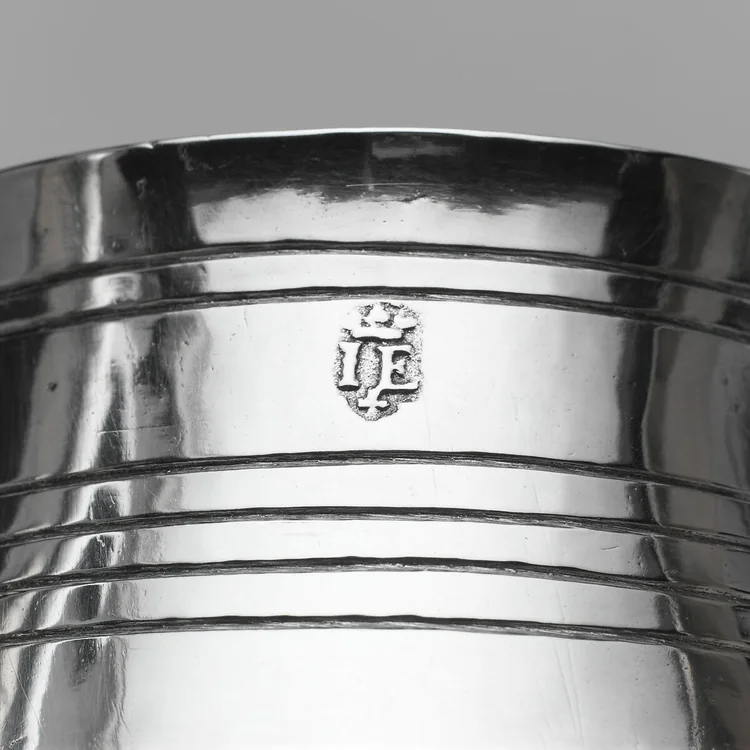
In the close-up, the crowned punch is the silversmith’s mark: the Met reads it as “IE” and attributes it to John Edwards. Elizabeth’s script name and the initials under the cup are ownership evidence. The wear at the spout is use evidence. It helps to record each separately. You can find a name for the maker and a name for the owner without knowing who drank from the cup or who held it for them.
If you come across an unfamiliar silver vessel, capture the whole profile, the mouth of the spout, the handle and visible marks. Work from photographs rather than trying the cup with water. Describe what survives before deciding whether anything is missing. A puncture, abrasion or curious bit of wear is worth documenting before anyone reaches for polish or calls it damage that should be repaired.
Greenleaf’s cup is one more object to look for in The Met’s American silver collection. If you’re curious about the separate question of silver and microbes, the evidence guide explains why a silver vessel is not a disinfectant.
Sources
Object records, primary sources and image credits
- The Met: John Edwards, Spout Cup, 24.109.34 and Early American Silver in The Metropolitan Museum of Art, cat. 28, pp. 85–86. Object, provenance, tooth marks, shop account, original cover type and punch.
- Jonathan Greenleaf, A Genealogy of the Greenleaf Family, 1854, p. 52. Later family history presenting Daniel’s role; not a contemporary shop record.
- The Met: William Thomson, Pap Boat, 38.120 and London Museum: Pap boat made for the Foundling Hospital, 79.470. Comparative form, historical use and different materials. London Museum photograph is not reproduced.
- Images: The Metropolitan Museum of Art, Bequest of Charles Allen Munn, 1924, 24.109.34 (cup and maker’s mark), and Rogers Fund, 1938, 38.120 (pap boat). Public Domain.