
One collection, several tax questions
A silver coin can carry a purchase price, a collector premium, and a story reaching back generations. Its tax history follows it from purchase to resale: sales and use taxes concern a transaction or use, while federal income tax can concern the gain when an owner sells.
This revised guide focuses on U.S. individuals who directly own physical precious metals outside retirement accounts. It offers a framework and a few dated state examples, rather than a fifty-state tax chart. Rules were checked on November 5, 2026. A particular sale, unusual acquisition, or filing decision deserves advice from a qualified tax professional.
Start with the amount actually gained
For purchased property, basis is generally its cost for tax purposes. IRS Publication 551 explains that cost can include sales tax and freight. Adjusted basis means that figure after any required adjustments. Keeping the original invoice therefore matters: a later spot-price chart cannot reconstruct what a collector actually paid for a particular coin or group of bars.
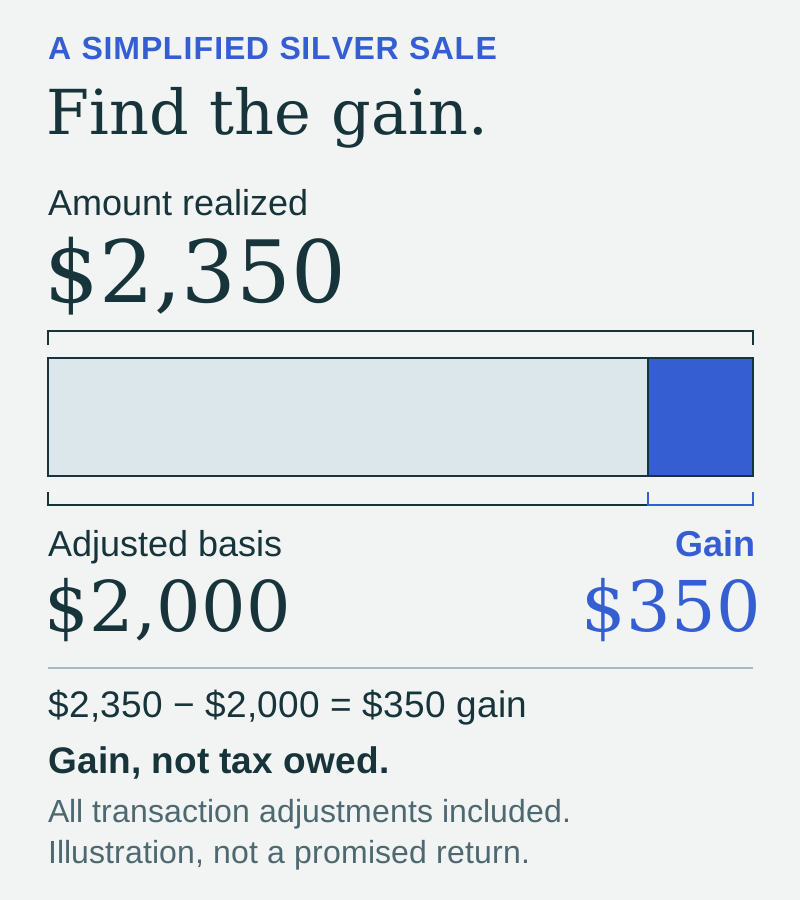
Consider a deliberately simplified example. Assume a collector sells silver with an adjusted basis of $2,000 and an amount realized from the sale of $2,350, with all required transaction adjustments already included. The resulting gain is $350. That figure enters the applicable tax calculation; the $2,350 received is not itself the gain. Gifts and inheritances need their own basis analysis.
The holding period and the collectibles category
For an ordinary purchase, holding an asset for more than one year generally produces a long-term capital gain or loss when it is sold. A holding period of one year or less is generally short-term. Net short-term capital gains are taxed at ordinary income rates.
For federal capital-gains purposes, the IRS includes coins and metals such as gold, silver, and platinum bullion in the collectibles category. The word therefore reaches beyond rare museum pieces. A plain bullion bar can fall within this tax category even when its appeal comes entirely from its metal content.
Net long-term gains from collectibles have a maximum 28% federal income-tax rate. The word maximum matters: 28% is not an automatic flat charge on every sale. Other gains, losses, and taxable income affect the calculation. Additional federal net investment income tax may also apply. State income-tax treatment requires a separate check.
Purpose matters when an item loses value, too. A loss on personal-use property is not deductible, even though a gain on such property can be taxable. A piece of jewelry worn for enjoyment should not automatically be treated like an investment holding when considering a loss.
Read the exemption for the actual object
State sales-tax rules use their own definitions. Virginia, for example, distinguishes bullion valued for mass and purity from legal-tender coins issued by a government. Its exemption language excludes jewelry and works of art. A silver bar, a government-issued coin, and a silver bracelet therefore need to be identified accurately before applying an exemption. A metal name alone does not settle the question.
Alaska illustrates why local rules deserve attention. The state levies no state sales tax, but several municipalities levy their own sales taxes. A statement that Alaska has no sales tax anywhere is misleading. The relevant municipality is part of the research.
Virginia also shows how dates change the answer. Its 2022 legislation removed the requirement that eligible purchases exceed $1,000. The enacted 2026 budget keeps the exemption for qualifying gold, silver, or platinum bullion and legal-tender coins in effect through July 1, 2028. The budget provision matters because the code section still displays an earlier sunset date.
Washington moved in the other direction. Its former bullion exclusion from the statutory definitions of retail and wholesale sales was repealed effective January 1, 2026. That change makes transaction dates essential when comparing an older exemption chart with a later purchase.
Online purchases still need a tax check
Use tax covers certain purchases used or stored in a state when the applicable sales tax was not collected. California explains that a taxable out-of-state purchase generally creates a use-tax obligation for the buyer. Whether a particular precious-metal purchase qualifies for an exemption still needs checking. A checkout showing no tax, or a trip across a state border, does not by itself answer that question.
Keep a record for each identifiable purchase or lot: description, quantity, acquisition date, invoice, costs included in basis, and later sale documents. Record selling fees as well so they can be handled correctly. Form 8949 generally records capital-asset transactions, with totals carried to Schedule D. Accurate records make that process much easier than reconstructing several years of purchases from memory. Use the forms and instructions for the relevant tax year.
A payment-platform form and the underlying tax obligation are separate issues. The IRS says reportable income must be reported even when no Form 1099-K arrives. Equally, a form showing gross payments does not establish the profit on an item. Reconcile payment records with purchase costs and sale details rather than guessing from the form alone.
A short chapter in monetary history
Gold’s monetary history remains part of its fascination. In August 1971, President Nixon closed the gold window, ending the conversion of foreign governments’ dollars into gold. The move helped bring the Bretton Woods monetary system to an end. Restrictions on private gold ownership were subsequently lifted effective December 31, 1974.
Those milestones concern monetary arrangements and ownership. Today’s collector still needs the rules for the particular object, account, location, and transaction date. Historical monetary significance can enrich a collection without resolving how a modern sale should be reported.
Match the rules to the way you hold silver
Retirement accounts require separate care. IRS guidance describes limited exceptions for certain coins and bullion under the retirement-account collectibles rules, including fineness and trustee-possession conditions for qualifying bullion. Those exceptions do not remove eligible coins and bullion from the federal long-term collectibles-gain definition for an ordinary taxable holding.
An exchange-traded fund, or ETF, is one form of exchange-traded product. Others include commodity trusts and notes. For a product marketed as a silver ETF, check its specific tax disclosures and the account holding it. For a physical collection, the useful starting habits remain straightforward: identify the object, preserve its records, and check the applicable rule before acting.
About this edition
Original source and editorial notes
Adapted from original material by Rich Silver. Original publication: Precious Metals Taxation in the United States: Current Landscape and Historical Context (2025-12-30).
Reviewed 2026-11-05. Revised from Rich Silver’s December 30, 2025 article. This edition replaces the original nationwide survey with a focused collector guide. Tax rules and the cited state examples were checked on November 5, 2026. It distinguishes purchase taxes from income tax on gains and preserves the original publication separately. General educational information only; individual transactions and filings require their own review.
Sources & further reading
- IRS: Topic 409, Capital gains and losses
- IRS: Publication 551, Basis of Assets (December 2025)
- IRS: Instructions for Schedule D (2025)
- Virginia Code § 58.1-609.1, subdivision 19
- Alaska Office of the State Assessor: Alaska Sales Tax Information
- Virginia Division of Legislative Services: 2022 Session Summary, HB936
- Virginia 2026 Special Session I HB30, Chapter 1, Item 3-5.22
- Washington Legislature: RCW 82.04.062 disposition
- California CDTFA: California Use Tax
- IRS: Instructions for Form 8949 (2025)
- IRS: Form 1099-K FAQs, What to do if you receive a Form 1099-K
- Federal Reserve History: Nixon Ends Convertibility of U.S. Dollars to Gold
- U.S. Mint: Statement on Gold Clause Resolution
- IRS: Investments in collectibles in individually directed qualified plan accounts
- IRS Notice 2023-27: statutory background on collectibles
- SEC Investor.gov: Exchange-Traded Products