
A small number with a long story
A silver collector opening a government financial report can stumble across a startling figure: $1.292929292 per fine troy ounce. Why would a modern balance sheet carry silver at a number that looks as though it belongs in a much older coin cabinet?
The number is real. Understanding it means separating the amount of silver held, the accounting rate attached to it, and the market value disclosed for a particular date. Each answers a different question. Reading all three together makes the story more useful than treating the smallest number as the whole truth.
What the latest available report actually says
On November 5, 2026, Treasury’s report index identified FY2025 as its latest Agency Financial Report. Issued January 27, 2026, it covers the fiscal year ended September 30, 2025. Those dates matter: the figures below describe that reporting date, rather than today’s holdings or today’s silver price.
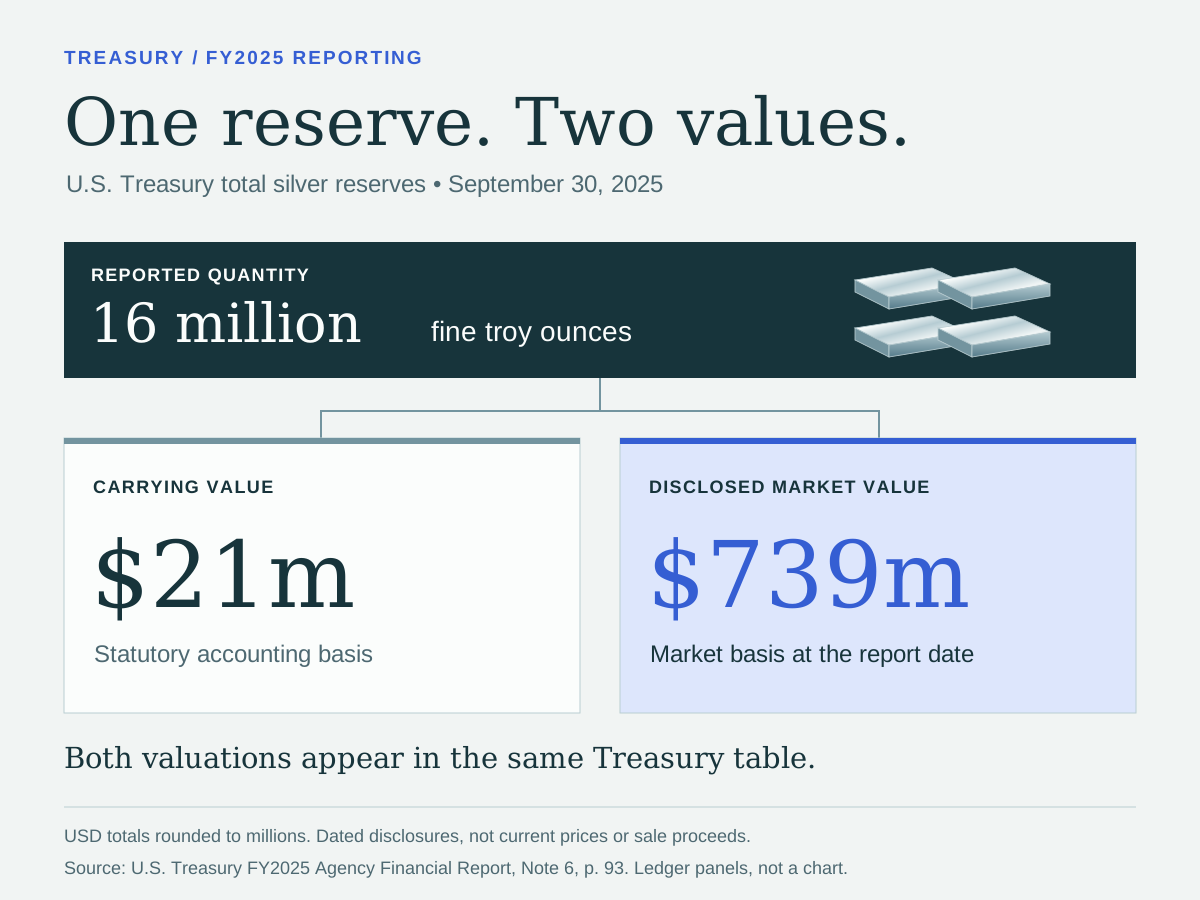
Note 6 lists 16 million fine troy ounces of silver reserves. It shows a statutory carrying value of $21 million and a market value of $739 million, both rounded to millions. The market-rate column uses $46.18 per fine troy ounce. Treasury therefore presents the large gap openly in the same table.
A fine troy ounce measures the precious-metal content. Keeping that unit attached to the figures avoids confusing the weight of silver itself with the gross weight of an object containing silver.
The law gives a minimum sale price
The current published text of 31 U.S.C. §5116(b)(2) says that the Treasury Secretary shall sell silver under appropriate conditions for at least $1.292929292 a fine troy ounce. The phrase “at least” matters. A minimum does not require a sale at that price, establish a retail bargain, or cap the world market.
Treasury’s financial report supplies the accounting connection: it explains that these reserves are reported using statutory rates and that silver is valued at $1.292929292 per fine troy ounce. The statute’s sale provision and Treasury’s stated accounting treatment should be described separately rather than blended into a supposed official spot price.
The same statutory subsection also discusses obtaining silver for coin production and refers to an average world price determined by a widely recognized commodity exchange. Reading the surrounding text helps prevent one memorable historical number from swallowing the rest of the law.
Why another report shows about seven million ounces
The original article referred to approximately seven million ounces valued at roughly $9 million. That scale matches a narrower category: the Mint’s custodial deep-storage silver reserves. Treasury’s Inspector General published an audit of those schedules on December 12, 2025.
The schedule reports 7,075,171.14 fine troy ounces of deep-storage silver at September 30, 2025, with a statutory value of $9,147,696 and a market value of $326,731,403. Its notes define deep storage as Treasury-owned bullion reserves secured by the Mint in sealed vaults. These are Treasury assets held in custody, rather than the Mint’s own manufacturing assets.
The schedule expressly excludes working stock and reserve amounts due to be replenished by the Mint’s Public Enterprise Fund. Consequently, its approximately seven-million-ounce figure should not be presented as the complete Treasury silver-reserve total. Nor should either report be described as an inventory of every silver-containing item anywhere in the federal government.
Book value does not hide the metal
Book value is the amount carried under an accounting basis. Market value estimates what the same quantity is worth using a stated market rate at a stated time. A report can show both without claiming that either number is the cash already available to spend.
These documents disclose quantities as well as values. A low carrying rate therefore does not, by itself, demonstrate concealed wealth, secret transfers, or a scheme to suppress silver prices. Those allegations would require evidence about actual transactions and decisions. The difference between two valuation columns cannot supply it.
Likewise, changing an accounting number alone would not add ounces to a vault or produce sale proceeds. Questions about selling reserves, changing their valuation basis, or using proceeds involve further legal and financial steps. The table is a starting point for those questions, not evidence that they have occurred.
A better way to follow the silver
For collectors, the practical habit is simple: check the reporting date, identify the exact reserve category, and read the quantity, valuation policy and market-value disclosure together. If two figures appear to disagree, check their scope before assuming metal has appeared or disappeared.
The $1.29 figure remains an intriguing link between silver and federal monetary law. Its real lesson is about how carefully a ledger must be read. Silver’s reported carrying value can sit far below a disclosed market valuation without the difference being a secret, a price forecast, or an invitation to buy government silver for a dollar and change.
About this edition
Original source and editorial notes
Adapted from original material by Rich Silver. Original publication: The $1.29 Silver Mystery: Why Is the U.S. Still Undervaluing Its Treasure? ↗ (2025-12-21).
Reviewed 2026-11-05. Replaced unsupported hidden-wealth, collusion and price-suppression theories with a sourced accounting explanation. Distinguished the statutory sale minimum from Treasury’s disclosed accounting policy, and total reserves from custodial deep storage. Updated the reporting reference to FY2025, the latest AFR listed when checked November 5, 2026; all valuation figures are dated September 30, 2025, not current spot quotations. No inference about secret transactions or the disposition of the difference between reserve categories is made.
Sources & further reading
- U.S. Treasury: Agency Financial Report index, latest report checked November 5, 2026 ↗
- U.S. Treasury FY2025 Agency Financial Report, issued January 27, 2026, Note 6, printed page 93 ↗
- 31 U.S.C. §5116, especially subsection (b)(2); OLRC text through Public Law 119-124, October 15, 2026 ↗
- Treasury OIG-26-002: Mint custodial deep storage audit, December 12, 2025, Notes 1–2, printed pages 9–10 ↗