
Two moons on one card
On a card from the Rijksmuseum, the Moon appears twice. Two bright disks, seen through a stereoscope, were meant to give a viewer an impression of depth. The small print beneath each Moon credits the negatives to Henry Draper and names the instrument he used: a silvered-glass telescope. The next line names the publisher, Charles Bierstadt, and gives Niagara Falls, New York. What a buyer could hold in one hand came out of years of work figuring and supporting a large disk of glass.
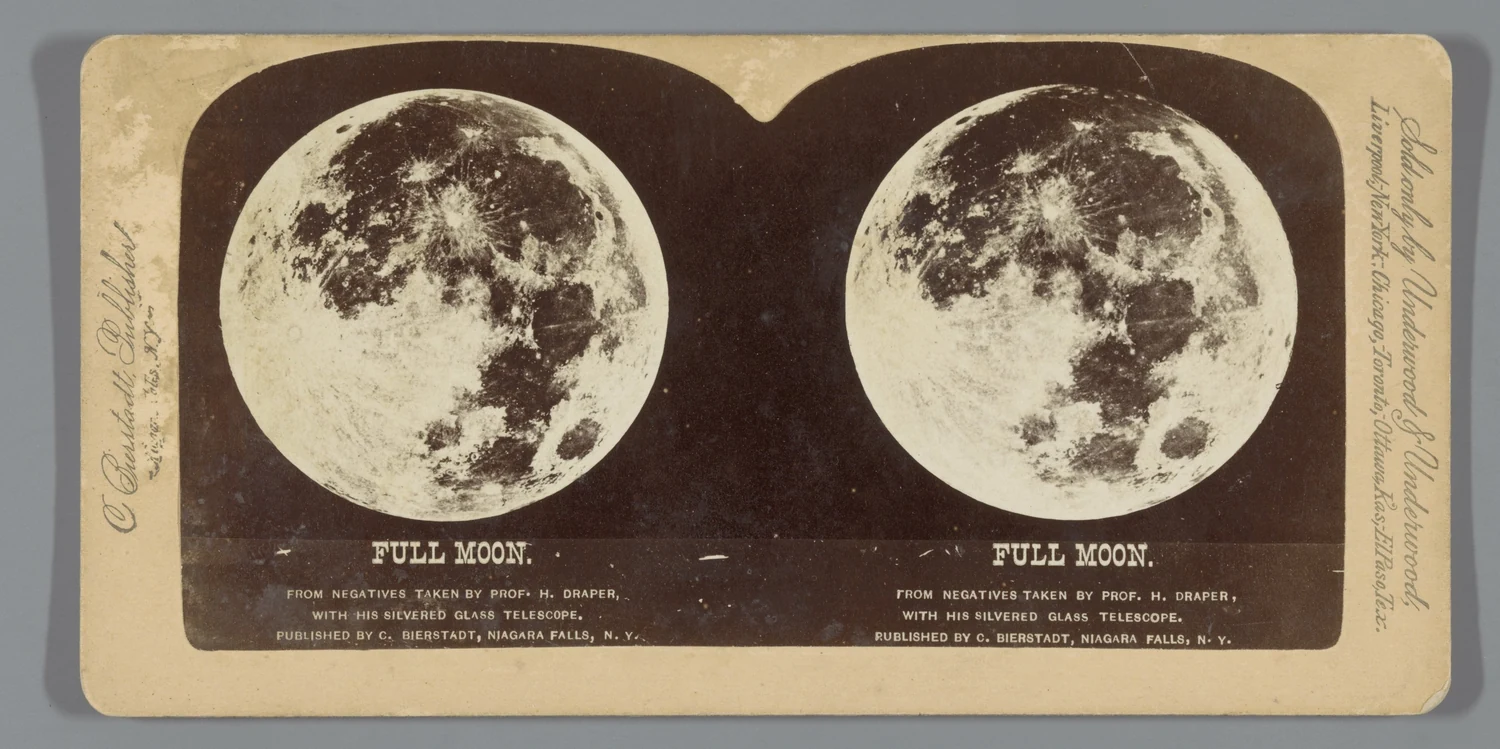
The card is an albumen stereograph dated about 1864. A different object, a mounted photograph at the Smithsonian, identifies Hastings-on-Hudson, New York, a 15½-inch telescope aperture and September 3, 1863. The Rijksmuseum does not give a capture date for its card's source negatives. The dated print anchors the story, but it does not date the card or tell us which settings made that exposure. Draper's 1864 account of building the telescope helps explain what it took to get either kind of object into a viewer's hands.
First silver: return the light
Draper had worked with a copper-tin alloy called speculum metal before adopting a shaped glass mirror. In a speculum, the metal doing the reflecting is also the block that has to keep its exact shape. A silvered glass mirror splits that assignment. The glass provides the figure; the thin silver film facing the sky reflects the light. The film can be renewed rather than asking a polisher to restore the reflecting surface of a solid metal block.
Draper measured 239 milligrams of silver on one unusually thick coat. He put the metal cost below a cent. Neither number belongs to the night of September 3 by default. And whatever the price of the silver, it did not pay for turning a broad glass disk into a precision surface. In his memoir a troubling test image changed when he turned the mirror in its support. The glass was being distorted by how it was held. Better polishing could not fix a mirror being bent into the wrong shape. See how silvering changed the design of telescope mirrors.
Find out what’s known about the reflective backing in antique looking glasses.
Second silver: register the image
The telescope mirror did not hand off metal to the camera. It handed off light. In the camera that concentrated light fell on a sensitized wet-collodion plate. There, light-sensitive silver compounds made it possible to develop a negative. The silver in the camera and the silver facing the sky were doing entirely different jobs. Both had to work before a picture existed.
Draper gave about 188 square inches as the mirror's collecting area and about two square inches as the sensitized area occupied by the lunar image in the calculation. That second number is not the size of the whole glass plate or the published print. It explains why he could concentrate enough light for photography, not what size Moon the reader sees here. The wet plate was a working negative, distinct from both the dated Smithsonian print and the Rijksmuseum's published card. Read more about the silver chemistry of early photography.
Move the plate, not the telescope
Draper could point the telescope at the Moon, but he still had to stop the image wandering across the glass during an exposure. While Henry was away with his regiment in Virginia, his brother Daniel kept working on that problem. When Henry returned, Daniel gave him a sliding plate holder and a sand clock. Henry credited the early apparatus with some excellent photographs. That holder is figure 32 in his memoir; the figure reproduced here is the later version.
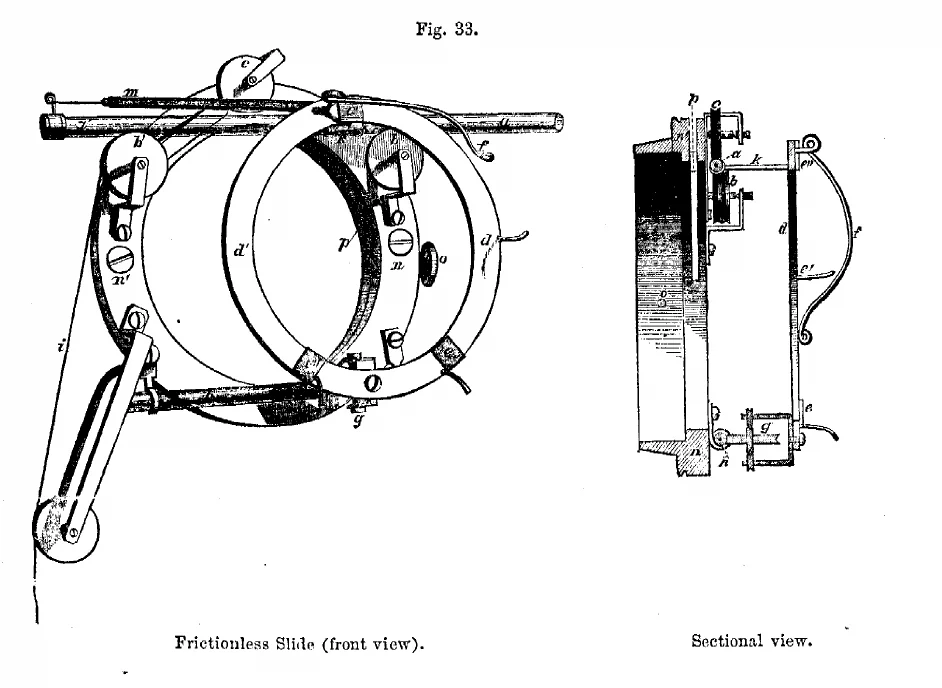
In the later holder, rollers let the plate travel more smoothly. Draper set the direction by drawing a line on ground glass and turning the holder until a lunar crater traveled along it. A second line crossed the first. If the moving holder held that crater at the crossing, its speed was close enough for the shot. The telescope could stay still while the plate followed the moving image. The ground glass with the guide marks was for setting up the motion; it wasn't the sensitized negative.
Daniel's sand clock pulled the slide with a descending weight. Henry later noticed minute vibrations and used a redesigned water clock. His memoir does not say which drive was used for the surviving September 3 photograph. Nor should two appearances of twenty seconds be confused: the pasteboard screen could stay in place for about that long while the apparatus settled before exposure, and on a hazy night he reports taking about that long for an exposure itself. In especially clear air he reports about a third of a second. None of these examples supplies a shutter time for the print with the September date.
The Moon comes home
Draper also describes enlarging a lunar image to fifty inches. That was another piece of work, not the size of either museum object. A negative could be enlarged for one audience and made into a small stereograph for another. On the Bierstadt card the Moon became something a reader could turn over, slip into a viewer, and share. It carried the names of the people who made and published it, and, unusually, an account of the material that let it be seen.
Read the card again. The words “silvered glass” tell you about the mirror. The picture itself depends on another use of silver. Most viewers had no reason to think about either. Both were there in the room with them.
Sources and objects
Henry Draper, Smithsonian memoir, 1864: p. 5 for silver-coat weight; pp. 34–40 for plate holders and clocks; pp. 48–50 for exposures and light concentration; and the postscript for the fifty-inch enlargement. Rijksmuseum stereograph, RP-F-F10400. Smithsonian photograph, PH.325762. The broader chemical-silvering story.