
The glass in the drawer
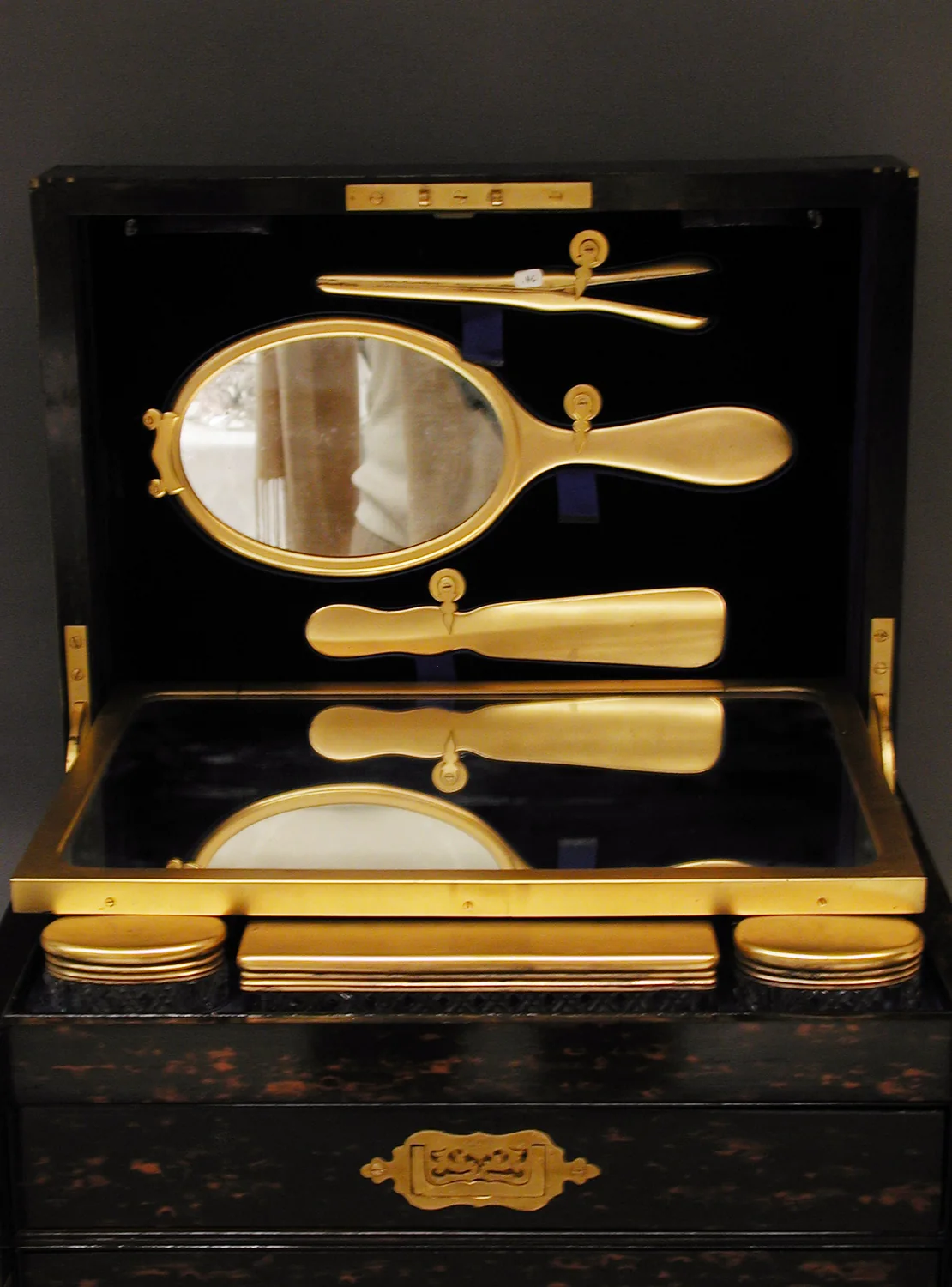
In a photograph from the Met, an oval hand mirror rests in the lid of a black dressing case, its handle held in place among fitted tools. It is a London piece dated 1874–75. But the museum’s record, which gives the materials as silver and glass, leaves a question unanswered: what is on the other side of the glass? A second Met hand mirror, from the kind of fitted traveling case that turned getting dressed away from home into a carefully organized ritual, leaves the same question open. The silver a maker worked into the mount is not necessarily the metal that returns your face.
In July 1864, the Smithsonian published a book by Henry Draper, a New York physician who made a telescope at his family’s home in Hastings-on-Hudson. Draper had been trying to solve a different mirror problem. He wanted to gather enough moonlight to take a sharp photograph before the image moved out of place. For his 15½-inch reflector, he reckoned the silver itself cost “not quite a cent”. It took less than four grains. Four grains is about a quarter of a gram. He recorded 239 milligrams on one occasion when the coat was unusually thick. He did not say that was the precise weight on the night of any particular exposure.
That number is a good way into the story, but a bad way to explain it. A fraction of a gram gives no hint of the years Draper spent learning how to make a telescope mirror. And the price of its silver tells us almost nothing about what it cost a factory to make a durable looking glass. The observatory and the dressing table wanted different things from what looked like the same invention.
How silver got onto glass
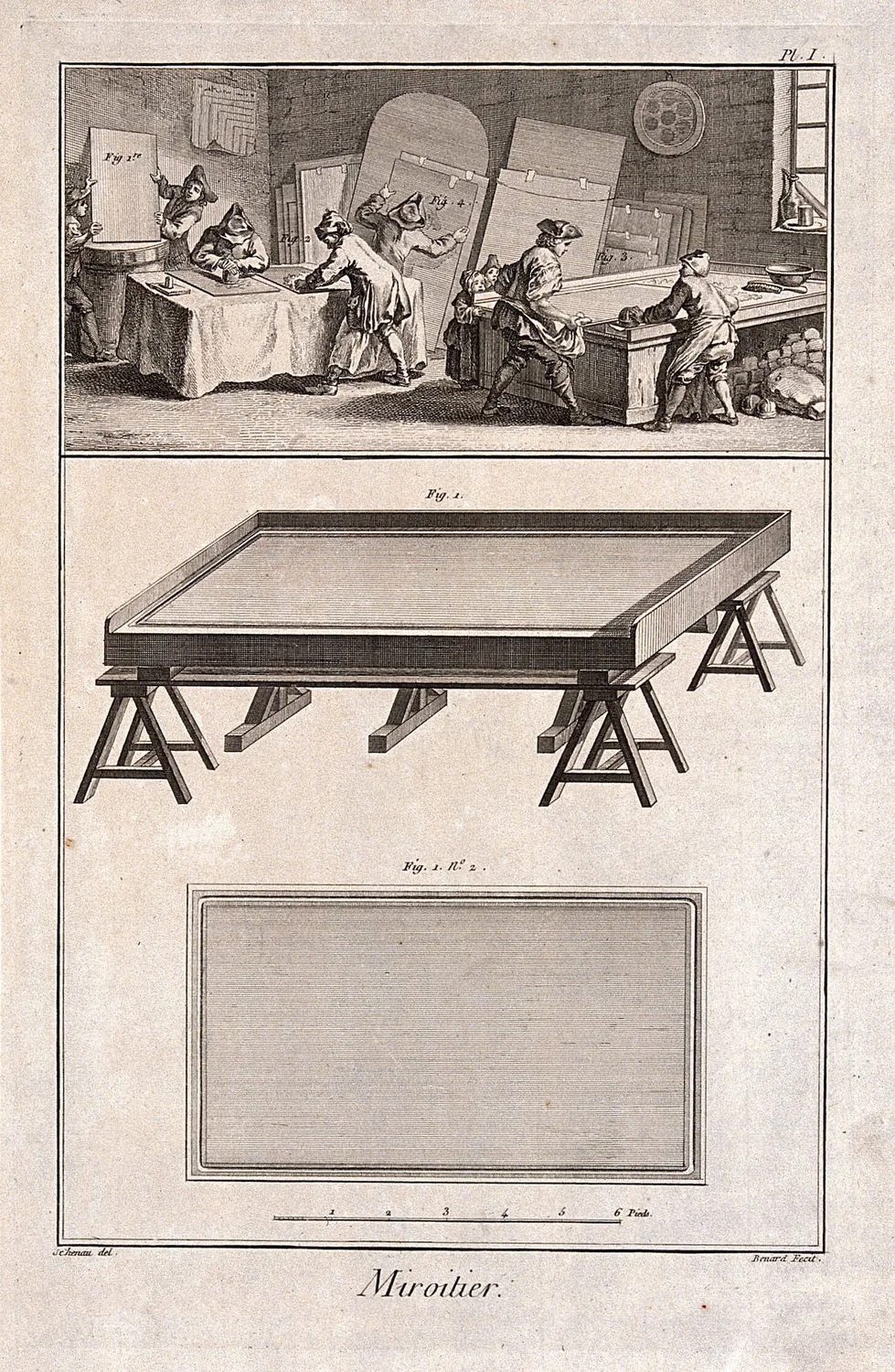
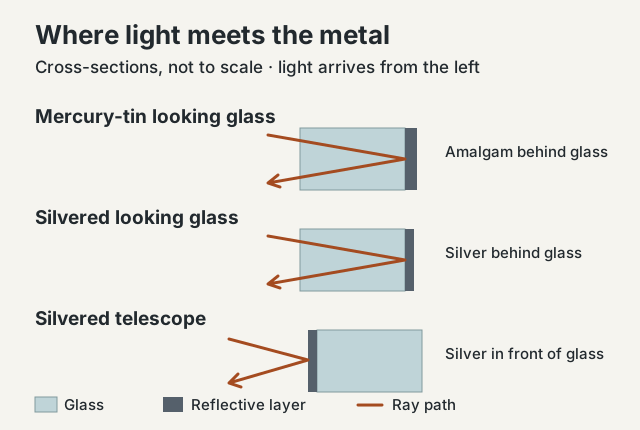
Putting metal on glass did not begin with silver. In 1847 the French chemist Antoine Bussy described the established practice. Workers laid tin foil on a level stone and brought it into contact with liquid mercury. The glass slid over the amalgam so air was not trapped between the metal and the plate. Weights held it in place; later the excess mercury drained away. Bussy reckoned a finished plate could be moved after five or six days. For a broad, flat looking glass, the method had a workmanship and a rhythm of its own. For irregular or curved glass, he noted, it was considerably harder to get a satisfactory result.
A chemically silvered mirror takes a different route. The silver arrives in a solution, not in a sheet. A chemical reaction produces metallic silver directly on the glass. It is not the same as electroplating, where an outside electrical current drives the deposition. The difference matters because both methods could appear in the making of one mirror, doing separate jobs.
The German chemist Justus von Liebig’s 1835 work on the oxidation of alcohol is often used as the starting date. But identifying a reaction that produces a bright deposit is not the same as making a looking glass that someone will pay for and keep. Compare two documents from the intervening years. In his 1844 U.S. patent, Thomas Drayton of Brighton explicitly argued that his method would dispense with the unhealthy use of quicksilver. By 1847 Bussy could examine mirrors from a Paris workshop using a version of the process. When he exposed a plate to hydrogen sulfide, unprotected silver discolored and spotted. Varnished areas held up better. A mirror could leave a factory bright and still prove to be a poor purchase.
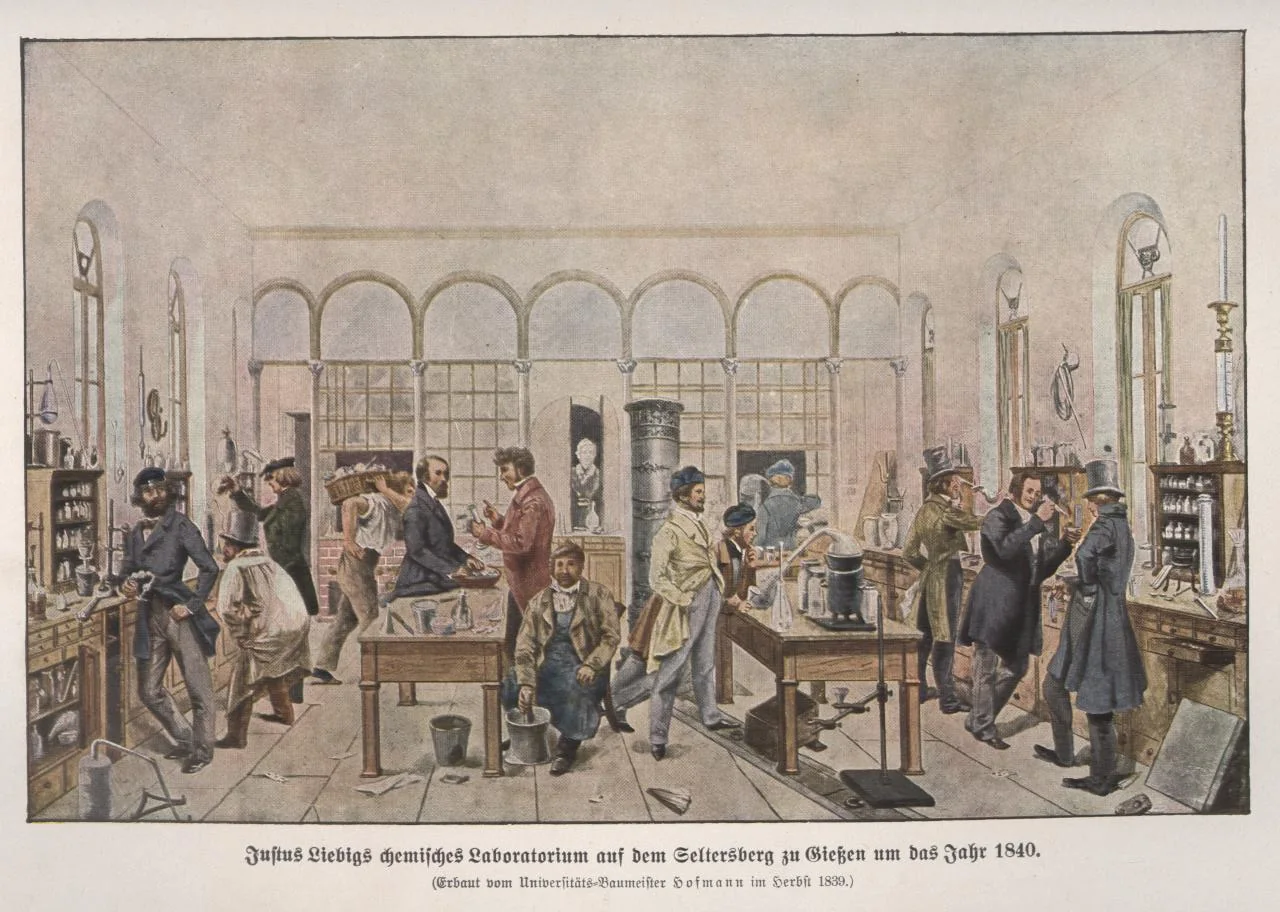
Then in 1856 Liebig described experiments requested by the optician Carl August von Steinheil. In the opening sentence he says the goal was to silver glass without heating it, particularly to make optical mirrors free of defects. Mercury poisoning is not the reason he gave in that paper. His concerns were a patchy coat, the difficulty of cleaning the glass and the need for a film even enough not to darken one side of the mirror relative to the other. In one trial, only 49 milligrams of the roughly 1,170 milligrams of silver in the bath ended up on the glass. Most collected elsewhere. The amount in the finished mirror was one thing; getting it there reliably was another.
Why telescopes moved first
A telescope reflector has at least two jobs. It must send light back efficiently, and its surface must send those rays to the right places. A polished copper-tin alloy called speculum metal could do both. Its liabilities showed up when the mirror grew large or its reflecting face tarnished. The surface doing the reflecting was part of the shaped block of metal itself. Working on it again meant risking the exact curvature that brought the image into focus.
Glass separated those jobs. Grind the glass to the shape you need and put the reflecting metal on the face toward the sky. Light reaches the coating without a round trip through the glass. If the metal deteriorates, the film can be renewed without starting over with a new shaped mirror. The new system did not make optical work easy; the glass still had to hold its shape under its own weight, and any defect in its figure could survive the silvering. But shape and finish no longer had to be made and remade together.
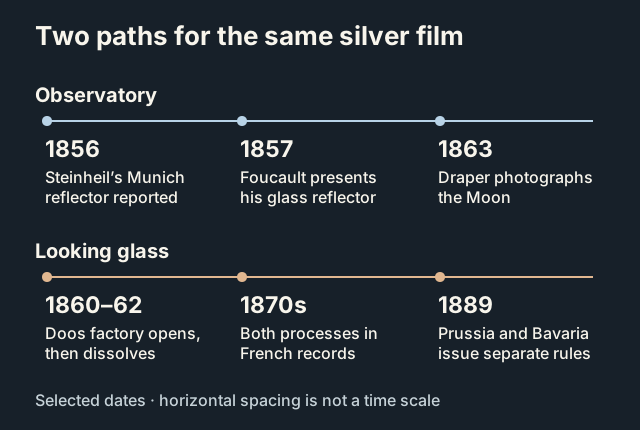
A March 1856 newspaper notice credited Steinheil’s Munich workshop with a small glass reflector silvered by Liebig’s process. Léon Foucault presented his own instrument to the French Academy of Sciences in February 1857 and recorded the earlier Munich announcement in his 1859 memoir. The question wasn’t just who showed a small telescope first. Foucault built a way of testing the face of a mirror and correcting its shape, so a glass reflector could move from a convincing demonstration to a practical instrument at larger sizes. His memoir describes a silvering method derived from Drayton’s, not the milk-sugar method in Liebig’s 1856 paper. The technique did not pass neatly from one inventor to the next.
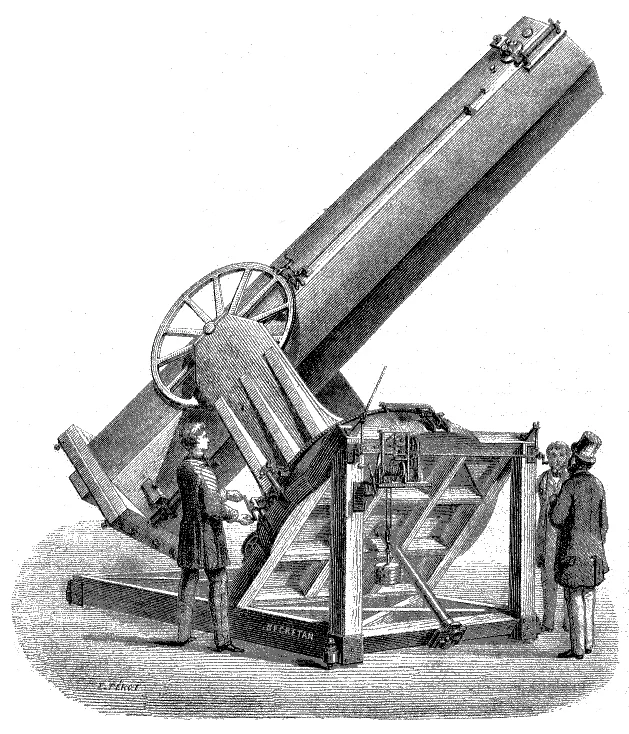
Draper tells the story from the point of view of someone who failed at both kinds of mirror before he got one he could use. After visiting the Earl of Rosse’s great reflector in Ireland, he tried making his own speculum. The Smithsonian text describes the weight and trouble of working it before he turned to glass. He polished more than a hundred mirrors of different sizes while learning how to make the larger ones with any certainty. An especially revealing failure looked at first like a badly shaped mirror. By rotating a disk in its support, Draper could make a clean test image split and then come together again. Some surfaces he had sent back for polishing had needed better support instead.
Two kinds of silver, one Moon
On September 3, 1863, Draper photographed the Moon. One surviving Smithsonian print carries the date, the place and the 15½-inch aperture on the mount. That inscription is a better witness than a photograph circulating online with a short caption. It identifies the apparatus and the exposure, but it cannot tell us how much silver was on the glass that day.
Draper used silver twice to make a lunar photograph. At the telescope’s front surface, metallic silver returned a beam of light. In the camera, a sensitized wet-collodion plate used light-sensitive silver compounds to register an image. The mirror did not supply the silver in the photograph. The two materials did different work at different points on the light’s path. And when a printer made an albumen print from a negative, the print became a third object with its own materials and history. That is why the Rijksmuseum’s example below is labeled a published print, not the original glass negative or necessarily the same exposure as the Smithsonian’s September picture.
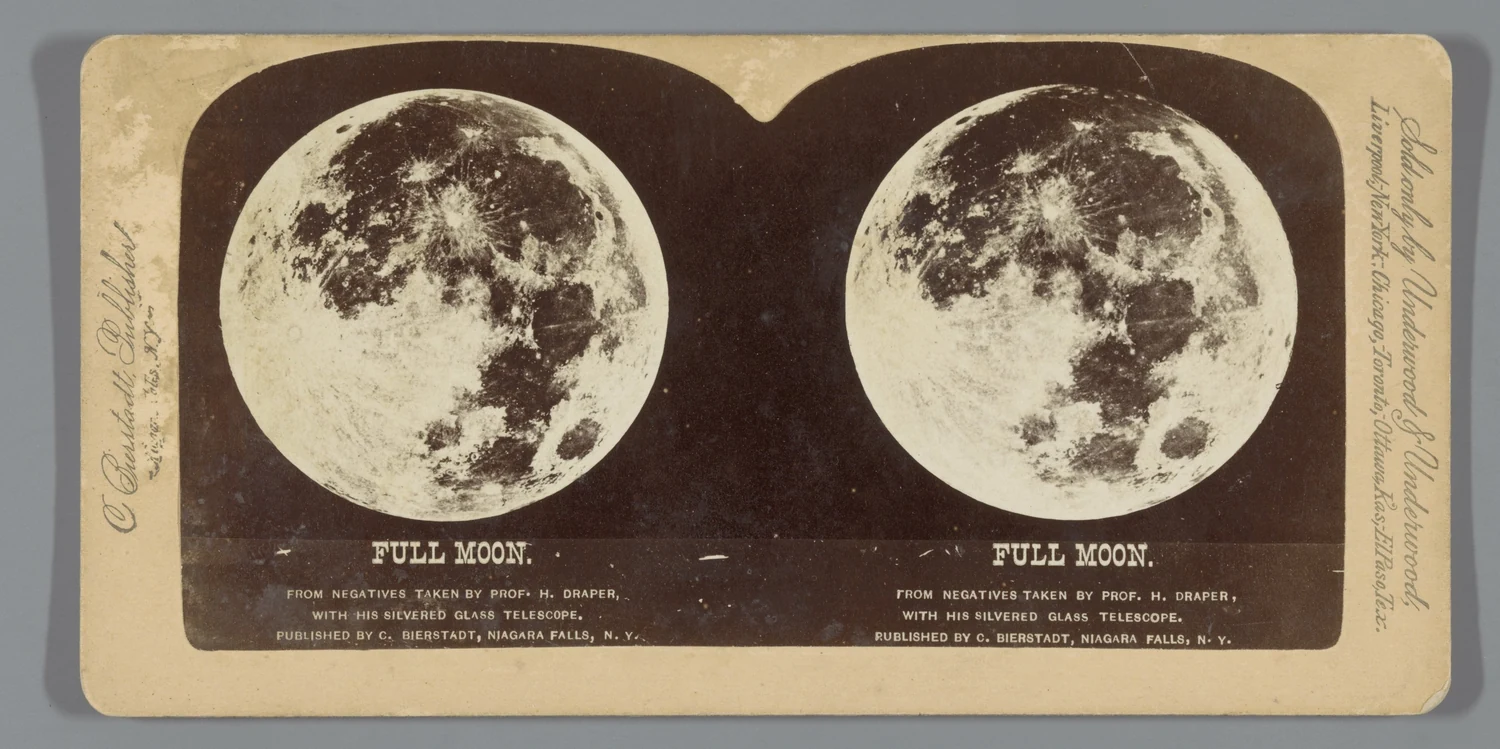
The long part of getting an exposure was not necessarily the exposure itself. A night with mediocre air and an evening with unusually steady air were not equivalent, no matter how splendid the mirror. In the monograph Draper describes a lunar exposure of about a third of a second under especially favorable conditions. He also writes about the work of steadying the image, providing sensitive plates, and enlarging a small negative without throwing away the detail he had worked to capture. The silver coat made the photograph possible. It did not do the whole job. Our guide to historic photography looks at what happened to silver in other forms, from a mirror-like daguerreotype to a picture on paper.
A mirror for the parlor
The telescope owner could renew the exposed silver. The customer buying a looking glass expected not to have to think about its back at all. A factory needed a dependable way both to deposit the silver in quantity and to keep it from deteriorating once it left the shop. There also had to be a price at which the mirror could compete with the mercury-backed versions customers already knew.
The people who wanted the change knew it was not merely a question of taste. An 1860 report on silver-mirror manufacture begins not with the brilliance of silver but with the health of mercury workers and their families around Fürth and Nuremberg. It describes years of attempts to address the harm and credits the Fürth trade-school rector, Johann Caspar Beeg, with promoting silvering. The physician Adolf Kussmaul’s 1861 study put chronic mercury poisoning under sustained medical scrutiny. The thing that let buyers see themselves carried a cost invisible to them and all too familiar to the people coating the glass.
Liebig and his collaborators put the new method to a commercial test at Doos, near Nuremberg. A Liebig Museum archival account dates production from January 1860 and dissolution to December 1862. The factory faced technical difficulties, trouble selling its output and competition from cheaper amalgam mirrors. Liebig himself later said it had made fine mirrors that did not find a market; he hoped resistance would fade. That was his reading of the failure, not a survey of why buyers turned away.
The Doos report shows what changed between a laboratory demonstration and a product. Its workers deposited the silver chemically, then used an electrical process to add a separate layer of copper before varnishing the back. A later account of Liebig’s silvering work also describes a copper compound added in small amounts to the silvering chemistry itself. The two uses of copper are not interchangeable. One changes how a coating forms; the other adds a protective layer. An American patent from Dominique Durand in 1872 likewise treats protection of the silver as the problem worth solving. In the parlor, the bright metal needed a back of its own.
The cost behind the glass
There is no one date when silver replaced mercury in every country. A 1878 exhibition report discusses Saint-Gobain’s use of Petitjean’s silvering process in France; the company’s archive inventory shows work on both methods in the 1870s. In the German lands, governments were still wrestling with the working conditions of amalgam coaters more than twenty years after the Doos factory closed.
In 1889 Prussia and Bavaria issued substantially similar rules separately. The Prussian ministerial circular dates to May 18; the Bavarian notice is dated July 30. The German social-policy document collection reproduces the Prussian text and explains the relationship between the rules. They tightened conditions on work that was still being done, rather than banning mercury mirrors everywhere at a stroke. A Fürth historical study traces how the old trade dwindled in the following years. It was already under pressure from competing production methods. The law mattered; it did not act alone.
That long overlap is useful to a collector. A date on a frame is evidence about the frame. Unless a record accounts for the plate, it cannot tell you whether a mirror retains its original glass, let alone the chemistry behind it. The Museum of Fine Arts, Houston, specifies mercury and tin for a looking glass made by Thomas Fentham around 1800. The Met’s two hand-mirror records do not. Those are different kinds of evidence, not two levels of certainty that can be closed by looking at a photograph. If you find an old mirror with a loose backing or signs of deterioration, leave it assembled rather than opening it to settle the question.
Sixty-four grams on a mountain
In April 2024, on Cerro Pachón in Chile, the Vera C. Rubin Observatory coated a glass mirror 8.4 meters across. The observatory’s account gives a number that would have pleased Draper: 64 grams of silver for the whole surface. But the modern mirror is not a scaled-up version of his chemical bath. The coating was applied in a vacuum chamber. Nickel-chromium layers help the stack adhere; a final layer of silicon nitride protects it. The team tested reflectivity, adhesion and pinholes before calling the work done. See our close-up of the Rubin mirror and its coating.
Liebig had worried about pinholes; Draper found that a drop of water could loosen the coating. At Doos, the question was how to send out a looking glass that would stay bright in somebody else’s home. At Rubin, even the protective top layer has to be thick enough to withstand cleaning but thin enough not to cost the telescope too much light. There is a thread through all three places: silver is very good at returning light, but something else has to keep it where it belongs.
Turn the London hand mirror over once more. There are two stories in that little object, one in the silver you can see and one on the side of the glass you can’t. The first is a story a collector can begin to read from the mount. The second reaches from a worker’s bench in Fürth to the Moon in a New York telescope. It starts by not assuming the two stories are the same.
Sources
Core documents: Thomas Drayton’s U.S. patent (1844); Antoine Bussy on coating mirror glass (1847); Justus von Liebig’s opening account of optical silvering (1856); Léon Foucault’s original memoir (1859); the Doos manufacture report (1860); Henry Draper’s Smithsonian account (1864), especially pp. 5, 7 and 49–50; and Rubin Observatory’s mirror-coating report (2024). Collection records linked in the story distinguish what is known about each surviving object from what is inferred from the period.