
Two dates on one story
When Denver tested its presses for a new silver dollar in 1965, the collars were too large at first. Mint Director Eva Adams told a House committee about the problem that May. A collar confines the edge of a coin as the dies strike it. The collar could be corrected, but the date wasn’t a mistake. The pieces coming off the press read 1964.
Congress had allowed the Mint to keep using 1964 dates as it dealt with a shortage of change. Denver revived Anthony de Francisci’s Peace design, last used on a regular-issue dollar in 1935. The Mint later described the trials as 90% silver. The example below is from the first year of the series, 1921. It shows the design family, not what came off the Denver presses in 1965.
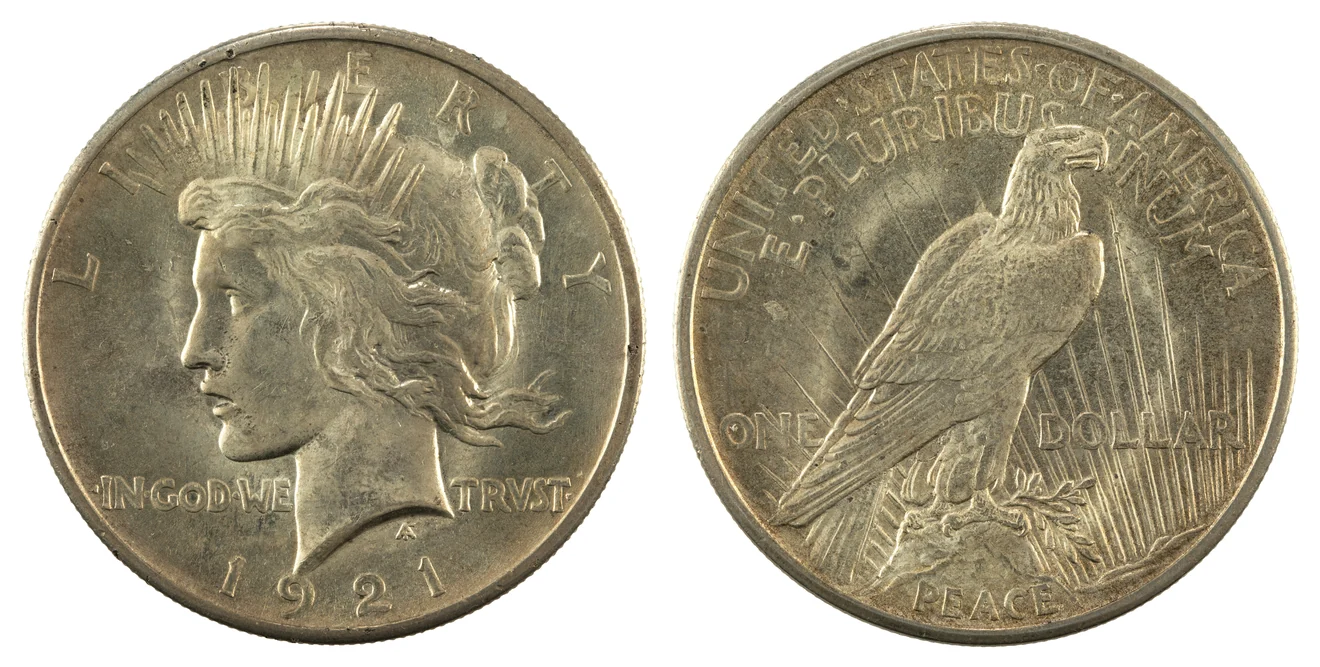
The freeze affected ordinary coins, too. See how long mints kept striking Kennedy halves with 1964 on them in Five Coin Dates That Need a Second Look.
Why make another dollar?
At the end of June 1963, Treasury had nearly 65.8 million silver dollars in stock. By March 25, 1964, only about 2.9 million remained. Treasury held those coins back and began giving silver certificate holders bullion instead. A person could still turn paper into metal, but could no longer count on getting a familiar dollar coin across the counter.
Congress approved $600,000 in 1964 for fiscal 1965, enough for up to 45 million new dollars. On May 15, 1965, President Lyndon Johnson announced that minting could go ahead and that he expected the coins to go where silver dollars had traditionally circulated. Nine days later, Treasury described a much smaller plan to Congress: about four to five million dollars, held back while the supply of everyday coins recovered. A small issue also risked being snapped up by collectors instead of circulating.
Treasury estimated that making 45 million silver dollars would displace production of about 500 million other coins. The smaller plan would still displace roughly 60 million. These were projections, not mintages. The country needed change; a large, handsome dollar wouldn’t make the presses any faster.
How much silver for five million?
Here’s the connection to the paper dollar. A Treasury exhibit in the House hearing put the silver requirement for five million standard dollars at 3,867,187.5 fine troy ounces. Divide by five million and you get 0.7734375 fine troy ounce per coin. Rounded to four decimals, that’s the 0.7734 fine troy ounce Treasury would pay out on a dollar in silver certificates at the monetary rate.

The two numbers describe different things: silver inside a proposed coin, and silver owed against a piece of paper. Both count only the fine silver, not the full weight of the coin or of any alloy handed out on redemption. The proposal didn’t get these coins into anyone’s pocket, but the arithmetic shows why a silver dollar and a dollar in certificates once belonged to the same system.
Struck is not the same as issued
When asked in the May hearing how many trial pieces Denver had made, Adams said she didn’t know. In 1973 the Mint said the trials were ordered destroyed and that none had cleared its usual process of counting, bagging and issuing finished coins. That’s what the record establishes. The trial pieces were struck; there was no public issue. The hearing and the Mint statement do not give an exact strike count, and neither is evidence that a particular coin offered today is authentic.
In July, Congress imposed a five-year pause on minting standard silver dollars. That later law didn’t put the 1964 date on the trials; the date policy was already in place. What survives in the official record is a brief attempt to put an old silver dollar back into circulation just as Treasury was moving away from it.
Keep reading and check the record
- Meet the Morgan and Peace designs in the silver dollar guide.
- Follow the paper dollar through the last days of silver redemption.
- Compare two very different silver dollars dated 1873.
Primary sources: 1964 coin dating law; President Johnson’s May 15 statement; May 24 House hearing (printed pp. 1–3, 8–9 and 50–51); Coinage Act of 1965, §101(c); the Mint’s 1973 account of the trial strikes.