
Two coins, one date
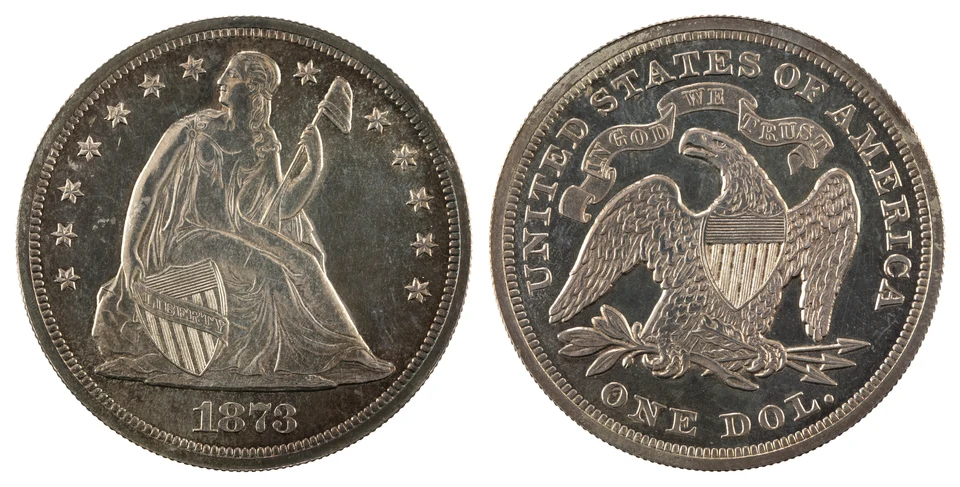
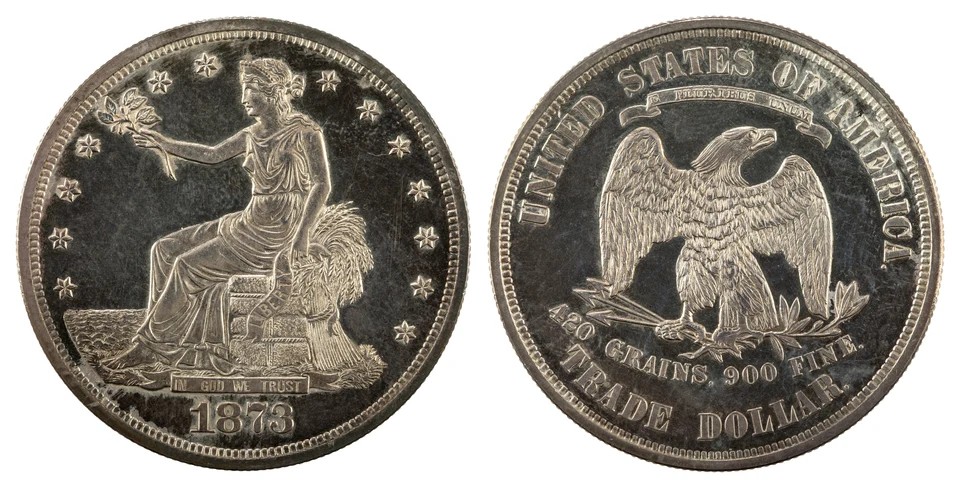
Put the two coins side by side, date up. Both say 1873. Both have thirteen stars and a seated Liberty. Then turn them over. One says ONE DOL. The other says TRADE DOLLAR and tells you its weight and fineness. You can see the difference without a scale. Understanding why the Mint bothered to put the numbers on one of them takes you from a merchant's counter in Asia to an American payday.
The quickest clue is on the back
Start with the eagle's chest. On the standard Seated Liberty dollar there is a striped shield. A ribbon above the eagle reads IN GOD WE TRUST, and ONE DOL. sits at the bottom. On the Trade dollar the eagle has no shield. Look below its talons for 420 GRAINS, 900 FINE and below that for TRADE DOLLAR. Those are dependable design clues even when the front is worn.
Now turn them face up. The Liberty of the standard dollar holds a liberty cap on a pole and rests a hand on a shield. On the Trade dollar, Liberty sits on cargo and extends a branch. Check the small ribbon beneath her seat for IN GOD WE TRUST. The words appear on both designs, but on opposite sides. That makes the motto's location more useful than the motto itself. U.S. Mint, history of the Seated Liberty dollar · Smithsonian, 1873 Trade dollar
Why publish the weight on a dollar?
The old standard dollar was 412½ grains of coin metal. The Trade dollar was 420 grains. Both standards called for 90 percent silver, so the extra weight meant extra silver, not just more of the alloy. The difference in pure silver was 6¾ grains, or about 0.44 gram. 1837 standard, sections 8–9 · Coinage Act of 1873, sections 13, 15 and 18
| 1873 coin | Standard gross weight | Silver fineness | Silver at standard weight |
|---|---|---|---|
| Seated Liberty dollar | 412½ grains (26.73 g) | 90% | 24.06 g (0.77344 troy oz) |
| Trade dollar | 420 grains (27.22 g) | 90% | 24.49 g (0.78750 troy oz) |
A grain is a small unit of weight, not a gram. The words 900 FINE mean 900 parts silver per thousand. A worn specimen need not weigh what it did fresh from the press. And matching the weight of an issue, by itself, does not authenticate a coin.
The new dollar was built to compete for trade in Asia, especially China, where dollar-size silver coins from different countries already changed hands. Congress required the Trade dollar's reverse to state weight and fineness. An unfamiliar American coin could show a merchant its claimed silver standard right on the metal. The stamp was a statement by the mint, not a guarantee that everyone abroad would accept it at a fixed price. Coinage Act of 1873, section 18 · Smithsonian, Howard F. Bowker collection
A merchant could leave a mark of his own
In East Asian commerce, people checking silver coin could stamp a small mark into its surface. Collectors call these chopmarks. The stamp was applied after the coin left the mint. It is not a mint mark, and its presence does not, on its own, identify a particular merchant or prove a coin genuine. Its absence does not prove the coin stayed in America. Smithsonian examples from the Bowker collection show how a coin issued in one country could acquire signs of use in another. Both dollars pictured here illustrate the mint designs; neither image is being presented as an example of a chopmark. Smithsonian, Howard F. Bowker collection
The export dollar came home
The Trade dollar's first law made it legal tender at face value for payments up to five dollars. In July 1876 Congress withdrew that status and allowed Treasury to limit minting to export demand. That did not pull every coin out of the country or keep people from accepting one voluntarily. A Treasury account reported that by late 1877, a Trade dollar's silver was worth less than a dollar in paper money, making it profitable to buy the metal, have it coined and spend the coin at face value. It was not necessarily a good bargain for the next person in line. The Mint director reported in 1883 that coins were paid to workers in mining and factory districts in and around Pennsylvania and near New York. Workers then spent them with shopkeepers. Treasury annual report, 1883 1873 act, sections 15 and 21 · Joint resolution of July 22, 1876, section 2 · Treasury account on domestic circulation
By 1883 the director of the Mint was urging Congress to help holders who could least afford to take the loss. His report estimated that a Trade dollar then contained about 87 cents' worth of bullion, but noted that the coin itself had usually traded for near a dollar in New York before a recent decline. The same coin could have a bullion value, a market price and a dollar denomination, and those were not necessarily the same number. In 1887 Congress opened a six-month window to exchange eligible Trade dollars at face value, excluding coins that had been defaced, mutilated or stamped. Mint director's 1883 report · Act of March 3, 1887
The next time you see 1873 on a dealer's label, ask to see the back. The shield identifies the last year of one dollar. The words 420 GRAINS identify the first year of another. A scale can tell you which one was supposed to carry more silver. The history explains why the heavier dollar sometimes bought less.
Keep reading
What the Coinage Act of 1873 changed follows the law and the end of the standard dollar. Explore U.S. silver dollars puts both designs alongside the dollars that came before and after. Silver authenticity explains why weight is a check, not a verdict.
A statutory standard is a target. Read what happened when assayers tested a delivery of 1920 Denver quarters.
For another case where the date is not enough, compare Canadian quarters from 1967 and 1968.
Another chapter in the life of the silver dollar: when paper dollars stopped paying out metal.