
Two quarters, two readings
One quarter was 90.51 percent silver. Another from the same Denver Mint delivery was 89.91 percent. Both were supposed to be 90 percent. The first reading was high enough to make the U.S. Assay Commission check again. When the commissioners picked ten more quarters from that delivery, the richest of them went higher still.
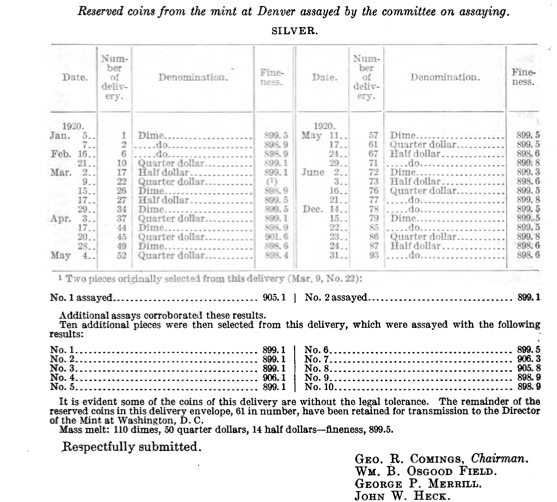
The evidence is a footnote on page 18 of the commission’s 1921 proceedings. Above it is a table of routine test results. In the row for March 9, 1920, where the fineness would ordinarily go, there is only a footnote marker. That little number is where the story begins. U.S. Assay Commission proceedings, p. 18
What was in the envelope?
The commission called it delivery No. 22. That was the Mint’s record of a delivery of quarters, not a number stamped on any of the coins. The first two samples read 905.1 and 899.1 parts silver per thousand. Additional assays corroborated the result, and the commissioners tested ten other pieces. Seven of those ten fell close to 900. Three didn’t: 906.1, 906.3 and 905.8.
The team concluded that some quarters in this delivery fell outside the legal tolerance. They kept the 61 coins left in that delivery’s reserve envelope to send to the director of the Mint in Washington. Sixty-one was the number they retained, not the number they found out of tolerance. The proceedings do not give a fineness reading for those retained coins on this page. Commission proceedings, p. 18
| Stage | Individual readings, in the commission’s order (silver parts per thousand) |
|---|---|
| First two quarters | 905.1, 899.1 |
| Ten additional quarters | 899.1, 899.1, 899.1, 906.1, 899.1, 899.5, 906.3, 905.8, 898.9, 898.9 |
How the Mint checked its coins
An assay measures what the metal is made of; weighing only tells you how much of it is there. Under the 1873 coinage law the U.S. silver coin standard was 900 parts pure silver to 100 parts copper by weight. The law specified a 12.5-gram half dollar and a quarter at half that weight, or 6.25 grams. A quarter at both standards would contain 5.625 grams of pure silver.
The law set a three-parts-per-thousand limit on how far a silver ingot used for coinage could depart from standard. It also required mints to reserve coins and provided for an annual commission at Philadelphia to check samples for weight and fineness. Saving pieces from particular deliveries made it possible to go back and test more of the same group when one result looked wrong. Every high result in Denver’s footnote was above 903 parts per thousand. The 899.5 result labeled “Mass melt” was a separate test on a combined melt of dimes, quarters and half dollars, not a result for the March 9 quarters. Coinage Act of 1873, §§13, 15, 33, 39 and 48 · National Archives, Assay Commission records · Commission proceedings, p. 18
What can you tell from a 1920-D quarter?
The quarter of the period was Hermon A. MacNeil’s Standing Liberty design. The date and mint mark can tell you which issue a coin belongs to. They cannot connect a surviving coin to delivery No. 22. Nor does the report establish what fraction of that delivery ran rich, what caused the differing results, or how many of those quarters might have reached someone’s change. There is no visible marker for that delivery in the report. U.S. Mint, quarter design history · U.S. Mint, mint marks
The richest measured sample was 90.63 percent silver. If that quarter had weighed the standard 6.25 grams, it would have contained just under four hundredths of a gram more silver than specified. The report gives the fineness, not the individual sample’s weight, so that’s an illustration, not a measurement. The surprise here isn’t a fortune in extra silver. It is that two quarters from the same delivery, with the same design and the same face value, could give such different results when someone finally measured the metal inside.
Keep reading
- Silver identification and hallmarks explains why a fineness claim is different from a test result.
- Understanding U.S. silver dollar specifications puts total weight and fine-silver weight side by side.
- What the Coinage Act of 1873 changed explains the law behind the Denver samples.
- Explore the Denver Mint in the collector places directory. Check the U.S. Mint’s tour page before a visit.